
Business partner ne Rs 40 lakh ka contract kiya — kaam nahi kiya, paisa nahi lautaya. Court mein case file kiya — 7 saal baad sunwai hui, tabb tak business khatam ho gaya. Ya — construction company ne building late deliver ki, Rs 1.5 crore ka penalty clause tha agreement mein — lekin civil suit mein 5 saal lag gaye.
Yeh Indian judicial system ki reality hai — 3.5 crore pending cases courts mein. Average commercial dispute settlement time — 5-10 saal. Aur itne time tak business rukta nahi, paise aate nahi, relationship khatam ho jaati hai. arbitration kya hai
Isliye duniya bhar ke businesses ek alternative use karte hain — arbitration. Aur arbitration kya hai — yeh samajhna India ke har business owner, entrepreneur, aur professional ke liye zaroori hai. arbitration kya hai
Main ek practicing advocate hoon aur corporate aur commercial disputes regularly handle karta hoon Gurugram courts aur arbitration proceedings mein. Main aapko honestly bataunga — arbitration kya hai, kab use karna chahiye, kab nahi, process kya hai, aur kaise ensure karein ki aapki agreement mein sahi arbitration clause ho.
Quick Answer: Arbitration kya hai — ek private dispute resolution mechanism jahan dono parties apna neutral “judge” (arbitrator) appoint karti hain, apni procedure choose karti hain, aur ek binding decision (arbitral award) paati hain — court ke bina jaaye. Arbitration and Conciliation Act 1996 govern karta hai. Award = court decree ki tarah enforceable. Court se faster (12-18 mahine), confidential, aur expert arbitrator milta hai. Kab use karein: business contracts, construction disputes, commercial agreements, real estate, international deals. Kab nahi: criminal matters, matrimonial disputes (personal law), insolvency proceedings. arbitration kya hai
Also Read :- Habeas Corpus Kya Hai — Illegal Detention Ke Against Court Mein Kaise Jaayein
Arbitration Kya Hai — Simple Explanation
Arbitration — yeh do Latin words se aaya hai: “arbitrari” meaning “to judge.” Simple mein — private court jahan aap khud judge choose karte ho.
Ek analogy se samajhte hain:
Regular Court: Government ka judge, government ki procedure, government ki timeline. Aap sirf ek number hain queue mein.
Arbitration: Aap dono parties milke ek neutral expert choose karte ho — retired judge, senior advocate, technical expert — jo sirf aapka ek case sunenge. Aapki timeline, aapkी procedure, aapka venue. Private justice. arbitration kya hai
Arbitration Ki Legal Definition
Section 2(1)(a) Arbitration and Conciliation Act, 1996:
“Arbitration means any arbitration whether or not administered by a permanent arbitral institution.”
Black’s Law Dictionary:
“A method of dispute resolution involving one or more neutral third parties who are agreed to by the disputing parties and whose decision is binding.”
Core Principle: Party Autonomy
Arbitration kya hai — iska core principle hai “party autonomy” — dono parties decide karte hain: arbitration kya hai
- Kaun arbitrator hoga
- Kahan arbitration hogi (seat)
- Kaunsi language mein
- Kaunse rules follow honge
- Kitne arbitrators honge (1 ya 3)
Yeh flexibility hi arbitration ko court se fundamentally alag banati hai.
4 Types Of Arbitration — Kaunsa Aapke Liye Sahi Hai
Type 1: Ad-hoc Arbitration
Sabse common — especially India mein SMEs ke liye.
Dono parties milke apne rules banate hain — koi institutional framework nahi. Flexible, cheaper.
Best for: Small to medium business disputes (Rs 5 lakh — Rs 5 crore), where parties know each other, less complex disputes.
Drawback: No institutional support — agar ek party cooperate na kare, delay ho sakta hai.
Type 2: Institutional Arbitration
Reputed arbitration institution ke rules follow hote hain.
India mein major institutions:
- DIAC — Delhi International Arbitration Centre
- MCIA — Mumbai Centre for International Arbitration
- ICC India — International Chamber of Commerce
- LCIA India — London Court of International Arbitration India
Best for: Large disputes (Rs 5 crore+), international contracts, complex commercial matters.
Advantage: Institution case manage karti hai — delays kam hote hain, arbitrators pre-screened hote hain.
Drawback: Institution fees additional hoti hain.
Type 3: Domestic Arbitration
India ke andar, Indian law govern karta hai, Indian parties.
Arbitration and Conciliation Act 1996 — Part I (Sections 2-43) apply hota hai. arbitration kya hai
Type 4: International Commercial Arbitration
Section 2(1)(f) ke under — ek party foreign ho ya foreign element ho.
Part I ya Part II — depend karta hai seat of arbitration pe.
Popular international seats: Singapore (SIAC), London (LCIA), Paris (ICC), Hong Kong (HKIAC).
Advocate’s Note: Arbitration kya hai — sirf bade companies ke liye nahi. India mein lakhs of small business disputes hain jinhein arbitration se 3-4 mahine mein resolve kiya ja sakta hai. Rs 50 lakh ke neeche ke disputes mein sole arbitrator se kaam chalta hai — cost bhi reasonable rehti hai. Aapka business contract mein arbitration clause hona chahiye — main article mein ready-to-use template dunga. arbitration kya hai
Court Vs Arbitration — Detailed Comparison
Arbitration kya hai aur court se kaise alag hai — yeh table clearly batata hai:
| Aspect | Court | Arbitration |
|---|---|---|
| Timeline | 5-10+ saal | 6-18 mahine |
| Judge | Government appointed | Parties choose karte hain |
| Expertise | General judge | Domain expert (CA, engineer, advocate) |
| Confidentiality | Public proceeding | Private — confidential |
| Cost | Lower court fees, but longer | Higher upfront, but faster = cheaper overall |
| Flexibility | Fixed CPC procedure | Parties define procedure |
| Enforceability | Court decree | Same as court decree (Section 36) |
| Appeal | Multiple levels | Very limited grounds (Section 34) |
| International | Complex enforcement | New York Convention — 168 countries enforce |
| Location | Fixed court | Parties choose (any city, any country) |
| Language | Hindi/English (court language) | Any language parties agree |
When Court Better Than Arbitration:
- Criminal matters — police, FIR, bail — arbitration nahi hoti
- Matrimonial disputes — personal law matters — family courts better
- Insolvency — IBC proceedings — NCLT
- Small amounts — Rs 5 lakh se kam — consumer court ya Lok Adalat faster + free
- Emergency injunction — court faster for urgent restraining orders
Arbitration and Conciliation Act 1996 — Key Sections
Arbitration kya hai — legally samajhne ke liye yeh key sections jaano: arbitration kya hai
Section 7 — Arbitration Agreement
Foundation of arbitration. Written agreement mandatory hai.
Agreement ho sakti hai:
- Main contract ke andar ek clause ke roop mein — (most common)
- Alag se written agreement
Agreement mein kya hona chahiye:
- Dispute refer karne ki clear intention
- “Shall be referred to arbitration” — mandatory language
- Arbitrator number (1 ya 3)
- Seat of arbitration (city)
- Language
- Rules (ad-hoc ya institutional)
Section 11 — Arbitrator Appointment
Parties arbitrator appoint karti hain. Agar agree nahi — High Court ya Supreme Court appoint karta hai.
Timeline (2019 amendment): Supreme Court/High Court ko 60 din ke andar appoint karna mandatory.
Qualifications arbitrators ki:
- Independent — no conflict of interest
- Impartial
- Fifth Schedule — disqualification grounds listed
- Seventh Schedule — mandatory disclosure requirements
Section 17 — Interim Relief (During Arbitration)
Arbitral tribunal khud interim relief de sakta hai:
- Property preserve karo
- Evidence secure karo
- Status quo maintain karo
Section 9 — Court se bhi interim relief mil sakti hai before/during arbitration. arbitration kya hai
Section 29A — 12-Month Timeline (Most Important Reform)
2015 Amendment ka sabse powerful provision:
- Arbitral proceedings 12 mahine mein complete hone chahiye
- Extension: 6 mahine court permission se
- 18 mahine total maximum (domestic arbitration)
- Exceed hone pe arbitrators ka mandate terminate — court appoint karta hai
Practical impact: Arbitration indefinitely delay karna possible nahi raha.
Also Read :- Bail Kaise Milti Hai 2026: Anticipatory, Regular Aur Default Bail Par BNSS Ke Naye Niyam
Section 34 — Setting Aside Award (Limited Grounds)
Arbitral award ko sirf limited grounds pe challenge kar sakte ho High Court mein:
- Party incapacity
- Agreement invalid tha
- Proper notice nahi mila
- Award agreement ke scope se bahar
- Arbitral tribunal composition galat tha
- “Public policy of India” violation (narrow interpretation post-2015)
Important: Factual errors, legal errors — challenge ke grounds nahi hain. Award ke merits pe appeal nahi hoti. arbitration kya hai
Section 36 — Enforcement
Agar Section 34 challenge period (3 mahine) guzar gaya ya challenge fail hua — award court decree jaisi enforceable hai. Civil court ki tarah execute karo — property attachment, salary attachment.
Arbitration Agreement — Kaise Banate Hain
Arbitration kya hai — yeh samajhne ke baad sabse important practical step hai — sahi arbitration clause apne contract mein include karna.
Ready-To-Use Arbitration Clause (Simple Version):
ARBITRATION CLAUSE

Any dispute, controversy or claim arising out of or
relating to this Agreement, or the breach, termination
or invalidity thereof, shall be settled by arbitration
in accordance with the Arbitration and Conciliation
Act, 1996.

The arbitration shall be conducted by a Sole Arbitrator
mutually agreed upon by the parties. If the parties
fail to agree on the appointment of a Sole Arbitrator
within 30 days of the notice of arbitration, the
arbitrator shall be appointed by the High Court of
[State] in accordance with Section 11 of the
Arbitration and Conciliation Act, 1996.

The seat and venue of arbitration shall be [City],
India. The language of arbitration shall be English/
Hindi. The arbitral award shall be final and binding
on both parties.
Comprehensive Arbitration Clause (For Large Contracts):
DISPUTE RESOLUTION

1. Amicable Settlement: The parties shall attempt
   to resolve any dispute amicably through good
   faith negotiations for a period of 30 days from
   the date of written notice of the dispute.

2. Arbitration: If the dispute is not resolved
   within 30 days, it shall be referred to
   arbitration under the Arbitration and
   Conciliation Act, 1996.

3. Arbitral Tribunal: The dispute shall be decided
   by [a Sole Arbitrator / a panel of 3 Arbitrators].

   [For 3 arbitrators: Each party shall appoint
   one arbitrator, and the two appointed arbitrators
   shall appoint the presiding arbitrator.]

4. Seat: The seat of arbitration shall be [City],
   India.

5. Language: English.

6. Governing Law: The arbitration agreement and
   the substantive contract shall be governed by
   the laws of India.

7. Award: The arbitral award shall be final, binding
   and not subject to appeal except as permitted
   under the Act.

8. Costs: Costs of arbitration shall be borne by
   the losing party unless otherwise directed by
   the arbitral tribunal.
Arbitration Clause Mein Common Mistakes:
| Mistake | Consequence |
|---|---|
| “May refer to arbitration” — permissive | Not mandatory — court ke paas jaayega |
| No seat mentioned | Jurisdiction confusion |
| Even number of arbitrators (2, 4) | Deadlock — no majority |
| Too narrow scope (“only payment disputes”) | Other disputes court mein jaayenge |
| No governing law | Conflict of laws issues |
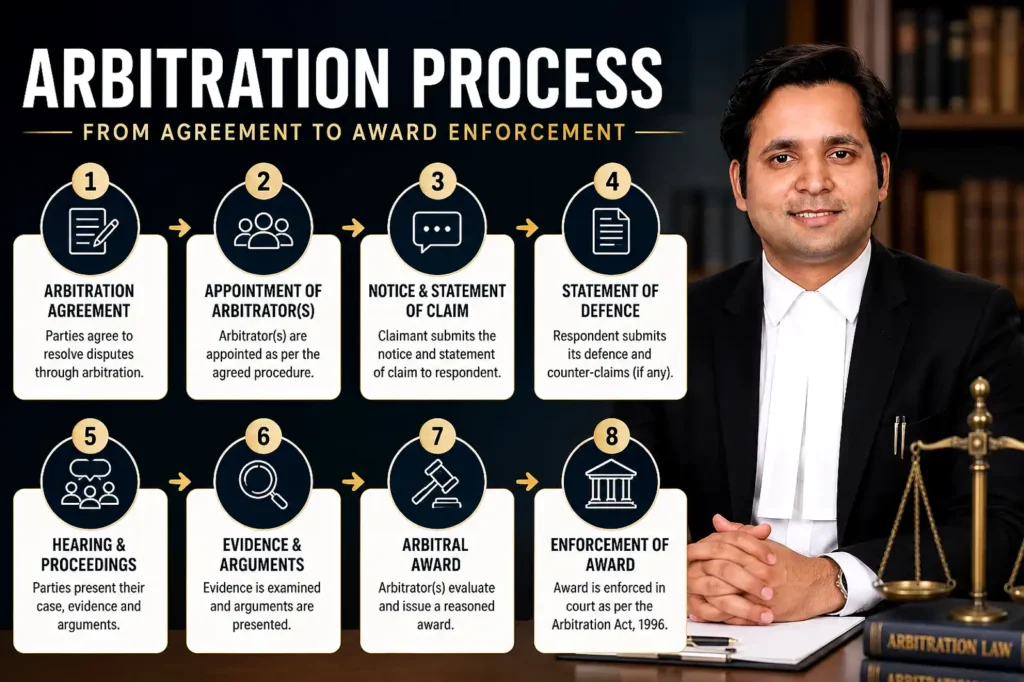
Arbitration Process — Step By Step
Arbitration kya hai ka process — ab clearly samjho:
Step 1: Notice of Arbitration
Aggrieved party written notice bhejti hai — “Main yeh dispute arbitration mein refer kar raha/rahi hoon.”
Notice mein:
- Dispute ki nature
- Relief demanded
- Proposed arbitrator (agar agreement hai)
Step 2: Arbitrator Appointment
Sole arbitrator (1 person): Dono parties agree karein — ya court appoint kare.
3 arbitrators: Claimant ek appoint kare, respondent ek, dono milke presiding arbitrator appoint karein.
Timeline: 30 din mein appoint karo — nahi toh court Section 11 ke under appoint karega.
Arbitrator kaun ho sakta hai:
- Retired judge
- Senior advocate
- Domain expert (CA, engineer, valuer)
- Any neutral professional — agreed by both parties
Arbitrator kaun nahi ho sakta:
- Kisi ek party ka employee/associate
- Financial interest wala
- Fifth Schedule ke under disqualified
Step 3: Statement of Claim and Defence
Claimant: Written statement of claim file karta hai — facts, legal grounds, evidence, relief.
Respondent: Written defence file karta hai — counterarguments, counterclaim (agar hai).
Timeline: Tribunal decide karta hai — typically 30-60 din har step ke liye.
Step 4: Evidence and Hearings
- Documents exchange hoti hain
- Witnesses examine hote hain
- Arguments sunaye jaate hain
- Expert witnesses bhi possible hain
Location: Agreed seat mein — office, hotel conference room, arbitration center — anywhere parties agree. arbitration kya hai
Format: Physical ya online (video conferencing — Section 29B ke under fast-track arbitration mein)
Step 5: Arbitral Award
Tribunal written award pass karta hai:
- Reasons mandatory hain (Section 31)
- Signed by all/majority arbitrators
- Date and place mentioned
- Relief granted
- Costs decision
Timeline: Arguments complete hone ke baad typically 30-90 din mein award.
Award ke types:
- Interim award (during proceedings)
- Final award (conclusive)
- Consent award (agar parties settle karein during arbitration)
Step 6: Enforcement
3 mahine ka challenge period (Section 34). Agar challenge nahi kiya — Section 36 ke under execute karo — civil court mein decree ki tarah.
Execution: Property attachment, bank account freeze, salary attachment — same as court decree.
4 ADR Methods — Arbitration Vs Others
Arbitration kya hai — aur alternative dispute resolution (ADR) ke baaki options kya hain:
| Method | Binding? | Third Party Role | Best For |
|---|---|---|---|
| Arbitration | ✅ Yes | Decides the dispute | Commercial contracts, large disputes |
| Mediation | ❌ No | Facilitates settlement | Relationship preservation, family disputes |
| Conciliation | Conditionally | Suggests settlement | Employment disputes, smaller matters |
| Lok Adalat | ✅ Yes (if settled) | Facilitates compromise | Small amounts, quick settlement |
Mediation Vs Arbitration — Most Confused
Mediation:
- Mediator koi decision nahi deta
- Parties khud agree karti hain
- Non-binding — agar agree nahi hue, koi award nahi
- Relationship preserve karna goal hai
Arbitration:
- Arbitrator binding decision deta hai
- Parties agree karein ya nahi — award aata hai
- Confidential private court
Use mediation when: You want to preserve business relationship and both parties are willing to compromise.
Use arbitration when: You need a definitive binding outcome and informal negotiations have failed.
<!– Image Suggestion: ADR methods comparison table infographic — arbitration mediation conciliation Lok Adalat –> <!– Alt Text: arbitration kya hai vs mediation conciliation Lok Adalat ADR India comparison –>
Arbitration Clause Kab Include Karein
Arbitration kya hai — yeh jaanke ab decide karo kab apne contracts mein include karein:
✅ Zaroor Include Karo — These Contracts:
- Business partnership agreements
- Vendor/supplier contracts (Rs 10 lakh+)
- Construction and infrastructure contracts
- Real estate purchase agreements (builder-buyer)
- Employment contracts (senior level)
- Software development contracts
- Franchise agreements
- Joint venture agreements
- Loan agreements (private)
- International trade contracts
❌ Arbitration Clause Avoid Karo — These Situations:
- Consumer disputes — consumer court better
- Labour/workman disputes — Industrial Disputes Act separate framework
- Criminal matters — FIR, police — non-arbitrable
- Matrimonial disputes — family courts
- Insolvency — NCLT/NCLAT
- Trust/charity matters — specific laws govern
Institutional Arbitration Centers India — Important To Know
Arbitration kya hai institutional context mein — yeh centers use karo:
1. DIAC — Delhi International Arbitration Centre
- Established under High Court of Delhi
- DIAC Rules 2023
- Best for: Delhi-NCR disputes, real estate, commercial
- Website: delhihighcourt.nic.in/diac
2. MCIA — Mumbai Centre for International Arbitration
- Premier institution for international disputes
- MCIA Rules
- Best for: International commercial, finance, corporate
- Website: mcia.world
3. CIArb India — Chartered Institute of Arbitrators
- Part of global CIArb network
- Trained arbitrators directory
- Best for: Complex technical disputes
4. ICADR — International Centre for Alternative Dispute Resolution
- Government established
- Lower costs
- Best for: Domestic disputes
Using An Institution — Benefits:
- Pre-vetted arbitrators list
- Administrative support
- Fixed fee schedule (predictable costs)
- Less scope for obstruction by one party
- Internationally recognized
Costs Of Arbitration — Realistic Estimate
Arbitration kya hai practically — kharcha kitna hoga:
| Dispute Value | Sole Arbitrator Fees | Institution Fees | Advocate Fees | Total Estimate |
|---|---|---|---|---|
| Rs 10-50 lakh | Rs 50,000-2 lakh | Rs 20,000-50,000 | Rs 50,000-2 lakh | Rs 1.5-5 lakh |
| Rs 50 lakh-2 crore | Rs 2-8 lakh | Rs 50,000-2 lakh | Rs 2-8 lakh | Rs 5-18 lakh |
| Rs 2-10 crore | Rs 8-25 lakh | Rs 2-5 lakh | Rs 8-25 lakh | Rs 18-55 lakh |
Vs Court:
- Court fees lower
- But 5-10 saal ka time — indirect business cost massive
- Arbitration overall cheaper when time value of money considered
“Loser pays” principle (Section 31A): Arbitrators can direct losing party to pay costs — incentivizes reasonable settlement.
5 Landmark Supreme Court Judgments — Arbitration Law
| Case | Key Ruling |
|---|---|
| BALCO v. Kaiser Aluminium (2012) | Foreign-seated arbitrations — Indian courts minimal intervention — landmark |
| Vidya Drolia v. Durga Trading (2021) | Arbitrability — what disputes CAN go to arbitration — detailed framework |
| DMRC v. Delhi Airport Metro (2021) | Public policy grounds — narrow interpretation — award difficult to set aside |
| Amazon v. Future Retail (2021) | Emergency arbitrator orders — Indian courts recognize international emergency awards |
| N.N. Global Mercantile v. Indo Unique (2023) | Unstamped arbitration agreements — constitution bench ruling — significant |
Real Case Study — Gurugram Business Dispute, Rs 45 Lakh Settlement In 4 Months
Background: Mr. Arjun (age 42), software company owner, Gurugram. Client TechCorp India ne Rs 45 lakh ka software development contract diya. 8 mahine mein delivery expected thi. Arjun ne 6 mahine mein 70% kaam complete kiya — TechCorp ne remaining payment rok li — “Quality unsatisfactory.”
Contract mein tha: Arbitration clause (sole arbitrator, seat Gurugram, DIAC rules).
Arjun ka loss: Rs 18 lakh pending payment. TechCorp ka claim: Rs 12 lakh counter-claim (redevelopment cost).
Arbitration Process:
Week 1: Notice of arbitration bheja — Registered post + email. TechCorp ne receive kiya.
Week 3: Sole arbitrator agreed — Retired District Judge, Gurugram — both parties ko acceptable.
Week 4: Arbitrator ne preliminary meeting call ki — schedule set kiya:
- Week 6: Statement of claim (Arjun)
- Week 9: Statement of defence + counterclaim (TechCorp)
- Week 12: Evidence
- Week 14-15: Hearings (2 days)
Key Evidence Arjun ke paas:
- Git repository — code completion percentage
- Email chain — TechCorp ne 70% approve kiya tha
- Client’s own team emails — “good progress” acknowledgments
- Technical expert opinion — industry standard quality maintained
Hearing mein:
- Arjun ka advocate: Rs 18 lakh payment due, work was satisfactory
- TechCorp advocate: Quality deficient, counterclaim Rs 12 lakh
- Technical expert both sides se presented
Award (Month 4):
- Arbitrator found: Work was substantially complete, quality acceptable
- TechCorp ordered to pay Rs 15 lakh (Rs 18 lakh minus 3 lakh quality deduction)
- TechCorp’s counterclaim: Rejected
- Costs: TechCorp to pay Arjun’s arbitration costs Rs 1.5 lakh
Total received by Arjun: Rs 16.5 lakh
Enforcement: TechCorp ne 30 din mein pay kiya — court execution se bachne ke liye.
Comparison with court route:
- Same case in civil court: 5-7 saal estimated
- Business relationship: Completely ended (expected) but faster closure
- Confidential: TechCorp’s internal issues never became public
Arjun ka takeaway: “Arbitration clause mere contract mein tha — isliye 4 mahine mein resolve hua. Jo 5 saal court mein ladte, woh businesses ab arbitration clause include karte hain.”
Arbitration Ke Advantages Aur Limitations — Honest Assessment
Advantages:
1. Speed — 12-18 mahine maximum (Section 29A). Court mein 5-10 saal.
2. Confidentiality — Proceedings private. Business secrets, internal disputes — public nahi hote.
3. Expert Arbitrator — Technical disputes mein engineer, CA, domain expert choose karo — general judge nahi.
4. Flexible Procedure — Apne rules banao — court ki rigid CPC procedure nahi.
5. Finality — Limited challenge grounds. Award usually stick karta hai.
6. International Enforcement — New York Convention — 168+ countries mein enforce ho sakta hai.
7. Party Autonomy — You control the process.
Limitations (Honest):
1. Cost — Arbitrator fees + institution fees — upfront substantial.
2. Limited Appeal — Agar galat decision aaya — barely any remedy. Section 34 very narrow.
3. Interim Relief — Emergency mein court faster hai.
4. Obstruction — Ek party cooperate nahi kare — delay ho sakti hai (though 2015 amendment ne improve kiya).
5. Not Suitable For All — Criminal, family, consumer — nahi chalegi.
6. Quality of Arbitrators — India mein variability hai — kuch experienced, kuch nahi.
FAQ — Arbitration Kya Hai Ke Common Questions
Q: Arbitration kya hai aur court mein case file karne mein kya fark hai? A: Court mein government judge hota hai, public proceedings, 5-10 saal timeline. Arbitration mein aap khud judge choose karte ho, private proceedings, 6-18 mahine timeline. Both are legally binding — arbitral award = court decree. Main fark: speed, confidentiality, aur expertise. Business disputes ke liye arbitration hamesha better option hai agar arbitration clause contract mein hai.
Q: Kya arbitration mandatory hai agar contract mein clause hai? A: Haan — agar valid arbitration agreement hai aur dispute usi scope mein hai — court ko bhi refer karna padta hai parties ko arbitration mein (Section 8). Party directly court mein jaaye — doosri party Section 8 application file kare — court arbitration refer karega.
Q: Arbitrator fees kitni hoti hain? A: Depend karta hai dispute value pe. Fourth Schedule of the Act mein fee guidelines hain — Rs 50 lakh dispute ke liye approximately Rs 50,000-2 lakh sole arbitrator fee. Institutional arbitration mein institution fees additional. Overall still cheaper than 5-7 saal ki litigation.
Q: Kya arbitral award ke against appeal ho sakti hai? A: Bahut limited. Section 34 ke under sirf specific grounds pe High Court mein application — party incapacity, agreement invalid, no notice, beyond scope, public policy violation. Factual ya legal errors pe appeal nahi hoti. Yeh arbitration ki strength bhi hai (finality) aur limitation bhi (wrong decision ka limited remedy).
Q: Kya international company ke saath dispute mein arbitration kaam karti hai? A: Haan — international commercial arbitration ke liye specifically. Award New York Convention ke under 168+ countries mein enforce hoti hai. Popular neutral seats: Singapore (SIAC), London (LCIA). Indian companies typically SIAC ya ICC choose karti hain international contracts mein.
Q: Agar doosri party arbitration mein participate nahi kare toh? A: Ex parte proceedings — Section 25 ke under. Agar respondent participate nahi karta — arbitrator proceedings continue karta hai, evidence sunता hai, aur award pass karta hai. Award valid aur enforceable hai — non-participation se award invalid nahi hota. Enforcement ke time court dekh lega.
Q: Startup founder agreement mein arbitration clause kaise hona chahiye? A: Startups ke liye recommended clause: Sole arbitrator (cost effective), seat — Bangalore/Gurugram (startup hubs), DIAC ya MCIA rules, English language, governing law Indian. Founder disputes ke liye mediation first (relationship preserve), phir arbitration agar mediation fail ho — yeh two-tier clause recommend karta hoon.
Q: Arbitration clause nahi hai contract mein — ab kya karein? A: Agar agreement mein arbitration clause nahi hai — dono parties alag se written arbitration agreement sign kar sakte hain dispute arise hone ke baad. Section 7 yeh allow karta hai. Dono agree hain toh arbitration ho sakti hai. Agar doosri party agree nahi karti — civil court mein jaana padega. Isliye pehle se clause rakho — baad mein convince karna mushkil hota hai jab dispute already hai.
Arbitration — India Ka Business Future
Arbitration kya hai — yeh understanding India ke har business owner ko honi chahiye. Court system overloaded hai — 3.5 crore pending cases. Government bhi actively arbitration promote kar rahi hai — 2015, 2019, 2021 amendments, Arbitration Council of India, institutional arbitration push.
India arbitration hub ban raha hai — DIAC, MCIA — internationally recognized ho rahe hain. Aane wale years mein arbitration clause har serious business contract ka standard hissa ban jaayega.
Yaad rakhein:
- Arbitration kya hai — private binding dispute resolution, court ke bina
- Arbitration and Conciliation Act 1996 — governing law, multiple amendments se strengthen
- 12-18 mahine — Section 29A ke under maximum timeline — court ke 5-10 saal se bahut better
- Confidential — business disputes public nahi hote
- Section 36 — award = court decree — same enforcement
- Section 34 — limited challenge grounds — finality guaranteed
- Contract mein arbitration clause — mandatory include karo (ready-to-use template upar diya)
- Institutional arbitration — DIAC, MCIA — large disputes ke liye
- International — New York Convention — 168+ countries enforcement
- Not suitable — criminal, matrimonial, consumer (small amounts), insolvency
- Costs — upfront more, but overall cheaper (time value + opportunity cost)
DuoCounsel ke podcast pe humne arbitration, commercial disputes aur contract law pe detailed episodes kiye hain. Zaroor sunein. Agar aapke business contract mein arbitration clause add karwana hai, ya koi existing dispute arbitration mein jaana hai — comment mein likhein. Hum practicing advocates hain Gurugram mein aur Punjab & Haryana Bar Council se enrolled hain — commercial aur corporate disputes regularly handle karte hain.
===== AUTHOR SECTION =====
Is Article Ke Baare Mein
Yeh article DuoCounsel ke dono practicing advocates ne Gurugram courts aur arbitration proceedings ke real experience ke aadhar pe likha hai. Commercial disputes, contract drafting aur arbitration clauses — Adv. Yogesh Solanki aur Adv. Barkha Jain dono handle karte hain.
👨⚖️ Adv. Yogesh Solanki
Co-Founder, DuoCounsel | Punjab & Haryana Bar Council
Adv. Yogesh Solanki DuoCounsel ke Co-Founder aur Punjab & Haryana Bar Council se enrolled practicing advocate hain. Gurugram District Courts mein active practice — RERA disputes, consumer cases, civil litigation, property disputes aur criminal matters mein specialization. Solanki Engineers ke official legal retainer.
Commercial disputes, arbitration proceedings, contract enforcement — Yogesh ka Gurugram courts mein direct experience hai. Property disputes aur construction contract arbitrations mein specifically. DuoCounsel podcast ke through legal awareness Hinglish mein pahunchate hain.
Specialization: RERA | Civil Litigation | Property Disputes | Consumer Cases | Criminal Law | Commercial Disputes
📍 Practice: Gurugram District Courts | Punjab & Haryana High Court
👩⚖️ Adv. Barkha Jain
Co-Founder, DuoCounsel | Punjab & Haryana Bar Council
Adv. Barkha Jain DuoCounsel ki Co-Founder aur Punjab & Haryana Bar Council se enrolled practicing advocate hain. Arbitration aur commercial disputes — Barkha ka primary expertise area hai.
Arbitration clause drafting, arbitration agreement review, commercial contract disputes, startup agreements mein arbitration provisions, international commercial arbitration basics — in matters mein Barkha ka extensive corporate practice experience hai. GST, income tax aur business compliance mein bhi comprehensive guidance. DuoCounsel podcast mein complex corporate matters simple Hinglish mein explain karti hain.
Specialization: Corporate Law | Arbitration | Commercial Disputes | Contract Drafting | Business Compliance | GST | Income Tax | Matrimonial Law
📍 Practice: Gurugram District Courts | Punjab & Haryana High Court
⚠️ Disclaimer: Yeh article sirf legal awareness aur educational purpose ke liye hai. Arbitration highly fact-specific aur contract-specific matter hai. Specific arbitration clause drafting ya dispute resolution strategy ke liye qualified advocate se personally consult zaroor karein.
🎙️ DuoCounsel Podcast sunein — legal awareness Hinglish mein | duocounsel.com/podcast