
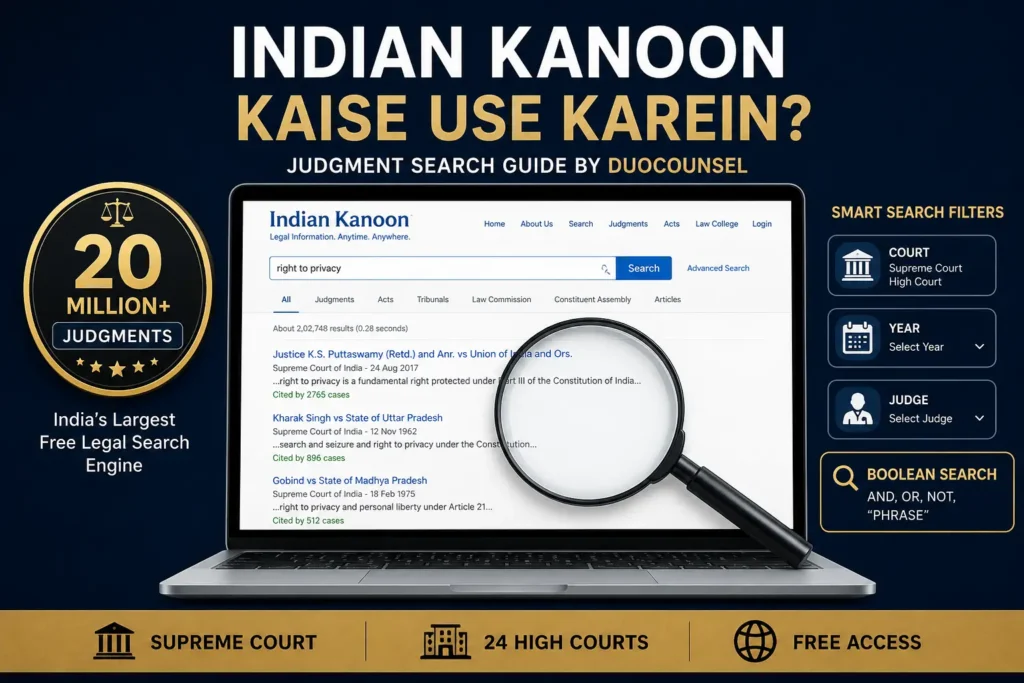
Law student ho aur assignment ke liye koi landmark judgment chahiye. Ya advocate ho aur case ke liye precedent dhundh rahe ho. Ya aam aadmi ho aur apne situation se related koi Supreme Court ka faisla padhna chahte ho. Pehle yeh sab sirf expensive paid databases (SCC Online, Manupatra) ya law library mein possible tha — har koi afford nahi kar sakta tha.
Phir 2008 mein ek game-changer aaya — Indian Kanoon. India ka sabse bada free legal search engine — 20 million+ documents, Supreme Court ki saari judgments, 24 High Courts, tribunals, central laws — sab free mein. Logon ne ise “Indian Legal Google” kaha.
Lekin yahan ek problem hai — database itna bada hai ki agar aap sirf “bail” search karo, millions of results aate hain — useless. Indian Kanoon kaise use karein ki sahi technique nahi pata toh aap ghanton waste karoge aur phir bhi sahi judgment nahi milega.
Main ek practicing advocate hoon aur 15 saal se Indian Kanoon daily use karta hoon — Gurugram courts ke cases ke liye research mein. Indian Kanoon kaise use karein properly — yeh skill law students, junior advocates, aur curious citizens ke liye invaluable hai. Sahi technique se research time 80% kam ho jaata hai.
Is complete tutorial mein main step-by-step bataunga — Indian Kanoon kaise use karein, basic se advanced search, Boolean operators, filters, judgment kaise padhein efficiently, “Cited By” se validity check, aur common mistakes jo avoid karni hain.
Quick Answer: Indian Kanoon kaise use karein — (1) indiankanoon.org pe jaao (free, no login needed for search); (2) Basic search — specific keywords daalo, phrase ke liye quotation marks (“freedom of speech”); (3) Boolean operators — AND, OR, NOT use karke narrow karo (e.g. “Section 138” AND “cheque bounce” AND “compensation”); (4) Filters — left sidebar se court, year, judge select karo; (5) Judgment padho — “Mark Above Structure” feature se color-coded reading; (6) “Cited By” check karo — judgment overruled ya distinguished toh nahi (validity); (7) Author/Bench search — “author:” filter se specific judge ki judgments. Free features sufficient hain — Premium (PRISM AI tools) optional. Important: BNS/BNSS ke naye sections search karo (purane IPC/CrPC ki jagah).Indian Kanoon kaise use karein
Also Read :- Section 498A False Case 2026 — Husband Ka Bachaav Aur Legal Defense Strategy
Indian Kanoon Kya Hai — Background
Indian Kanoon (indiankanoon.org) — ek free legal search engine hai jo 4 January 2008 ko launch hua. Iska mission — Indian law ko aam logon tak accessible banana.
Kya Kya Milta Hai Indian Kanoon Pe:
- Supreme Court ki judgments
- 24 High Courts ki judgments
- 17 tribunals ke orders
- 1.4 million+ central laws aur sections
- Constituent Assembly debates
- Law Commission reports
- Kuch law journals
Database size: 20 million+ documents — aur 20,000+ documents daily add hote hain.
Free Vs Premium
Free (sabse important):
- Saari search functionality
- All judgments access
- Filters, Boolean search
- Reading features (Mark Above Structure, cite-text)
- Yeh 95% users ke liye sufficient hai
Premium (paid — optional):
- PRISM — 8 AI research tools
- Query Alert Service (daily alerts on topics)
- NoteIK — research annotation tool
- Outcome prediction tools
DuoCounsel recommendation: Free version se start karo — most needs cover ho jaati hain. Premium tabhi lo jab heavy professional research karte ho.
Advocate’s Note: Indian Kanoon kaise use karein seekhne ki sabse badi value yeh hai ki yeh playing field level karta hai. Pehle senior advocates ke paas paid databases the, junior aur students ke paas nahi. Ab har koi same judgments access kar sakta hai free mein. Maine khud apni practice ke shuruaat mein Indian Kanoon se hi research kiya — aur aaj bhi daily use karta hoon. Sirf technique aani chahiye — phir yeh tool kisi bhi paid database se kam nahi.Indian Kanoon kaise use karein
Basic Search — Indian Kanoon Kaise Use Karein (Shuruaat)
Indian Kanoon kaise use karein — basic search se shuru karte hain:
Step 1: Website Open Karo
indiankanoon.org pe jaao. Login ki zaroorat nahi search ke liye — bilkul free, open access.
Step 2: Search Bar Mein Keywords Daalo
Search bar mein apne keywords type karo. Lekin yahan technique matter karti hai:
Galat: Sirf “bail” → millions of results, useless Sahi: “anticipatory bail” “economic offence” → focused results Indian Kanoon kaise use karein
Step 3: Word Vs Phrase Search
Word search: Individual words — “murder negligence” — yeh dono words wale documents dhundta hai.
Phrase search: Exact phrase ke liye quotation marks use karo:
- “freedom of speech” — yeh exact phrase
- “reasonable restrictions” — exact phrase
- “Section 138 NI Act” — exact phrase
Quotation marks ka use sabse important basic technique hai — yeh precision dramatically badhata hai.
Step 4: Results Dekho
Results relevance ke hisaab se aate hain. Har result mein:
- Case name
- Court
- Date
- Relevant snippet (jahan keyword match hua)
Advanced Search — Boolean Operators (Game Changer)
Indian Kanoon kaise use karein like a pro — Boolean operators seekho. Yeh research time 80% kam kar dete hain.
Boolean Operators Explained:
AND — dono terms hone chahiye:
"Section 138" AND "compensation" AND "interim"Yeh sirf woh judgments dega jisme teeno hain.
OR — koi ek term:
"alimony" OR "maintenance"Yeh dono mein se kisi ek wale documents dega.
NOT — exclude karna:
"bail" NOT "anticipatory"Yeh anticipatory bail wale exclude kar dega.
Practical Boolean Examples:
Example 1 — Cheque bounce specific:
"Section 138" AND "cheque bounce" AND "Supreme Court"Example 2 — Specific judge ki view:
"Section 482" AND "quashing" AND "FIR"Example 3 — Property specific:
"ancestral property" AND "daughter" AND "coparcener"Combining Techniques:
"medical negligence" AND "compensation" NOT "criminal"Yeh medical negligence compensation cases dega, criminal wale exclude karke.
<!– Image Suggestion: Boolean operators search examples infographic –> <!– Alt Text: Indian Kanoon kaise use karein Boolean operators AND OR NOT search judgment India –>
Filters Ka Use — Results Narrow Karna
Indian Kanoon kaise use karein efficiently — left sidebar ke filters sabse powerful tool hain.Indian Kanoon kaise use karein
Available Filters:
Court Filter:
- Supreme Court only
- Specific High Court (Delhi, Bombay, Punjab & Haryana, etc.)
- Tribunals
Year Filter:
- Specific year ya date range
- Recent judgments ke liye useful
Document Type:
- Judgments
- Laws/Acts
- Law Commission reports
- Constituent Assembly debates
Judge Filter:
- 2200+ judges resolved (all SC judges, all HC judges post-2008)
- Specific judge ki judgments
Practical Filtering Strategy:
- Broad search karo keywords se
- Court filter lagao — agar sirf SC precedent chahiye
- Year filter — recent judgments ke liye (last 5 years)
- Refine until manageable results (10-20)
Yeh combination — keywords + Boolean + filters — sabse efficient research method hai.
Judgment Kaise Padhein — Reading Features
Indian Kanoon kaise use karein judgments efficiently padhne ke liye — yeh free features amazing hain:
Mark Above Structure Feature
Judgment lambi hoti hai — 50-100 pages bhi. Yeh feature automatically different segments ko alag colors mein mark karta hai:Indian Kanoon kaise use karein
- Facts
- Arguments
- Court’s reasoning
- Final decision
“Mark Above Structure” select karo — ya individual categories — sirf woh portion padho jo chahiye. Time bachta hai dramatically.
Cite-Text Sentiment Analysis
Har judgment mein jo doosre cases cite hote hain, unka sentiment Indian Kanoon batata hai:
- Relied by Party — party ne rely kiya
- Accepted by Court — court ne accept kiya
- Negatively viewed by Court — court ne reject/criticize kiya
- No clear sentiment
“Mark all Cite Text” — yeh sab cited cases highlight karta hai sentiment ke saath. Isse quickly samajh aata hai ki kaunsa precedent strong hai.
“Cited By” Feature — Judgment Valid Hai Ya Nahi
Yeh sabse critical feature hai jo log miss karte hain. Indian Kanoon kaise use karein safely — हमेशा “Cited By” check karo.
Problem: Overruled Judgments
Ek judgment 1990 ka hai — lekin ho sakta hai baad mein kisi badi bench ne use overrule kar diya ho. Agar aap purana overruled judgment cite karte ho — embarrassing aur harmful.Indian Kanoon kaise use karein
Solution: “Cited By” Link
Har judgment pe “Cited By” link hota hai — yeh dikhata hai ki kaunse future cases ne is judgment ko cite kiya:
- Agar bahut saare recent cases cite karte hain — judgment strong, valid hai
- Agar koi case ne “overruled” ya “distinguished” kiya — caution
- Citation count dekho — 500 cases ne cite kiya = landmark, reliable
Important Note:
Indian Kanoon mein paid databases jaisa “Red Flag” (automatic overruled warning) nahi hai. Aapko khud “Cited By” check karke detective work karni padti hai — judgment abhi valid hai ya nahi.
Yeh step skip mat karo — especially agar judgment court mein cite karna hai.
<!– Image Suggestion: Cited By feature checking judgment validity flowchart –> <!– Alt Text: Indian Kanoon Cited By feature judgment validity overruled distinguished check India –>
Author/Bench Search — Specific Judge Ki Judgments
Indian Kanoon kaise use karein advanced level — specific judge ki judgments dhundo.
“author:” Filter
Agar aapko pata hai ki ek specific judge ki koi topic pe particular view hai:
author: [judge name] AND "Section 482" AND "quash"Yeh us judge ki authored judgments dega us topic pe.
Bench Search
Specific bench ya judge combination ki judgments bhi search kar sakte ho. 2200+ judges resolved hain — SC ke saare, HC ke post-2008.Indian Kanoon kaise use karein
Practical Use:
- Litigation strategy — agar aapke case mein specific judge hai, unke past views dekho
- Research — kaunsa judge kis topic pe liberal/strict hai
- Academic — judge-specific jurisprudence study
BNS/BNSS Naye Sections — Important Update
Indian Kanoon kaise use karein in the new criminal law era — yeh critical hai.
Purana Vs Naya:
July 2024 se naye criminal laws lagu hue:
- IPC → BNS (Bharatiya Nyaya Sanhita)
- CrPC → BNSS (Bharatiya Nagarik Suraksha Sanhita)
- Evidence Act → BSA (Bharatiya Sakshya Adhiniyam)
Search Strategy:
Purane judgments (pre-2024): IPC/CrPC sections se search karo — woh judgments un sections pe hain.
Naye matters: BNS/BNSS sections se search karo:
- Old “Section 302 IPC” → New “Section 101 BNS” (murder)
- Old “Section 420 IPC” → New “Section 318 BNS” (cheating)
- Old “Section 482 CrPC” → New “Section 528 BNSS” (quashing)
Dono search karo — kyunki purani judgments IPC/CrPC pe hain, nayi jurisprudence BNS/BNSS pe develop ho rahi hai. Transition period mein dono relevant hain.
10 Practical Use Cases — Kaun Kaise Use Kare
Indian Kanoon kaise use karein different users ke liye:
Law Students:
- Assignment research — landmark judgments dhundo
- Moot court prep — precedents aur arguments
- Exam preparation — important case laws padho
Junior Advocates:
- Case precedents — apne case ke liye supporting judgments
- Opposing arguments — doosri side ke possible precedents
- Judge research — bench ke past views
Aam Citizens:
- Apne situation samajhna — similar cases kaise decide hue
- Rights research — apne legal rights jaanna
- Pre-lawyer preparation — basic understanding before consultation
Researchers/Journalists:
- Legal analysis — trends, patterns, landmark cases study
Common Mistakes — Indian Kanoon Use Karte Waqt
Indian Kanoon kaise use karein — yeh galtiyan avoid karo:
- Too broad search — sirf “murder” ya “bail” — millions of results. Always specific + Boolean.
- Quotation marks nahi use karna — phrases ke liye essential hain precision ke liye.
- “Cited By” skip karna — overruled judgment cite karna dangerous hai. Always check validity.
- Filters ignore karna — left sidebar filters research time 80% bachate hain.
- Sirf old IPC/CrPC search — naye matters ke liye BNS/BNSS sections bhi search karo.
- Headnote pe rely karna — full judgment padho, sirf summary pe nahi.
- Free features underutilize — Mark Above Structure, cite-text sentiment — yeh powerful free tools hain.
- Context ignore karna — judgment apne facts pe based hota hai — blindly apply mat karo.
Real Case Study — Gurugram Law Student Ka Research
Background: Simran (age 22), law student, Gurugram. Moot court competition ke liye ek property dispute problem mila — daughter’s right in ancestral property. Pehle usne Google pe search kiya — confusing, scattered information. Phir DuoCounsel ke ek workshop mein Indian Kanoon kaise use karein seekha.
Research Process:
Step 1 — Initial Search:
- Pehle galti ki — sirf “daughter property rights” search kiya — thousands of results
- Realized — too broad
Step 2 — Boolean Refinement:
"ancestral property" AND "daughter" AND "coparcener"- Manageable results mile
Step 3 — Filter Applied:
- Court filter — Supreme Court only
- Year filter — last 6 years (recent jurisprudence)
Step 4 — Landmark Found:
- Vineeta Sharma v. Rakesh Sharma (2020) — the landmark daughter coparcenary case
- Full judgment Mark Above Structure se efficiently padha
Step 5 — Validity Check:
- “Cited By” checked — 200+ cases ne cite kiya — strong, valid precedent
- Confidently use kar sakti thi
Step 6 — Related Cases:
- Cite-text sentiment se related landmark cases identify kiye
- Strong moot court arguments banaye
Result:
- Simran ne moot court mein best researcher award jeeta
- Strong precedent-backed arguments
- Total cost: Zero — sab free Indian Kanoon se
Simran ka takeaway: “Pehle main Google pe ghanton waste karti thi confusing information mein. Indian Kanoon kaise use karein seekhne ke baad — Boolean operators, filters, Cited By — 30 minute mein exact landmark judgment mil jaata hai. Yeh skill har law student ko aani chahiye.”
Key Insight: Sahi technique se Indian Kanoon kaise use karein — yeh ek law student ko expensive paid databases ke barabar research capability deta hai, bilkul free.
Pro Tips — Indian Kanoon Master Banne Ke Liye
Indian Kanoon kaise use karein like an expert:
- Citation copy karo properly — judgment se exact snippet copy karke, citation + paragraph number ke saath. Court mein precision impress karti hai.
- Combine operators — AND, OR, NOT + quotation marks + filters — sab milake use karo.
- “Cited By” hamesha — validity check non-negotiable hai.
- Recent first — year filter se recent jurisprudence pehle dekho.
- Judge research — litigation mein bench ke views jaano “author:” filter se.
- Bookmark important cases — apne frequently used judgments save karo.
- Full judgment padho — headnote sufficient nahi, ratio decidendi full judgment mein hota hai.
- BNS/BNSS dono — transition period mein old + new sections dono search karo.
FAQ — Indian Kanoon Kaise Use Karein Ke Common Questions
Q: Indian Kanoon kaise use karein — kya yeh bilkul free hai? A: Haan — search aur judgments bilkul free hain, login bhi zaroori nahi. 20 million+ documents, Supreme Court + 24 High Courts + tribunals — sab free access. Sirf Premium features (PRISM AI tools, Query Alerts, NoteIK research tool) paid hain — lekin 95% users ke liye free version sufficient hai. Law students aur aam log free version se complete research kar sakte hain.
Q: Indian Kanoon pe specific judgment kaise dhundein? A: Best technique — Boolean operators + quotation marks + filters. Specific phrase quotation marks mein (“Section 138 NI Act”), AND/OR/NOT se narrow karo, phir left sidebar se court aur year filter lagao. Example: “anticipatory bail” AND “economic offence” + Supreme Court filter + last 5 years. Yeh seconds mein focused results deta hai.
Q: Kaise pata chale ki judgment abhi valid hai ya overrule ho gaya? A: “Cited By” feature use karo — har judgment pe yeh link hota hai. Dekho kaunse future cases ne is judgment ko cite kiya. Agar recent cases positively cite karte hain — valid hai. Agar koi badi bench ne “overruled” ya “distinguished” kiya — caution. Citation count bhi dekho — 500 cases = landmark. Indian Kanoon mein paid databases jaisa auto “Red Flag” nahi hai — khud check karna padta hai.
Q: Indian Kanoon pe BNS/BNSS ke naye sections kaise search karein? A: Naye sections directly search karo — “Section 101 BNS” (murder), “Section 318 BNS” (cheating), “Section 528 BNSS” (quashing). Lekin dono search karo — purane judgments IPC/CrPC sections pe hain (Section 302 IPC, 420 IPC, 482 CrPC), nayi jurisprudence BNS/BNSS pe develop ho rahi hai. Transition period mein dono relevant hain comprehensive research ke liye.
Q: Indian Kanoon aur paid databases (SCC Online, Manupatra) mein kya fark hai? A: Indian Kanoon free hai, paid databases mehenge (advocates ke liye). Paid databases mein extra features — automatic “Red Flag” (overruled warning), better headnotes, editorial content. Lekin judgments same hote hain. Free Indian Kanoon se serious research possible hai — bas “Cited By” manually check karna padta hai validity ke liye. Students aur junior advocates ke liye Indian Kanoon sufficient hai.
Q: Kya aam aadmi (non-lawyer) Indian Kanoon use kar sakta hai? A: Bilkul — Indian Kanoon ka mission hi yahi hai, law ko aam logon tak accessible banana. Search algorithm aise design hai ki bina legal knowledge ke bhi results mil jaate hain. Aam aadmi apne situation se related judgments padh sakta hai, rights samajh sakta hai. Lekin yaad rakhо — judgment padhna alag hai, usse apne case mein apply karna alag — action ke liye advocate se consult karo.
Q: Indian Kanoon pe judgment download ya print kar sakte hain? A: Haan — judgments copy, print kar sakte ho. Free version mein text copy possible hai (citation + paragraph number ke saath). Professional use ke liye proper citation maintain karo. Premium membership mein additional document management features hain, lekin basic download/copy free version mein available hai.
Q: Indian Kanoon kaise use karein research ko fast banane ke liye? A: 80% time bachane ke liye — (1) Specific keywords + quotation marks; (2) Boolean operators (AND, OR, NOT); (3) Filters (court, year, judge); (4) Mark Above Structure se efficient reading; (5) Cite-text sentiment se quick precedent identification; (6) “Cited By” se validity. Yeh combination master karo — phir koi bhi research minutes mein ho jaayegi. Practice se speed aati hai.
Indian Kanoon — Har Kisi Ka Free Legal Research Tool
Indian Kanoon kaise use karein — yeh skill aaj ke digital legal world mein invaluable hai. Yeh tool ne sach mein legal research ko democratize kiya hai — pehle jo sirf bade law firms aur senior advocates ke paas tha (expensive databases), ab har law student, junior advocate, aur curious citizen ke paas hai — bilkul free.
Sirf technique aani chahiye — Boolean operators, filters, “Cited By”, reading features. Yeh master kar lo, aur aap kisi paid database se kam research nahi karoge.
Yaad rakhein:
- Indian Kanoon kaise use karein — indiankanoon.org, free, no login needed
- 20 million+ documents — SC, 24 HCs, tribunals, central laws
- Boolean operators (AND, OR, NOT) — research time 80% kam
- Quotation marks — phrases ke liye precision
- Filters — court, year, judge — results narrow karo
- Mark Above Structure — efficient judgment reading
- Cite-text sentiment — quick precedent strength identification
- “Cited By” — judgment validity check (overruled ya nahi) — never skip
- Author filter — specific judge ki judgments
- BNS/BNSS — naye sections + purane IPC/CrPC dono search karo
- Free sufficient — Premium (PRISM) optional
DuoCounsel ke podcast pe humne legal research, law student guidance, aur legal technology pe detailed episodes kiye hain. Zaroor sunein. Indian Kanoon se research karna ek skill hai — lekin yaad rakhein, judgment padhna aur usse apne specific case mein apply karna alag cheezein hain. Action ke liye qualified advocate se consult karein. Hum practicing advocates hain Gurugram mein aur Punjab & Haryana Bar Council se enrolled hain.
===== AUTHOR SECTION =====
Is Article Ke Baare Mein
Yeh article DuoCounsel ke practicing advocates ne 15+ saal ke legal research experience ke aadhar pe likha hai. Indian Kanoon ka daily use, case precedent research, law student guidance — Adv. Yogesh Solanki aur Adv. Barkha Jain ka direct experience hai.
👨⚖️ Adv. Yogesh Solanki
Co-Founder, DuoCounsel | Punjab & Haryana Bar Council
Adv. Yogesh Solanki DuoCounsel ke Co-Founder aur Punjab & Haryana Bar Council se enrolled practicing advocate hain. Gurugram District Courts mein active practice — RERA disputes, consumer cases, civil litigation, property disputes aur criminal matters mein specialization. Solanki Engineers ke official legal retainer.
15+ saal se Indian Kanoon daily use karte hain case research ke liye — precedents, judgments, legal research. Junior advocates aur law students ko legal research techniques sikhate hain. DuoCounsel podcast ke through legal awareness aur research skills Hinglish mein pahunchate hain.
Specialization: RERA | Civil Litigation | Property Disputes | Legal Research | Consumer Cases | Criminal Law | MACT Claims
📍 Practice: Gurugram District Courts | Punjab & Haryana High Court
👩⚖️ Adv. Barkha Jain
Co-Founder, DuoCounsel | Punjab & Haryana Bar Council
Adv. Barkha Jain DuoCounsel ki Co-Founder aur Punjab & Haryana Bar Council se enrolled practicing advocate hain. Corporate law, business compliance, legal research aur matrimonial law mein deep expertise.
Corporate aur tax matters mein extensive legal research — Indian Kanoon, case law analysis, precedent research — Barkha ka daily practice hai. Legal technology aur research tools ko effectively use karna sikhati hain. DuoCounsel podcast mein complex legal research simple Hinglish mein explain karti hain.
Specialization: Corporate Law | Legal Research | Business Compliance | GST | Income Tax | Matrimonial Law
📍 Practice: Gurugram District Courts | Punjab & Haryana High Court
⚠️ Disclaimer: Yeh article sirf legal awareness aur educational purpose ke liye hai. Indian Kanoon se judgment padhna aur usse apne specific case mein apply karna alag cheezein hain — legal research ka matlab professional advice nahi hai. Specific legal matters mein qualified advocate se consult zaroor karein. Indian Kanoon ke features at the time of writing accurate hain.
🎙️ DuoCounsel Podcast sunein — legal awareness Hinglish mein | duocounsel.com/podcast