
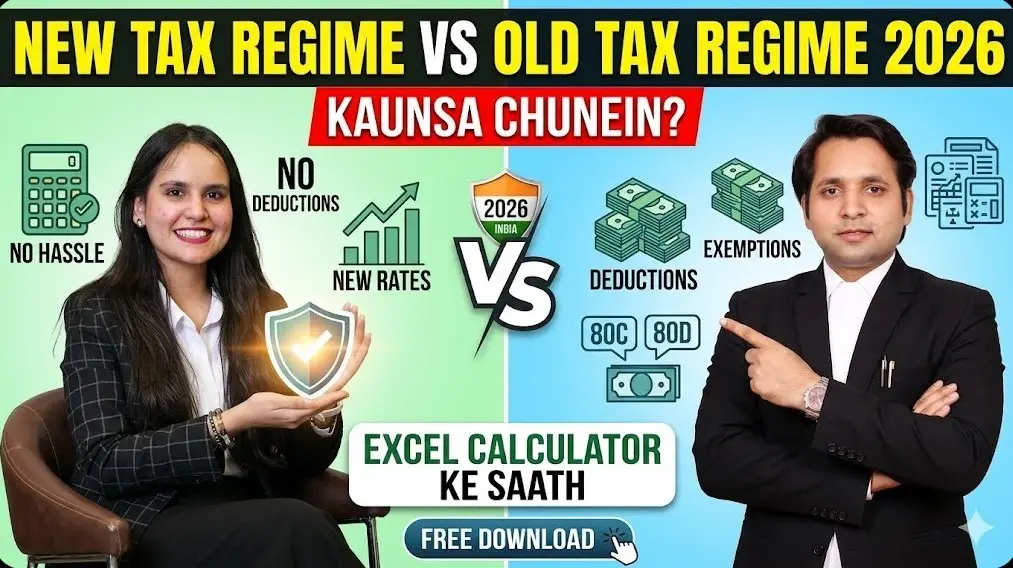
Agar aap bhi yeh sawaal pooch rahe hain ki “New Tax Regime vs Old Tax Regime 2026 – Kaunsa Chunein?” toh aap sahi jagah aaye hain. Union Budget 2026 ke baad bhi yeh confusion bani hui hai ki kaunsa tax regime zyada faydemand rahega. Finance Minister Nirmala Sitharaman ne 1 February 2026 ko Budget present karte hue income tax slabs mein koi badlav nahi kiya, jisse New Tax Regime vs Old Tax Regime 2026 ka decision aur bhi important ho gaya hai.
Is comprehensive guide mein hum step-by-step samjhenge ki New Tax Regime vs Old Tax Regime 2026 mein se aapke liye best option kaunsa hai. Chahe aap salaried employee hon, freelancer hon, ya business owner – yeh guide aapko clear batayega ki aapko kis regime mein kam tax dena hoga. Hum saath mein ek Excel calculator ka bhi use karna sikhenge jisse aap khud calculate kar sakte hain.
Sabse pehle samajhte hain ki New Tax Regime vs Old Tax Regime 2026 ka basic difference kya hai. Old tax regime mein aapko bahut saare deductions aur exemptions milte hain – jaise Section 80C, HRA, home loan interest, medical insurance, etc. Lekin iske badle tax rates relatively higher hain. New tax regime mein tax rates lower hain, lekin aapko zyadatar deductions chhodne padte hain. Budget 2026 ke baad yeh New Tax Regime vs Old Tax Regime 2026 ka comparison aur bhi relevant ho gaya hai kyunki new regime ab default option ban chuka hai.
Aaiye detail mein samajhte hain ki New Tax Regime vs Old Tax Regime 2026 ke beech aapko final decision kaise lena chahiye.
Also Read :- India mein SaaS Startup Register Kaise Karein? Step-by-Step Legal Guide (2026)
Union Budget 2026: Kya Badla, Kya Nahi Badla?
Bahut se logon ko lagta tha ki Budget 2026 mein income tax slabs mein kuch relief milega. Lekin Finance Minister Nirmala Sitharaman ne clear kar diya ki FY 2026-27 (AY 2027-28) ke liye income tax slabs unchanged rahenge. Iska matlab New Tax Regime vs Old Tax Regime 2026 ka calculation pichle saal jaisa hi rahega.
Kuch important changes jo Budget 2026 mein hue:
- New Income Tax Act 2025: 1 April 2026 se Income Tax Act 1961 replace ho jayega. Section numbers change ho rahe hain – jaise Section 80C ab Section 123 ban gaya hai, lekin deduction limits wahi rahengi.
- TCS Rates mein reduction: Overseas education aur medical treatment par TCS 5% se ghata kar 2% kar diya gaya. Overseas tour packages par 20% se 2%.
- ITR Filing Deadline Extension: Revised return file karne ki last date 31 December se badha kar 31 March kar di gayi (nominal fee ke saath).
- No change in slabs: Dono regimes ke slabs unchanged hain.
Yeh samajhna zaroori hai ki New Tax Regime vs Old Tax Regime 2026 mein slab structure wahi hai jo FY 2025-26 mein tha. Government ne “stability” par focus kiya hai rather than “relief” par.
New Tax Regime 2026-27: Slabs, Rebate aur Deductions
Jab hum baat karte hain New Tax Regime vs Old Tax Regime 2026 ki, toh pehle new regime ke features ko clearly samajhna hoga. New tax regime mein tax slabs kuch is prakar hain:
| Income Slab (₹) | Tax Rate |
|---|---|
| 0 – 4,00,000 | Nil |
| 4,00,001 – 8,00,000 | 5% |
| 8,00,001 – 12,00,000 | 10% |
| 12,00,001 – 16,00,000 | 15% |
| 16,00,001 – 20,00,000 | 20% |
| 20,00,001 – 24,00,000 | 25% |
| Above 24,00,000 | 30% |
Standard Deduction: New tax regime mein salaried employees aur pensioners ko ₹75,000 ka standard deduction milta hai. Old regime mein yeh sirf ₹50,000 hai.
Section 87A Rebate: Agar aapki taxable income (standard deduction ke baad) ₹12 lakh ya usse kam hai, toh aapko Section 87A ke tahat poora tax rebate milta hai. Matlab aapka tax ₹0 ho jata hai. Salaried employees ke liye yeh effective tax-free limit ₹12.75 lakh ho jati hai (₹12 lakh + ₹75,000 standard deduction).
Deductions jo New Tax Regime mein milte hain:
- Standard deduction (₹75,000)
- Employer ka NPS contribution (Section 80CCD(2)) – up to 14% of salary
- Interest on home loan for let-out property (Section 24)
- Family Pension deduction (₹15,000 ya 1/3rd, whichever is lower)
- Gratuity, Leave Encashment, VRS compensation
Deductions jo New Tax Regime mein NAHI milte:
- Section 80C (PPF, ELSS, LIC, EPF, tuition fees, etc.)
- Section 80D (Health Insurance premium)
- HRA (House Rent Allowance)
- LTA (Leave Travel Allowance)
- Home Loan Interest on self-occupied property (Section 24(b))
- Professional Tax
- Entertainment Allowance
Jab aap New Tax Regime vs Old Tax Regime 2026 compare karte hain, toh yeh list bahut important hai. Agar aapke paas heavy deductions nahi hain, toh new regime almost certainly better hoga.
Old Tax Regime 2026-27: Slabs aur Available Deductions
New Tax Regime vs Old Tax Regime 2026 ke comparison mein old regime un logon ke liye relevant hai jo significant tax-saving investments karte hain. Old regime ke slabs kuch is prakar hain (60 saal se kam age ke liye):
| Income Slab (₹) | Tax Rate |
|---|---|
| 0 – 2,50,000 | Nil |
| 2,50,001 – 5,00,000 | 5% |
| 5,00,001 – 10,00,000 | 20% |
| Above 10,00,000 | 30% |
Standard Deduction: Old regime mein ₹50,000 milta hai.
Major Deductions jo Old Regime mein available hain:
- Section 80C (Ab Section 123): PPF, EPF, ELSS, LIC premium, home loan principal, tuition fees, NSC, SSY, etc. – Maximum ₹1.5 lakh.
- Section 80D (Ab Section 126): Health insurance premium – Self/family ke liye ₹25,000 (senior citizens ₹50,000). Parents ke liye alag se ₹25,000/₹50,000.
- Section 24(b): Home loan interest on self-occupied property – Maximum ₹2 lakh deduction.
- Section 80CCD(1B) (Ab Section 124): Additional NPS contribution – ₹50,000 deduction (yeh 80C ke ₹1.5 lakh ke upar hai).
- HRA (House Rent Allowance): Salaried employees jo rent pay karte hain, unke liye significant exemption.
- Section 80E (Ab Section 129): Education loan interest – No upper limit.
- Section 80TTA/80TTB: Savings account interest – ₹10,000 (general) / ₹50,000 (senior citizens).
New Tax Regime vs Old Tax Regime 2026 mein yeh samajhna important hai ki old regime tabhi beneficial hai jab aapke total deductions ₹4-5 lakh se zyada hon.
Marginal Relief: New Tax Regime ka Hidden Benefit
New Tax Regime vs Old Tax Regime 2026 mein ek bahut important concept hai jo aksar miss ho jata hai – Marginal Relief. Jab aapki income ₹12 lakh se thodi si zyada hoti hai, toh bina marginal relief ke aapka tax suddenly bahut high ho sakta hai.
Marginal relief ensure karta hai ki aapka tax kabhi bhi “extra income” se zyada na ho. Example se samajhte hain:
Maan lijiye aapki salary ₹12,10,000 hai. Standard deduction (₹75,000) ke baad taxable income ₹11,35,000. Lekin agar taxable income ₹12,10,000 hoti (yaani salary ₹12,85,000), toh slab ke hisaab se tax hota:
- 5% on ₹4L = ₹20,000
- 10% on ₹4L = ₹40,000
- 15% on ₹10,000 = ₹1,500
- Total tax = ₹61,500
Lekin aapne earn kiya hai sirf ₹10,000 extra (₹12 lakh se upar). Toh ₹61,500 tax lena unfair hoga. Isliye Marginal Relief lagu hota hai – aapko tax dena hoga sirf ₹10,000 (utna hi jitna extra earn kiya).
Yeh New Tax Regime vs Old Tax Regime 2026 ka ek major advantage hai. Old regime mein aisa koi provision nahi hai. Agar old regime mein aapki income ₹5 lakh se ₹100 bhi zyada ho jaye, toh aapka poora tax slab ke hisaab se calculate hoga (Section 87A rebate ₹12,500 tak hi limited hai).
Important Limitation: Agar aapki taxable income ₹12.75 lakh ho jaye (matlab salary ₹13.5 lakh), toh marginal relief nahi milega kyunki tab tax liability (₹71,250) extra income (₹75,000) se kam ho jati hai. Is case mein aapko poora tax dena hoga.
Break-Even Analysis: Kab Old Regime Better Hai?
New Tax Regime vs Old Tax Regime 2026 ka final decision lene ke liye humein break-even point samajhna hoga – yaani kitne deductions hone par old regime beneficial hota hai.
Different income levels par break-even deduction requirement:
| Annual Income (₹) | Break-even Deductions Required (Approx) |
|---|---|
| 10 lakh | ₹2.5 – 3 lakh |
| 15 lakh | ₹4 – 4.5 lakh |
| 20 lakh | ₹5 – 5.5 lakh |
| 25 lakh | ₹6 – 7 lakh |
| 30 lakh | ₹7 – 8 lakh |
| 50 lakh | ₹8 – 9 lakh |
Rule of Thumb:
- Income ₹15 lakh tak: Agar deductions ₹3.5 lakh se kam hain, new regime better.
- Income ₹15-25 lakh: Agar deductions ₹5 lakh se kam hain, new regime better.
- Income ₹25 lakh se upar: Agar deductions ₹7 lakh se kam hain, new regime better.
Yeh New Tax Regime vs Old Tax Regime 2026 ka quick decision framework hai.
Case Study 1: Young Professional (₹12 lakh salary, limited deductions)
Salary: ₹12,00,000 | Investments: ₹50,000 (PPF), HRA: ₹1,20,000
Old Regime Calculation:
- Gross Salary: ₹12,00,000
- Less: Standard Deduction: ₹50,000
- Less: HRA: ₹1,20,000
- Less: 80C: ₹50,000
- Taxable Income: ₹9,80,000
- Tax: ₹1,08,500 (approx)
New Regime Calculation:
- Gross Salary: ₹12,00,000
- Less: Standard Deduction: ₹75,000
- Taxable Income: ₹11,25,000
- Tax: ₹0 (Section 87A rebate)
Verdict: New regime saves ₹1,08,500.
Is case mein New Tax Regime vs Old Tax Regime 2026 ka winner clearly new regime hai.
Case Study 2: Mid-Career Professional (₹25 lakh salary, good deductions)
Salary: ₹25,00,000 | 80C: ₹1,50,000 | 80D: ₹25,000 | Home Loan Interest: ₹2,00,000 | NPS (80CCD(1B)): ₹50,000 | HRA: ₹1,80,000
Old Regime Calculation:
- Gross Salary: ₹25,00,000
- Less: Standard Deduction: ₹50,000
- Less: HRA: ₹1,80,000
- Less: 80C: ₹1,50,000
- Less: 80CCD(1B): ₹50,000
- Less: 80D: ₹25,000
- Less: Home Loan Interest: ₹2,00,000
- Taxable Income: ₹18,45,000
- Tax: ₹3,88,500 (approx)
New Regime Calculation:
- Gross Salary: ₹25,00,000
- Less: Standard Deduction: ₹75,000
- Taxable Income: ₹24,25,000
- Tax: ₹3,43,200 (approx)
Verdict: New regime still saves ₹45,300. Itne deductions ke baad bhi new regime better hai!
Case Study 3: High Earner with Heavy Deductions (₹50 lakh salary)
Salary: ₹50,00,000 | 80C: ₹1,50,000 | 80D: ₹50,000 | Home Loan Interest: ₹2,00,000 | NPS (80CCD(1B)): ₹50,000 | HRA: ₹3,00,000 | 80E (Education Loan): ₹1,00,000
Old Regime Calculation:
- Gross Salary: ₹50,00,000
- Less: Standard Deduction: ₹50,000
- Less: HRA: ₹3,00,000
- Less: 80C: ₹1,50,000
- Less: 80CCD(1B): ₹50,000
- Less: 80D: ₹50,000
- Less: Home Loan Interest: ₹2,00,000
- Less: 80E: ₹1,00,000
- Taxable Income: ₹41,00,000
- Tax: ₹10,65,000 (approx)
New Regime Calculation:
- Gross Salary: ₹50,00,000
- Less: Standard Deduction: ₹75,000
- Taxable Income: ₹49,25,000
- Tax: ₹11,24,750 (approx)
Verdict: Old regime saves ₹59,750. Finally, old regime wins!
Is case mein New Tax Regime vs Old Tax Regime 2026 ka winner old regime hai kyunki total deductions ₹8 lakh+ cross kar gaye.
Surcharge and Cess: Dono Regimes Mein Applicable
New Tax Regime vs Old Tax Regime 2026 mein surcharge aur cess ka structure same hai. 4% Health and Education Cess dono regimes mein tax + surcharge par applicable hota hai.
Surcharge rates (income ke hisaab se):
| Income Range (₹) | Surcharge Rate |
|---|---|
| 50 lakh – 1 crore | 3% |
| 1 crore – 2 crore | 4.5% |
| 2 crore – 5 crore | 7.5% |
| Above 5 crore | 15% |
New tax regime mein effective tax rates (surcharge + cess ke saath) up to 39% ja sakte hain. Old regime mein yeh up to 42.74% tak jaata hai.
New Tax Regime vs Old Tax Regime 2026: Kab Kaunsi Regime Chunein?
Ab tak humne detail mein dekha ki New Tax Regime vs Old Tax Regime 2026 ka comparison kaise karte hain. Summary mein:
New Tax Regime Chunein Agar:
- Aapki annual income ₹15 lakh se kam hai (specially ₹12-13 lakh tak – zero tax!)
- Aapke paas limited deductions hain (80C, HRA, home loan interest negligible hai)
- Aap simplicity chahte hain – proof submit karne ki tension nahi
- Aap young professional hain jo abhi investments build kar rahe hain
- Aap freelancer ya consultant hain jinka income fixed nahi hai
Old Tax Regime Chunein Agar:
- Aapke paas significant home loan interest hai (₹1.5-2 lakh+)
- Aap HRA claim karte hain jo ₹2-3 lakh+ hai
- Aapki 80C investments fully utilized hain (₹1.5 lakh)
- Aap NPS mein additional ₹50,000 daalte hain
- Aapke total deductions ₹5-8 lakh+ hain (income ke hisaab se)
- Aapki income ₹30 lakh+ hai aur aap aggressive tax-saver hain
New Tax Regime vs Old Tax Regime 2026 ka final decision lene se pehle apne actual numbers Excel calculator mein daalkar zaroor check karein.
Excel Calculator: Old vs New Tax Regime Comparison Kaise Karein?
New Tax Regime vs Old Tax Regime 2026 ko accurately compare karne ke liye aap Excel calculator use kar sakte hain. Bahut se free aur paid calculators available hain online.
Basic Excel Calculator Setup (DIY):
Aap khud bhi simple Excel sheet bana sakte hain:
- Cell A1: “Annual Income” (e.g., ₹15,00,000)
- Cell A2: “Standard Deduction – Old” (₹50,000)
- Cell A3: “Standard Deduction – New” (₹75,000)
- Cell A4: “80C Deduction” (Max ₹1,50,000 – only old regime)
- Cell A5: “80D Deduction” (Max ₹25,000/50,000 – only old regime)
- Cell A6: “Home Loan Interest” (Max ₹2,00,000 – only old regime)
- Cell A7: “HRA Exemption” (Actual – only old regime)
- Cell A8: “NPS 80CCD(1B)” (Max ₹50,000 – only old regime)
Formulas:
- Old Regime Taxable Income = A1 – A2 – A4 – A5 – A6 – A7 – A8
- New Regime Taxable Income = A1 – A3
- Old Regime Tax = IF(Taxable Income<=250000,0,IF(Taxable Income<=500000,(Taxable Income-250000)*5%,IF(Taxable Income<=1000000,12500+(Taxable Income-500000)*20%,112500+(Taxable Income-1000000)*30%)))
- New Regime Tax = IF(Taxable Income<=400000,0,IF(Taxable Income<=800000,(Taxable Income-400000)*5%,IF(Taxable Income<=1200000,20000+(Taxable Income-800000)*10%,IF(Taxable Income<=1600000,60000+(Taxable Income-1200000)*15%,IF(Taxable Income<=2000000,120000+(Taxable Income-1600000)*20%,IF(Taxable Income<=2400000,200000+(Taxable Income-2000000)*25%,300000+(Taxable Income-2400000)*30%))))))
Cess (4%) add karein: Tax * 1.04
Rebate for New Regime:
=IF(New_Taxable_Income<=1200000, 0, New_Tax_Calculated)
Marginal Relief for New Regime:
=IF(AND(New_Taxable_Income>1200000, New_Taxable_Income<1275000), MIN(New_Tax_Calculated, New_Taxable_Income-1200000), New_Tax_Calculated)
Yeh New Tax Regime vs Old Tax Regime 2026 calculator aapko exact batayega ki kaunsi regime aapke liye beneficial hai.
Recommended Free Calculators:
Common Mistakes to Avoid
New Tax Regime vs Old Tax Regime 2026 decide karte waqt yeh common mistakes avoid karein:
- Employer ke through galat regime select karna: Agar aapne galat regime select kiya, toh TDS zyada ya kam kat sakta hai. ITR filing ke time aap regime change kar sakte hain (except business income).
- Home loan interest bhoolna: Agar aap new regime mein hain, toh self-occupied property ka home loan interest deduction nahi milega. Let-out property ka interest milta hai.
- Marginal Relief ignore karna: ₹12-13 lakh income walon ko marginal relief ka fayda check karna chahiye.
- Section 80C ka over-investment: Old regime mein bhi 80C limit ₹1.5 lakh hi hai. Isse zyada invest karna tax-saving ke liye faydemand nahi.
- NPS employer contribution bhoolna: New regime mein employer ka NPS contribution (up to 14%) tax-free hai. Iska fayda uthayein.
- Every year regime change kar sakte hain: Salaried employees har saal regime change kar sakte hain. Isliye New Tax Regime vs Old Tax Regime 2026 ka analysis har saal dobara karein.
Akhri Salaah: New Tax Regime vs Old Tax Regime 2026
Toh finally, New Tax Regime vs Old Tax Regime 2026 – kaunsa chunein?
Simple jawab: Apna Excel calculator khol kar actual numbers daaliye.
Lekin agar general trend dekhein toh:
- 75% taxpayers already new regime mein shift ho chuke hain (FY 2024-25 data).
- Over 80% individual return filers ab new regime use karte hain.
- Government new regime ko hi promote kar rahi hai – yeh default option hai.
New tax regime ka sabse bada fayda hai simplicity. Aapko investment proofs collect karne ki tension nahi, LTA/HRA ke bills nahi sambhalne. Aur middle-income group (₹12 lakh tak) ke liye toh bilkul tax-free income ka mauka hai.
Old regime unke liye hai jo genuinely heavy savers hain – jinpe home loan hai, jo NPS mein daalte hain, jinhe HRA ka significant benefit milta hai. Lekin aise taxpayers ab minority mein hain.
New Tax Regime vs Old Tax Regime 2026 – aap jo bhi chunein, ensure karein ki aapne informed decision liya hai, na ki bas “sab yehi kar rahe hain” wala. Excel calculator use karein, apne CA se consult karein, aur phir final karein.
Yaad rakhein: New Tax Regime vs Old Tax Regime 2026 ka decision aap har saal badal sakte hain (unless aapke paas business income hai). Isliye har saal March mein baith kar calculate karein ki kaunsi regime aapke liye better hai.
Duo Counsel par hum aapki har legal aur financial query ka jawab dene ke liye hamesha tayar hain. Agar aapko New Tax Regime vs Old Tax Regime 2026 par koi specific doubt hai, toh niche comment karein ya humse directly contact karein.
About the Author
Adv. Barkha Jain & Adv. Yogesh Solanki (Founders, Duo Counsel)
Hum Duo Counsel hain—Adv. Barkha Jain aur Adv. Yogesh Solanki, Gurugram District Courts aur Punjab & Haryana High Court mein practicing advocates.
Ek advocate ke roop mein, humne dekha hai ki kis tarah gharelu hinsa auraton ko mentally tod deti hai. Hamara primary maqsad complex kanooni bhasha (legal jargon) ko todna aur aam janta tak right legal awareness simple Hinglish mein pohochana hai taaki har aurat ko kanooni empowered feel ho. Family Law, Matrimonial Disputes (Divorce, Domestic Violence, 498A), aur Women Rights hamari practice ka core hissa hain.
Hum samajhte hain ki ek aurat ke liye court aana kitna emotionally draining hota hai. Isliye agar aap ek safe aur confidential legal counsel dhoondh rahi hain, aur step-by-step guidance chahti hain ki exactly ground level par Domestic Violence Case Kaise Kare, toh hamari team aapki poori madad karne ke liye tayyar hai.
- Platform: DuoCounsel.com
- 🎙️ Podcast: Duo Counsel Podcast (Available on YouTube & Spotify)
- 📸 Instagram: instagram.com/duocounsel
(Disclaimer: Yeh article sirf educational purposes aur legal awareness ke liye likha gaya hai. Har marriage aur DV case ki facts alag hoti hain. Kripya is article ko apni personal professional legal advice ka direct substitute na maane. Koi bhi legal action lene se pehle apne personal family advocate se zaroor consult karein.)