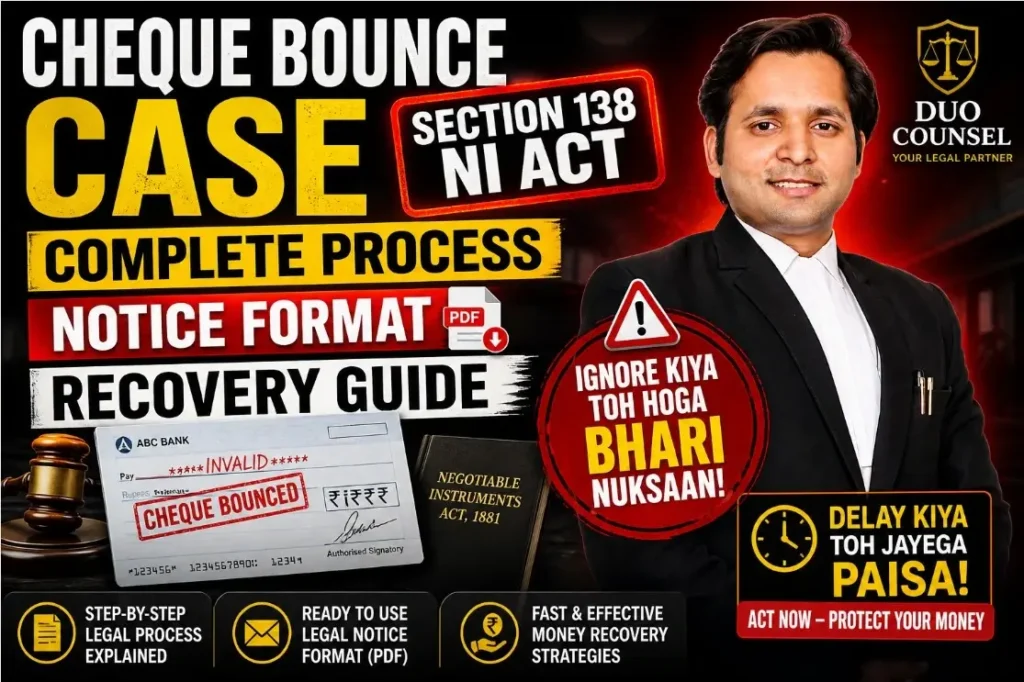
Business partner ne Rs 5 lakh ka cheque diya — “Transaction complete, payment done.” Aap bank gaye, cheque deposit kiya. 2 din baad bank se SMS aaya — “Your cheque No. XXXXXX has been returned unpaid. Reason: Insufficient Funds.”
Gussa aaya? Shock hua? Ab kya karein?
Yeh cheque bounce case ki starting hai — aur India mein har saal 40 lakh se zyada aisi situations hoti hain. Cheque bounce sirf ek banking inconvenience nahi hai — yeh Section 138 Negotiable Instruments Act, 1881 ke under ek criminal offence hai. Punishment hai 2 saal tak jail aur cheque amount ke double tak fine. Aur victim ko paisa wapas dilwane ka ek powerful mechanism bhi hai.
Lekin cheque bounce case mein ek strict timeline hai — teen critical deadlines. Ek bhi miss ho gayi toh aapka case automatically dismiss ho jaata hai. Main ek practicing advocate hoon aur Gurugram courts mein Section 138 ke dozens of cheque bounce case handle kiye hain — dono sides se — complainant aur accused. Main aapko exact process bataunga.
Is complete evergreen guide mein main cover karunga — Section 138 kya hai, 5 mandatory conditions, 3-step critical timeline, ready-to-use notice format, magistrate complaint format, punishment details, defense strategies agar aap accused hain, settlement options aur real case study.
Quick Answer: Cheque bounce case mein 3 critical steps hain — (1) Cheque dishonour hone ke 30 din ke andar registered post se legal notice bhejo; (2) Notice milne ke baad drawer ko 15 din mein payment ka mauka milta hai; (3) 15 din mein payment nahi aayi toh 30 din ke andar magistrate court mein complaint file karo. Teen deadlines — 30 + 15 + 30. Koi bhi miss karo = case dismiss. Punishment: 2 saal jail + cheque amount ka double fine + compensation. Section 143A ke under interim compensation bhi maang sakte ho — complaint file hone ke baad.
Also Read :- Cheque Bounce Case Process 2026: Section 138 NI Act Ki Ultimate Guide
Section 138 NI Act Kya Hai — Background Aur Purpose
Negotiable Instruments Act, 1881 mein Section 138 ko 1988 mein amendment karke add kiya gaya tha. Purpose tha — cheques ko trustworthy payment instrument banana. Jab tak cheque bounce karna consequence-free tha, businesses cheque dete the bina paisa hone ke. Section 138 ne isko criminal offence bana diya.
Simple equation: Cheque issued as payment + Bounce + Notice ignored = Criminal liability
Section 138 Ke Under Offence Kab Banta Hai — 5 Mandatory Conditions
Supreme Court ne K. Bhaskaran v. Sankaran Vaidhyan Balan (1999) mein 5 conditions clearly define kiye. Sab 5 satisfy hone chahiye — ek bhi missing = case fail.
Condition 1: Cheque Legally Enforceable Debt Ke Liye Cheque sirf ek existing debt ya liability discharge karne ke liye issue hua hona chahiye. Gift ke liye, advance payment ke liye, ya security ke liye diya cheque Section 138 ke under cover nahi hota necessarily.
Important distinctions:
- Covered: Loan repayment, goods/services payment, rent, salary advance return
- Not covered: Gift cheque, post-dated cheque for future contingent liability (Indus Airways SC case)
- Grey area: Security cheques — courts case-by-case decide karte hain
Condition 2: Cheque Validity Period Mein Present Kiya Cheque 3 mahine ki validity period ke andar bank mein present kiya hona chahiye cheque date se. 3 mahine baad presented cheque — Section 138 ke under case nahi hoga.
Pro tip: Aap cheque multiple times present kar sakte ho validity period ke andar. Har dishonour pe fresh cause of action aata hai — MSR Leathers v. S. Palaniappan (SC) ke under.
Condition 3: Cheque Returned Unpaid Bank ne cheque return kiya ho — return memo ke saath. Common reasons:
- “Insufficient Funds” — Section 138 ke under criminal liability
- “Stop Payment” — Section 138 ke under criminal liability
- “Account Closed” — Section 138 ke under criminal liability
- “Signature Mismatch” — technical defect, generally civil liability only
- “Overwriting” — technical defect, generally civil only
Only insufficient funds, stop payment, account closed = criminal Section 138 case.
Condition 4: Notice 30 Din Ke Andar Bheja Return memo milne ke 30 din ke andar registered post se legal notice bhejni mandatory hai. Ek din bhi late = case fail.
Condition 5: Drawer Ne 15 Din Mein Payment Nahi Ki Notice milne ke baad drawer ko 15 din milte hain payment karne ke. Payment aa gayi = matter close, no offence committed. Payment nahi aayi = cause of action arise, complaint file ho sakti hai.
Advocate’s Note: Cheque bounce case mein sabse common mistakes jo main dekha hoon — (1) Notice 30 din se late bheja, (2) Notice registered post se nahi bheja, (3) Complaint 30 din se late file ki. Teen mein se koi bhi ek galti = case dismiss. Dates track karna sabse critical hai.
Critical Timeline — 30 + 15 + 30 Days
Yeh cheque bounce case ki lifeline hai. Ek bhi deadline miss = case dead.
CHEQUE BOUNCE TIMELINE:

DAY 0: Bank returns cheque with "Return Memo"
         ↓
DAY 1-30: Send Registered Post Notice to drawer
         ↓  (DEADLINE 1 — 30 days from return memo)
DAY [X]: Notice received by drawer
         ↓
DAY [X+1] to [X+15]: DRAWER'S PAYMENT WINDOW
         ↓  (If payment received = CASE CLOSED, no offence)
DAY [X+16]: Cause of action arises (15 days expired without payment)
         ↓
DAY [X+16] to [X+46]: FILE COMPLAINT IN MAGISTRATE COURT
                        (DEADLINE 2 — 30 days from cause of action)
         ↓
MAGISTRATE COURT: Cognizance + Summons + Trial
Notice “deemed served” rule: Agar drawer notice refuse kare ya “not available” pe return aaye — notice deemed served hai law mein (C.C. Alavi Haji v. Palapetty Muhammed SC). Notice ka weight postal receipt + envelope hi hai.
<!– Image Suggestion: 30+15+30 day timeline infographic — cheque bounce case deadlines –> <!– Alt Text: cheque bounce case timeline 30 days notice 15 days window complaint magistrate Section 138 –>
Legal Notice Format — Ready To Use Template
Cheque bounce case mein notice ek zarooori step hai — galat notice = case dismiss. Yeh complete ready-to-use format hai:
[ADVOCATE LETTERHEAD — agar advocate se draft karwa rahe ho]
[YA: SENDER KA NAAM + ADDRESS — khud bhej rahe ho toh]

Date: [DD/MM/YYYY]

By Registered Post A.D. / Speed Post

To,
[Drawer ka poora naam]
[Complete address]

Subject: LEGAL NOTICE UNDER SECTION 138 OF THE NEGOTIABLE
         INSTRUMENTS ACT, 1881 FOR DISHONOUR OF CHEQUE
         NO. _______ DATED _________ FOR RS. ____________/-

Sir/Madam,

Under instructions from and on behalf of my client,
[Aapka poora naam], [Address], I hereby serve upon you
the following Statutory Notice under Section 138 of the
Negotiable Instruments Act, 1881:

1. That you had issued Cheque No. [_______], dated
   [DD/MM/YYYY], drawn on [Bank Name], [Branch Name],
   Account No. [_______], for a sum of Rs. [_______]/-
   (Rupees [amount in words] only), in favour of my
   client, [aapka naam], towards [discharge of legally
   enforceable debt/liability arising from loan/
   goods supplied/services rendered — specify exactly].

2. That my client duly presented the said cheque for
   encashment on [presentation date] through [Your Bank
   Name], [Branch]. However, the said cheque was
   dishonoured and returned unpaid vide Return Memo
   dated [return memo date] with the remark
   "[Insufficient Funds / Stop Payment / Account Closed]".

3. That the dishonour of the said cheque has caused
   great loss, inconvenience and financial hardship to
   my client.

4. That my client is entitled to recover the full amount
   of the cheque along with interest and legal costs.

NOTICE IS HEREBY GIVEN that you are called upon to
pay to my client the sum of Rs. [_______]/- (Rupees
[amount in words] only) being the cheque amount,
WITHIN 15 DAYS FROM THE DATE OF RECEIPT OF THIS
NOTICE, failing which my client shall be constrained
to initiate criminal proceedings against you under
Section 138 of the Negotiable Instruments Act, 1881,
and other applicable provisions of law, entirely at
your risk, cost and consequences.

Please treat this as a statutory notice under the
Negotiable Instruments Act, 1881.

A copy of this notice is being retained in our office
for future reference and use in legal proceedings.

Yours faithfully,

[Advocate ka naam aur signature]
[Bar Council Enrollment Number]
[Contact number, address]

[YA: Aapka naam aur signature agar khud bhej rahe ho]

Enclosures:
1. Copy of Cheque No. [_______]
2. Copy of Bank Return Memo dated [_______]
3. Copy of any relevant agreement/invoice/acknowledgment
Notice Ke 8 Mandatory Elements:
| Element | Why Critical |
|---|---|
| Cheque details | Number, date, amount, bank — exactly as on cheque |
| Bank return memo date | 30-day deadline start point |
| Reason for dishonour | “Insufficient funds” clearly mention |
| Debt/liability nature | Loan, goods, services — specifically |
| Exact amount demanded | Cannot be inflated or reduced — SC ruling |
| 15-day payment deadline | Mandatory — “within 15 days of receipt” |
| Criminal proceedings warning | “Section 138 proceedings will be initiated” |
| Registered Post A.D. | Method of sending — postal receipt mandatory |
Magistrate Court Mein Complaint Kaise File Karein
15-day window mein payment nahi aayi — ab cheque bounce case complaint file karo.
Step 1: Kahan File Karein — Jurisdiction
Section 142(2) NI Act (2015 Amendment):
- Complainant ki bank ka location — jahan cheque deposit kiya gaya
- Example: Mumbai ka drawer, Gurugram mein aapki bank — Gurugram court mein file karo
Practical benefit: Complainant ko familiar city mein case chalana convenient hai. Cheque Bounce Case
Step 2: Complaint Mein Kya Hona Chahiye
Supreme Court ke guidelines ke under standard complaint format: Cheque Bounce Case
- Parties ka complete detail
- Cheque details (copy attached)
- Return memo details (copy attached)
- Notice details (copy + postal receipt + acknowledgment)
- Cause of action — 15 din mein payment nahi aayi
- Prayer: Summons, trial, conviction, compensation
Attachments mandatory:
- Original dishonoured cheque (ya certified copy)
- Bank return memo
- Copy of legal notice
- Registered post receipt
- Acknowledgment card (agar received)
- Underlying agreement/invoice (agar hai)
- Affidavit supporting complaint
Step 3: Magistrate Ki Examination
Complaint file hone pe Magistrate complainant ka oath pe examination karta hai — Section 200 BNSS (purana Section 200 CrPC). Agar prima facie case hai — summons issue hoti hai accused ko. Cheque Bounce Case
Step 4: Section 143A — Interim Compensation (Game Changer)
Yeh 2018 amendment ka powerful addition hai cheque bounce case mein:
- Complaint file hone ke baad, trial ke during
- Complainant interim compensation maang sakta hai — cheque amount ka 20% tak
- Court accused ko order kar sakta hai — 60 din mein pay karo
- Agar acquittal ho — refund ho jaata hai
- Agar conviction ho — final compensation mein adjust Cheque Bounce Case
Practical impact: Rs 10 lakh ka cheque bounce — Rs 2 lakh interim compensation trial ke during. Cash flow maintain hoti hai complainant ka.
Step 5: Summary Trial — Faster Disposal
Section 143 NI Act ke under cheque bounce case summary trial ke through hota hai — regular trial se faster. Supreme Court ne directions diye hain — 6 mahine mein dispose ho.
Step 6: Conviction Aur Punishment
Conviction pe court award karta hai:
- Imprisonment: Up to 2 years
- Fine: Up to twice the cheque amount
- Compensation: Section 357 BNSS — cheque amount + interest complainant ko
Practical reality: First-time offenders mein zyaadatar fine + compensation hoti hai — imprisonment reserve hoti hai repeat offenders ya serious contempt ke liye.
<!– Image Suggestion: Cheque bounce case court process flowchart — complaint to conviction –> <!– Alt Text: cheque bounce case magistrate complaint summons trial conviction Section 138 process India –>
Cheque Bounce Case Mein Punishment — Complete Details
Section 138 NI Act punishment:
| Type | Maximum |
|---|---|
| Imprisonment | 2 saal (2 years) |
| Fine | Cheque amount ka double |
| Both | Imprisonment + Fine dono |
| Compensation | Section 357 BNSS — cheque amount + interest |
CIBIL Score Impact
Cheque bounce case conviction — CIBIL score pe severe negative impact:
- Banks ko cheque bounce information share hoti hai
- Future loan approvals difficult
- Credit card limits reduced
- Business loans affect
Mere cheque bounce (Section 138 case without conviction) bhi banking relationships damage karta hai — banks internally track karte hain.
Section 143A Interim Compensation (Trial During)
Complaint file hone ke baad — court 20% interim compensation order kar sakta hai. 60 din mein pay karna hoga accused ko. Yeh complainant ko immediate relief deta hai — trial ka wait nahi karna.
Accused Ki Defense Strategy — Cheque Bounce Case Mein Bachne Ke Tarike
Agar aap accused hain cheque bounce case mein — panic mat karein. Yeh strongest defenses hain:
Defense 1: No Legally Enforceable Debt
Agar cheque debt discharge ke liye nahi diya gaya tha — gift ke liye, security ke liye, ya future contingent liability ke liye — Section 138 apply nahi hota. Evidence chahiye — agreement, acknowledgment.
Important SC ruling: Indus Airways case — advance payment cheque (existing liability nahi thi) = Section 138 not attracted.
Defense 2: Notice Defect
- Notice 30 din ke baad bheja gaya
- Wrong address pe bheja
- Registered post nahi — simple post se bheja
- Notice mein amount wrong
- Notice Section 138 provisions clearly mention nahi kiya
Agar notice defective hai — complaint itself fail hoti hai. Yeh technical but powerful defense hai.
Defense 3: Complaint Time Barred
Cause of action (15-day window expiry) ke 30 din ke baad complaint filed — time barred. Delay condonation application filed hai kya? Agar sufficient cause nahi — case dismiss.
Defense 4: Payment Already Made
Agar 15-day window ke andar payment ho gayi — cheque amount — offence hua hi nahi Section 138 ke under. Bank statement, payment receipt proof hai toh strong defense.
Defense 5: Cheque Stolen Ya Forged
Cheque aapne issue nahi kiya — stolen blank cheque misused hua, ya signature forged hai. FIR file honi chahiye turant. Forensic handwriting expert — defense evidence.
Defense 6: 482 BNSS — Quash Petition
Agar complaint mein serious defects hain — notice proper nahi, jurisdiction wrong, complaint time-barred — High Court mein Section 482 BNSS (purana 482 CrPC) ke under quash petition file karo.
Advocate’s Note: Cheque bounce case mein accused ko ek presumption face karna padta hai — Section 139 NI Act — “rebuttable presumption” ki cheque debt ke liye issue hua tha. Accused ko court mein prove karna hoga ki cheque debt ke liye nahi tha. Isliye defense preparation strong honi chahiye — mere verbal argument se kaam nahi chalega. Documentary evidence critical hai.
Settlement — Cheque Bounce Case Kaise Band Karein
Section 147 NI Act ke under — cheque bounce case compoundable offence hai. Matlab dono parties anytime settle kar sakte hain — trial ke pehle bhi, during bhi, even after conviction (court permission se).
Settlement Ke Fayde:
Complainant ke liye:
- Cheque amount + interest + legal costs — guaranteed paisa wapas
- Years of litigation avoid
- Court time save
Accused ke liye:
- Criminal conviction avoid
- CIBIL impact nahi
- Reputation protect
- Future banking aur business relationships safe
Settlement Process:
- Dono parties agreement pe pahuncho — amount, payment mode
- Payment complete ho jaaye
- Compounding application jointly file karo magistrate court mein
- Court record karta hai — case disposed
Lok Adalat Route — Faster Settlement
Cheque bounce cases Lok Adalat mein refer ho sakte hain — ya directly apply karo. Lok Adalat settlement:
- No appeal possible — final decree
- Enforceable as court decree
- No court fees refund eligible
- Faster — typically 1-2 hearings
NI Act cases ke liye Permanent Lok Adalats bhi available hain kuch states mein.
7 Landmark Supreme Court Judgments — Cheque Bounce Case Law
| Case | Ruling |
|---|---|
| K. Bhaskaran v. Sankaran (1999) | 5 essential conditions of Section 138 laid down |
| C.C. Alavi Haji v. Palapetty Muhammed (2007) | Notice deemed served even if refused or returned — addressee cannot escape |
| MSR Leathers v. S. Palaniappan (2013) | Multiple presentations allowed — fresh cause of action each time |
| Indus Airways v. Magnum Aviation (2014) | Advance payment cheque — no existing liability — Section 138 not attracted |
| Sampelly Satyanarayana Rao v. IREDA (2016) | Post-dated cheques for future liability — Section 138 can apply if conditions met |
| K. Prakashan v. P.K. Surenderan | Mere issuance not guilt — complainant must prove legally enforceable debt |
| Dashrath Rupsingh Rathod v. State of Maharashtra (2014) | Jurisdiction — where cheque presented (overturned by 2015 amendment to complainant’s bank) |
Real Case Study — Rs 8.5 Lakh Cheque Bounce Recovery
Background: Mr. Rajiv (age 45), Gurugram-based IT services company owner. Client ne software development project ke liye Rs 8,50,000 ka cheque diya — “Final payment, project complete.” Rajiv ne cheque deposit kiya — return aaya “Insufficient Funds.” Phone calls, messages — client avoid karne laga.
Strict Timeline Followed:
Day 3 (Return Memo Date):
- Bank return memo received
- Advocate se turant mila
Day 7:
- Registered Post A.D. se legal notice bheja
- Notice mein exact cheque details, return memo date, 15-day demand
- Simultaneously email bhi
Day 20 (Notice received by client):
- Postal acknowledgment received
- 15-day clock start
Day 35 (15 days expired, no payment):
- Client ne respond nahi kiya
- Cause of action arise
Day 45 (within 30-day complaint window):
- Magistrate court Gurugram mein complaint file
- Attachments: Original cheque, return memo, notice copy, postal receipt, AC, underlying agreement
- Section 143A interim compensation prayer — 20% of Rs 8.5 lakh = Rs 1.7 lakh
Court Proceedings:
Week 3: Magistrate ne complaint par cognizance liya, summons issue ki
Month 2: Accused (client) court mein appeared — bail bond
Month 3: Section 143A interim compensation hearing — court ne Rs 1,70,000 interim compensation order diya — 60 din mein
Month 4: Client ne advocate se contact kiya — settlement interest
Settlement:
- Cheque amount: Rs 8,50,000
- Interest (12% p.a. — 8 months): Rs 68,000
- Legal costs: Rs 45,000
- Total settlement: Rs 9,63,000
- Payment mode: Bank transfer same day (court mein confirmed)
- Compounding application filed — case disposed
Total time: 4 months from cheque bounce to full recovery. Rajiv ka investment: Advocate fees Rs 35,000 — Rs 9.63 lakh recovered.
Key success factors:
- Day 3 mein advocate se milna — deadline tracking immediately
- Perfect timeline follow — 30+15+30 koi miss nahi
- Section 143A interim compensation — client pe financial pressure
- Settlement at right time — before full trial, time save
Cheque Bounce Se Bachne Ke 7 Practical Tips
Agar aap cheque issue karte hain:
- Balance confirm karo before cheque issuing — mobile banking check karo
- Post-dated cheques carefully — ensure balance will be available on date
- Stop payment instructions carefully use karo — Section 138 liability attract karti hai
- Account close karne se pehle — pending cheques clear karo
- Agreement mein debt clearly document karo — future disputes mein evidence
- Bounce hone pe turant contact karo payee — settle before notice
- Standing instructions set karo bank mein — overdraft facility consider karo
Agar aapko cheque diya gaya hai:
- Cheque validity check karo — date, signature, amount, crossing
- Return memo turant collect karo bank se — 30-day timer starts
- Advocate se same week milein — deadline track karo
- Registered post se notice — WhatsApp/email supplementary only
- All documents safe rakhein — cheque, return memo, agreement, correspondence
- Section 143A prayer zaroor include karo complaint mein — interim paisa milega
FAQ — Cheque Bounce Case Ke Common Questions
Q: Cheque bounce hone ke baad kitne din mein notice bhejna zaroori hai? A: 30 din ke andar — bank se return memo milne ki date se. Ek din bhi late = Section 138 case nahi chalega. Return memo ki date carefully note karo aur immediately advocate se milein. Yeh cheque bounce case ka sabse critical deadline hai.
Q: Kya WhatsApp ya email se notice valid hai? A: Supplementary use mein valid — courts increasingly accept karte hain. Lekin primary notice hamesha Registered Post A.D. se bhejo. Sirf WhatsApp pe depend mat karo — postal receipt + acknowledgment strongest evidence hai cheque bounce case mein.
Q: Agar drawer notice nahi accept kare — return aa jaaye? A: Deemed served hai — C.C. Alavi Haji Supreme Court case ke under. “Refused” ya “Not Available” — dono pe notice valid service maana jaata hai. Return envelope sambhaal ke rakho — yeh evidence hai ki notice bheja gaya tha sahi address pe.
Q: Ek cheque multiple baar bounce ho — ek ya multiple cases? A: MSR Leathers Supreme Court case ke under — har dishonour pe fresh cause of action aata hai. Aap multiple baar present kar sakte ho validity period mein. Har bounce ke baad fresh 30-day notice, 15-day window, 30-day complaint. Practically ek strong case ek dishonour pe hi file karo.
Q: Cheque bounce case mein accused ko jail zaroor hogi kya? A: First-time offenders mein zyaadatar fine + compensation hoti hai — jail reserved hai repeat offenders ya serious cases ke liye. Lekin criminal conviction CIBIL aur reputation pe severe impact deta hai. Settlement sabse smart option hai majority cases mein.
Q: Kya security cheque pe Section 138 chalega? A: Complicated area — courts case-by-case decide karte hain. Agar security cheque ke time debt clearly existing aur enforceable thi — Section 138 apply ho sakta hai. Agar cheque contingent future liability ke liye tha — nahi apply hoga. Advocate se specifically consult karo.
Q: Cheque bounce case kitne time mein complete hota hai? A: Summary trial ke under 6 mahine mein dispose hona chahiye — Supreme Court ki direction. Practically courts mein 1-2 saal lagte hain. Isliye Section 143A interim compensation aur early settlement practical options hain — full trial se better.
Q: Agar accused company hai — director personally liable hai? A: Haan — Section 141 NI Act — company ke cheque bounce mein company ke saath directors bhi liable hain agar woh company ke conduct ke responsible the. “Managing Director,” “Director in charge” — personally prosecute kiye ja sakte hain. Company pe cheque bounce case company + responsible directors — dono pe.
Cheque = Commitment, Bounce = Crime
Cheque bounce case India mein ek serious matter hai — Section 138 NI Act ne cheques ko reliable payment instrument banana ka serious attempt kiya hai. Rs 40 lakh annual cases, 2 saal jail ka provision, double amount fine — yeh law ke teeth hain.
Agar aap complainant hain — 30+15+30 timeline strictly follow karo. Ek din ki chook bhi case khatam kar sakti hai. Advocate se same week milein return memo milte hi.
Agar aap accused hain — notice ka immediately jawab do, payment ki possibility explore karo, strong defense ke liye evidence gather karo. Settlement hamesha pehle sochein — criminal conviction life-long impact deta hai.
Yaad rakhein:
- Section 138 cheque bounce case ek criminal offence hai — 2 saal jail + double amount fine
- 5 conditions satisfy honi chahiye — debt, presentation, dishonour, notice, non-payment
- 30-day notice mandatory — registered post A.D. se — return memo milne ke baad
- 15-day payment window drawer ko milta hai — payment aa gayi = no offence
- 30-day complaint — cause of action ke baad magistrate mein file karo
- Section 143A interim compensation — complaint file hone ke baad 20% interim relief
- Notice “deemed served” — refused ya returned notice bhi valid hai
- Settlement Section 147 — compoundable, anytime, Lok Adalat bhi option
- Accused ke liye — no debt defense, notice defect, quash petition options available
- Company cheque — director personally liable (Section 141)
DuoCounsel ke podcast pe humne cheque bounce aur commercial disputes pe detailed episodes kiye hain — real cases, timeline mistakes, settlement strategies. Zaroor sunein. Agar aapka cheque bounce case hai — as complainant ya accused — comment mein likhein ya hum se directly consult karein.
===== AUTHOR SECTION =====
Is Article Ke Baare Mein
Yeh article DuoCounsel ke dono practicing advocates ne Gurugram courts ke real Section 138 experience ke aadhar pe likha hai. Cheque bounce cases — complainant recovery aur accused defense dono — Adv. Yogesh Solanki aur Adv. Barkha Jain regularly Gurugram District Courts mein handle karte hain.
👨⚖️ Adv. Yogesh Solanki
Co-Founder, DuoCounsel | Punjab & Haryana Bar Council
Adv. Yogesh Solanki DuoCounsel ke Co-Founder aur Punjab & Haryana Bar Council se enrolled practicing advocate hain. Gurugram District Courts mein active practice — RERA disputes, consumer cases, civil litigation, property disputes aur criminal matters mein specialization. Solanki Engineers ke official legal retainer.
Section 138 cheque bounce cases — business disputes, property transactions, loan recoveries — Yogesh ka Gurugram courts mein extensive hands-on experience hai. DuoCounsel podcast ke through woh legal awareness Hinglish mein pahunchate hain.
Specialization: RERA | Civil Litigation | Property Disputes | Consumer Cases | Criminal Law | Cheque Bounce Recovery | MACT Claims
📍 Practice: Gurugram District Courts | Punjab & Haryana High Court
👩⚖️ Adv. Barkha Jain
Co-Founder, DuoCounsel | Punjab & Haryana Bar Council
Adv. Barkha Jain DuoCounsel ki Co-Founder aur Punjab & Haryana Bar Council se enrolled practicing advocate hain. Corporate law, business compliance, commercial disputes aur contract drafting mein deep expertise.
Section 138 cheque bounce cases — corporate aur business disputes — Barkha ka core expertise hai. Startup agreements, business-to-business disputes, vendor payment recoveries, commercial contract enforcement — in matters mein extensive practice. GST, income tax, company registration mein bhi comprehensive support.
Specialization: Corporate Law | Business Compliance | Commercial Disputes | Cheque Bounce (Business) | GST | Income Tax Notices | Matrimonial Law
📍 Practice: Gurugram District Courts | Punjab & Haryana High Court
⚠️ Disclaimer: Yeh article sirf legal awareness aur educational purpose ke liye hai. Har case ki facts alag hoti hain aur specific situations mein professional legal advice ke liye qualified advocate se personally consult zaroor karein. Section 138 timelines strictly follow karna mandatory hai — please advocate se milein immediately return memo milte hi.
🎙️ DuoCounsel Podcast sunein — legal awareness Hinglish mein | duocounsel.com/podcast