
Subah 4 baje aapke ghar pe knock hua. Police aapke bhai ko le gayi — koi warrant nahi, koi reason nahi bataya, koi thane ka naam nahi diya. Aap haath-pair dhundte reh gaye — police station mein call kiya, koi confirm nahi kar raha ki woh hai yahan. 48 ghante baad bhi koi pata nahi. Woh kahan hai? Zinda hai ya nahi? Kya karna chahiye?
Ya — aapke husband ko ek case mein arrest hua. Bail application already court mein hai. Lekin police magistrate ke saamne 24 ghante mein pesh nahi kar rahi. Unlawful extension of detention ho rahi hai. Ab kya option hai?
Dono cases mein answer ek hi hai — habeas corpus.
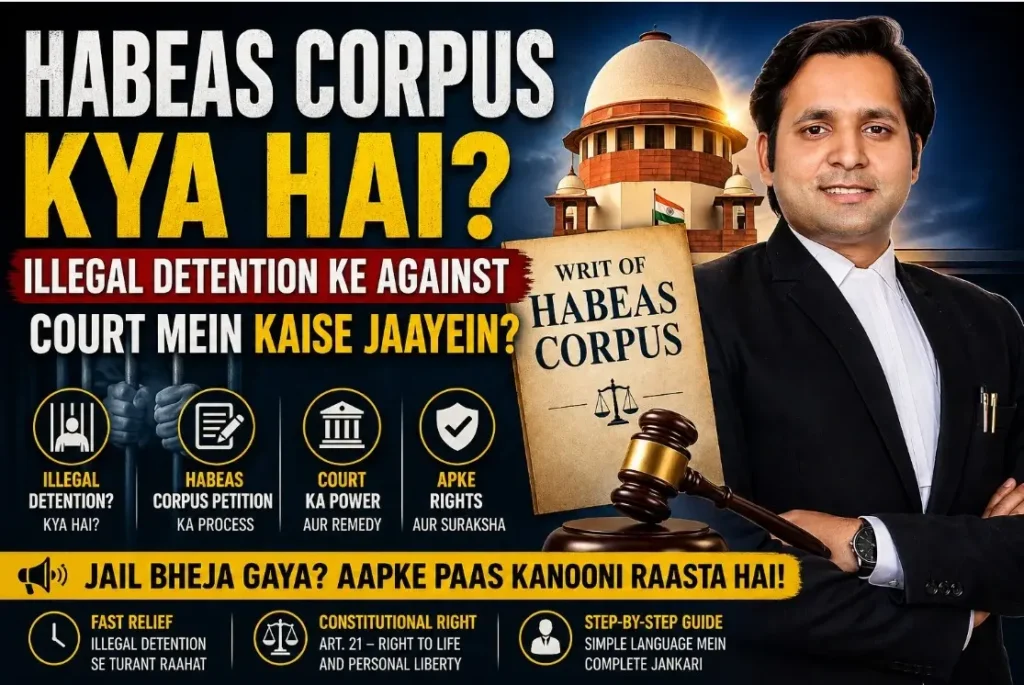
Habeas corpus — Latin mein meaning hai “you may have the body” — India ka sabse powerful constitutional remedy hai kisi bhi illegal detention ke against. Article 226 ke under High Court ya Article 32 ke under Supreme Court mein petition file karke same day hearing possible hai. Court detaining authority ko order deti hai — “produce the body” — yaani detained person ko court ke saamne hazir karo aur apna detention justify karo. Agar justify nahi kar sakte — turant release order.
Main ek practicing advocate hoon aur Gurugram courts mein criminal aur constitutional matters regularly handle karta hoon. Habeas corpus ek aisi remedy hai jo sirf advocates nahi — har naagrik ko jaanni chahiye. Kyunki jab koi illegal detention hoti hai, waqt bahut kam hota hai aur sahi action lena zaroori hota hai.
Is complete evergreen guide mein main aapko bataunga — habeas corpus kya hai, kab file karte hain, kaun file kar sakta hai, kahan file karte hain, petition format kya hota hai, compensation kab milta hai, aur landmark cases jo is remedy ko define karte hain.
Quick Answer: Habeas corpus ek constitutional writ hai jiske through illegal detention ko challenge kiya jaata hai. Article 226 ke under High Court mein ya Article 32 ke under Supreme Court mein petition file karo. Koi bhi file kar sakta hai — detained person khud, family, friend, ya NGO. Court urgent hearing karta hai — same day ya next day. Detention unlawful payi jaaye toh court turant release order deta hai. Compensation bhi award hota hai — Rudal Shah precedent ke under. Private detention (ghar pe bandhi, domestic confinement) ke against bhi Article 226 ke under habeas corpus file ho sakti hai.
Also Read :- Bina Vasiyat Maut Ho Jaye Toh Property Kaise Bategi? Hindu Succession Act Ka Jaal
Habeas Corpus Ka Meaning Aur History
“Habeas Corpus” Latin phrase hai — “habeas” meaning “you may have” aur “corpus” meaning “the body.” Poora phrase: “You may have the body (in court).”
Yeh writ English common law se aayi hai — 13th century England mein Magna Carta (1215) ke time se. Idea simple tha — koi bhi authority kisi insaan ko bina legal justification ke indefinitely nahi rok sakti. Court ko prove karna padega detention lawful hai.
India mein habeas corpus ko Constitution mein directly include kiya gaya — founding fathers ne ise fundamental rights ki protection ke liye essential maana. Dr. B.R. Ambedkar ne Article 32 ko “heart and soul of the Constitution” kaha tha — aur habeas corpus usi ka sabse powerful expression hai.
Habeas Corpus Ka Core Principle
Ek statement mein — “No person shall be deprived of liberty without due process of law.”
Article 21 ke under Right to Life and Personal Liberty guaranteed hai. Habeas corpus Article 21 ki enforcement mechanism hai — jab state ya koi private party bina law ke kisi ki liberty chheen le, habeas corpus judicial sword hai jo woh chains kaat deta hai.
Article 226 Vs Article 32 — Kahan File Karein
Habeas corpus do articles ke under file ho sakti hai — dono mein key differences hain:
Article 226 — High Court
Scope: Fundamental rights violations + any other legal rights
Key features:
- Territorial jurisdiction — sirf apne jurisdiction mein detention ke liye
- Broader scope — fundamental rights ke alawa aur legal rights bhi
- Private detention bhi cover karta hai — police hi nahi, koi bhi private party
- Faster — local High Court, immediate access
- Preferred route zyaadatar cases mein — practical aur fast
File karo: Apne state ki High Court mein — jahan detention ho rahi hai
Article 32 — Supreme Court
Scope: Sirf fundamental rights enforcement
Key features:
- Pan-India jurisdiction — koi bhi detention ke against
- Article 21 ka direct enforcement — personal liberty fundamental right
- Zyaadatar tab jab High Court se relief nahi mila ya matter national importance ka hai
- Dr. Ambedkar ne Article 32 ko constitution ka “heart and soul” kaha tha
File karo: Supreme Court of India, New Delhi
Practical Recommendation
Pehle Article 226 (High Court) — faster, local, broader jurisdiction.
Article 32 (Supreme Court) — agar:
- High Court ne relief deny kiya
- High Court ne unreasonably delay ki
- Matter involves national importance
- Multi-state detention
Advocate’s Note: Habeas corpus Division Bench ke saamne sunni jaati hai — 2 judges. Urgency mention karo petition mein — “urgent hearing requested as liberty is at stake.” Courts habeas corpus ko priority dete hain — same day listing usually possible hai genuine cases mein. Isliye agar aapko koi illegal detention ki khabar mili hai — advocate se turant milein, delay mat karein.
<!– Image Suggestion: Article 226 vs Article 32 comparison table infographic –> <!– Alt Text: habeas corpus Article 226 High Court Article 32 Supreme Court difference India filing –>
Habeas Corpus Kab File Karein — 8 Situations
Habeas corpus sirf police ke khilaaf nahi — yeh bahut broader remedy hai. Yeh 8 situations mein file hoti hai:
1. Illegal Police Arrest — Bina Warrant, Bina Grounds
Police ne bina warrant arrest kiya, grounds nahi bataye, ya cognizable offence nahi tha phir bhi arrest kiya. Habeas corpus turant file karo — court police ko production ka order deta hai.
2. 24-Hour Magistrate Rule Violation
BNSS Section 58 + Article 22(2) ke under — 24 ghante ke andar magistrate ke saamne pesh karna mandatory. Agar police yeh nahi kar rahi — habeas corpus file karo. Court immediate production order deta hai.
3. Detention Beyond Authorized Period
Bail mill gayi lekin police chhod nahi rahi. Ya remand expired ho gaya aur phir bhi custody mein. Ya sentence poori ho gayi lekin jail mein rakh ke baitha hai. Yeh habeas corpus ke classic grounds hain.
4. Preventive Detention — Grounds Nahi Bataye
NSA (National Security Act), UAPA, State preventive detention laws ke under detention — agar grounds communicate nahi kiye, advisory board se confirm nahi karwaya, ya period exceed ho gaya — habeas corpus file hoti hai.
5. Missing Person — Whereabouts Unknown
Family ko pata nahi hai detained person kahan hai — police acknowledge nahi kar rahi. Habeas corpus se court police ko order karta hai — “produce the person ya information do.”
6. Private Detention — Ghar Pe Band
Ye bahut important point hai — habeas corpus sirf state ke against nahi. Article 226 ke under private parties ke khilaaf bhi file ho sakti hai:
- Husband ne wife ko ghar mein band kar rakha hai
- Parents ne adult daughter ko ghar se nahi nikalne de rahe (forced confinement)
- Employer ne worker ko illegally rok rakha hai
- Cult ya religious group ne member ko control mein rakha hai
7. Mental Health Facility — Illegal Confinement
Kisi ko bina proper psychiatric procedure ke mental hospital mein forced admit kiya gaya. Ya period exceed ho gaya. Habeas corpus ke through release order possible hai.
8. Child Custody — Illegal Confinement By One Parent
Ek parent ne dusre parent ko child milne se illegally rok rakha. Ya guardian ne ward ko illegally confined kiya. Habeas corpus Article 226 ke under — child ko court ke saamne produce karo.
Kaun File Kar Sakta Hai — Liberal Locus Standi
Habeas corpus ki ek unique characteristic hai — liberal locus standi. Matlab koi bhi file kar sakta hai — detained person ka hona zarooori nahi:
- Detained person khud — agar access ho court ka
- Family members — parents, spouse, children, siblings
- Friends — close friend on behalf
- Advocate — detained person ke instructions pe
- NGO ya organization — public interest mein
- Any public-spirited person — agar detained person vulnerable hai (child, disabled, mentally ill)
- Journalist — Sheela Barse case mein journalist ne filed ki thi
Iska practical significance: Jab koi police custody mein hai, woh khud court nahi ja sakta. Family ya friend court jaake habeas corpus file kar sakte hain — detained person ke liye. Yeh bahut powerful feature hai.
Habeas Corpus Petition Format — Complete Template
High Court mein Article 226 ke under petition:
IN THE HON'BLE HIGH COURT OF [STATE NAME]
AT [CITY NAME]

WRIT PETITION (CRIMINAL) NO. _____ OF ______

IN THE MATTER OF:

[Petitioner ka naam, age, address]                    ... PETITIONER

VERSUS

1. State of [State Name], through [DGP/Commissioner]
2. Station House Officer, [Police Station Name, Address]
3. [Any other respondent]                             ... RESPONDENTS

WRIT PETITION UNDER ARTICLE 226 OF THE CONSTITUTION
OF INDIA FOR ISSUANCE OF WRIT OF HABEAS CORPUS

MOST RESPECTFULLY SHOWETH:

1. That the Petitioner is [relationship] of the detenu,
   Mr./Ms. [Detenu ka naam], aged [age] years,
   resident of [address].

2. That on [date], at approximately [time], the detenu was
   picked up/arrested by Respondent No. 2 from [location]
   without any warrant and without disclosing any grounds.

3. That since [date], the detenu has been kept in unlawful
   custody without being produced before any Magistrate
   within 24 hours as mandated by Article 22(2) of the
   Constitution and Section 58 of BNSS.

4. That the family has made efforts to locate the detenu:
   (a) Police Station [name] visited on [date] — denied knowledge
   (b) Phone calls made to [number] — no response
   (c) [Other attempts]

5. That the detention is illegal, arbitrary, and in violation
   of Article 21 and Article 22 of the Constitution of India.

GROUNDS:

(i)  The detention is without any legal authority or warrant.
(ii) No grounds of arrest have been communicated — violation
     of Article 22(1) and Section 47 BNSS.
(iii) The detenu has not been produced before a Magistrate
      within 24 hours — violation of Article 22(2).
(iv) The detention violates the fundamental right to personal
     liberty guaranteed under Article 21.
(v)  The DK Basu guidelines have been violated — no arrest
     memo, no family information, no visible identification.

PRAYER:

In view of the above, it is most respectfully prayed that
this Hon'ble Court may be pleased to:

(a) Issue a Writ of Habeas Corpus commanding Respondents
    to produce the detenu before this Hon'ble Court;

(b) Pass an order for the immediate release of the detenu
    from illegal detention;

(c) Award compensation for the illegal detention;

(d) Pass any other order deemed fit in the facts and
    circumstances of the case.

URGENT HEARING IS REQUESTED AS LIBERTY IS AT STAKE.

Place: [City]
Date: [Date]

[Petitioner's Signature]

Through Advocate:
[Advocate Name, Enrollment No., Address, Phone]
Step-By-Step Filing Process
Step 1: Advocate Se Turant Milein
Habeas corpus ek constitutional law matter hai — specialized advocate chahiye. Criminal law ya constitutional law mein experienced advocate dhundho. Emergency mein High Court ke duty advocate bhi available hote hain.
Documents jo saath leke jaao:
- Arrested person ki ID proof copy
- Arrest ki khabar kab kaise mili — timeline
- Police station ke naam/number jo malum hain
- Any communication with police (messages, call records)
- Witnesses jo arrest ke samay the
Step 2: Petition Draft Karo
Upar diya template use karo — facts clearly aur chronologically likho. Key points:
- Detention ki date, time, location
- Grounds nahi bataye — specifically mention
- 24-hour rule violation — if applicable
- Family ke attempts to locate — documented
- Article 21, 22 violations clearly grounds mein
Step 3: High Court Mein File Karo
- Criminal side registry mein jaao
- “Urgent Mention” karo — liberty case hai
- Nominal court fees (usually Rs 200-500)
- Division Bench ke saamne urgent listing request karo
- Same day listing possible hai genuine cases mein
Step 4: Court Hearing
Court hearing mein:
- Notice issue hoti hai respondents ko
- “Rule Nisi” — court reasons maangta hai detention ke
- Respondents (police/authority) ko “show cause” karna hota hai
- Agar urgent hai — same day interim order possible hai
Step 5: Production Order Ya Release Order
Agar court prima facie illegal detention paata hai:
- Production order — “Produce detenu in court within X hours”
- Agar police produce nahi karti — contempt of court
- Hearing pe agar detention unlawful prove hoti hai — turant release order
- Compensation prayer bhi allow ho sakti hai
<!– Image Suggestion: Habeas corpus filing flowchart — advocate to court to release order –> <!– Alt Text: habeas corpus petition filing process India High Court Article 226 release order steps –>
Compensation — Illegal Detention Pe Paisa Milta Hai
Yeh bahut log nahi jaante — habeas corpus sirf release nahi, compensation bhi dilwa sakti hai.
Rudal Shah v. State of Bihar (1983) — Landmark Judgment
Rudal Shah ko 1953 mein acquit kiya gaya tha — lekin Bihar government ne 1982 tak (14 saal!) jail mein rakha unlawfully. Supreme Court ne habeas corpus petition pe:
- Turant release order diya
- Rs 35,000 compensation state se award kiya
- Established principle: Illegal detention = monetary compensation
Yeh pehli baar tha ki court ne constitutional remedy mein monetary compensation award ki. Ab yeh settled law hai.
Compensation Ke Grounds:
- Wrongful arrest — bina legal grounds
- Detention beyond authorized period
- 24-hour rule violation
- DK Basu guidelines violation
- Custodial torture during detention
- Denial of medical treatment in custody
Compensation Amount:
Koi fixed amount nahi hai — court facts ke hisaab se decide karta hai:
- Duration of illegal detention
- Circumstances — torture, poor conditions
- Loss of livelihood
- Mental trauma
- Social reputation damage
Typical range: Rs 50,000 — Rs 5 lakh (state ke against). Exceptional cases mein zyada bhi.
State Ultimately Pays
Compensation state government pay karti hai — even agar individual officer ne galat kiya. Phir state officer se recover kar sakta hai departmental proceedings mein.
7 Landmark Habeas Corpus Cases — Indian Legal History
| Case | Court | Key Ruling |
|---|---|---|
| Kanu Sanyal v. District Magistrate (1973) | SC | Physical production of body not mandatory — court can examine legality directly |
| ADM Jabalpur v. Shivkant Shukla (1976) | SC | Emergency pe HC ne HC pe habeas corpus banned kiya — controversial, overruled |
| Sunil Batra v. Delhi Administration (1978) | SC | Habeas corpus extends to prison conditions — torture, solitary confinement challenge |
| Sheela Barse v. State of Maharashtra (1983) | SC | Journalist ki petition valid — liberal locus standi confirmed |
| Rudal Shah v. State of Bihar (1983) | SC | Compensation award in habeas corpus — landmark precedent |
| D.K. Basu v. State of West Bengal (1997) | SC | 11 mandatory arrest guidelines — habeas corpus complement |
| 44th Amendment (1978) | Parliament | Article 21 cannot be suspended even during Emergency — ADM Jabalpur overruled |
ADM Jabalpur Case — India Ka Darkest Judicial Moment
Emergency (1975-77) ke dauran, government ne fundamental rights suspend kiye. ADM Jabalpur case mein Supreme Court (4-1 majority) ne kaha ki Emergency mein habeas corpus nahi milti — Article 21 enforced nahi ho sakta.
Sirf Justice H.R. Khanna ne dissent kiya — yeh keh ke ki habeas corpus kabhi nahi ruk sakti. Unhe uske baad Chief Justice nahi banaya gaya.
44th Constitutional Amendment (1978) ne restore kiya — Article 21 aur habeas corpus Emergency mein bhi suspend nahi ho sakte. ADM Jabalpur practically overruled.
Lesson: Habeas corpus democracy ki last line of defense hai. Jab judicial courage fail hoti hai — democracy fail hoti hai.
Habeas Corpus Vs Bail — Kya Difference Hai
Bahut log confuse hote hain — habeas corpus aur bail ek hi hain kya?
| Aspect | Habeas Corpus | Regular Bail |
|---|---|---|
| Nature | Constitutional writ | Statutory provision (BNSS) |
| Court | High Court / Supreme Court | Sessions Court ya Magistrate |
| Ground | Detention itself illegal | FIR/charge valid, but release pending trial |
| Speed | Same/next day hearing | Days to weeks |
| Outcome | Release + compensation | Release with conditions |
| Who can file | Anyone (family, friend, NGO) | Accused ya advocate |
| Validity of arrest | Challenges validity itself | Accepts arrest, seeks release |
Simple rule:
- FIR valid hai, arrest proper hai, trial pending — bail lo
- Arrest/detention itself illegal hai — habeas corpus file karo
Dono simultaneously file ho sakte hain — different grounds pe.
Habeas Corpus Ki Limitations
Habeas corpus powerful hai lekin kuch limitations hain:
1. Valid Court Order Se Detention Agar court ne khud order diya detention ka (judicial custody, remand) — habeas corpus generally nahi chalti. Woh order ko challenge karna hoga different route se.
2. Preventive Detention — Tougher But Possible NSA, UAPA ke under detention mein habeas corpus file hoti hai — lekin courts more deferential hote hain national security matters mein. Ground hona chahiye — grounds communicate nahi kiye, advisory board procedure follow nahi hua.
3. Foreign Nationals Article 21 Indian citizens aur foreign nationals dono ko protect karta hai. Lekin enemy aliens pe limited.
4. Already Released Agar detained person release ho gaya — habeas corpus infructuous ho jaati hai (compensation claim alag rahti hai).
5. Territorial Jurisdiction High Court sirf apne territory mein hue detentions pe habeas corpus issue kar sakta hai.
Real Case Study — Gurugram Habeas Corpus Petition, Rs 2 Lakh Compensation
Background: Mr. Deepak (age 31), small trader, Gurugram. Neighbour dispute mein kisi ne call kiya police ko — false complaint. Police ne November mein subah Deepak ko “thane aao” bola — phir 38 ghante tak raka. Family ko bataaya nahi. Magistrate ke saamne pesh nahi kiya. Advocate se milne nahi diya.
Action on Day 2 (38 hours):
Family ne advocate engage kiya.
Violations documented clearly:
- Arrest without warrant (cognizable offence ka bhi koi mention nahi)
- Grounds nahi bataye — Article 22(1) + BNSS Section 47 violation
- Family inform nahi ki — BNSS Section 48 + DK Basu Guideline 3 violation
- 24-hour magistrate production nahi — Article 22(2) + BNSS Section 58 violation
- Lawyer se nahi milne diya — Article 22(1) violation
- Arrest memo nahi banaya — DK Basu Guideline 2 violation
Habeas Corpus Petition Filed:
Punjab & Haryana High Court mein Article 226 ke under — same day urgent mention.
Same day afternoon: Division Bench ne petition listed ki. SHO ko turant notice.
Next morning: SHO court mein hazir — “Deepak investigation mein sahayata kar raha tha, arrest nahi tha.”
Court’s response: “38 ghante bina warrant, bina magistrate production, bina family information — yeh investigation nahi, illegal detention hai.”
Order:
- Deepak ko turant release — usi din
- SHO ko cause show notice — contempt inquiry
- State of Haryana ko compensation Rs 2 lakh pay karne ka order
- District SP ko 15 din mein compliance report deni thi
Follow-up:
- Compensation Rs 2 lakh paid
- SHO ko departmental inquiry — adverse entry
- 2 constables — show cause notice
Total time from petition filing to release: 26 hours.
Deepak ka account: “38 ghante mein jo hua woh duniya ka worst experience tha. Lekin court ne 26 ghante mein sunwai ki aur release kara diya. Habeas corpus real kaam karti hai.”
Lesson: Habeas corpus fastest constitutional remedy hai. 38 ghante ki illegal detention pe 26 ghante mein release + Rs 2 lakh compensation.
10 Important Points — Habeas Corpus Ke Baare Mein
- Same day hearing possible hai — urgency clearly mention karo
- Koi bhi file kar sakta hai — family, friend, NGO — liberal locus standi
- Private detention bhi cover hoti hai Article 226 ke under — sirf police ke khilaaf nahi
- Compensation milti hai — Rudal Shah precedent — Rs 50K-5 lakh range
- Division Bench sunti hai — 2 judges
- Court fees nominal — Rs 200-500 typically
- Emergency mein bhi suspend nahi hoti — 44th Amendment ke baad
- Bail se alag hai — validity of arrest challenge karta hai, sirf release nahi
- Production mandatory nahi — court directly legality examine kar sakta hai (Kanu Sanyal)
- State pay karta hai compensation — individual officer nahi
FAQ — Habeas Corpus Ke Common Questions
Q: Habeas corpus file karne mein kitna kharcha aata hai? A: Court fees nominal hain — High Court mein typically Rs 200-500. Advocate fee alag hoti hai — emergency habeas corpus ke liye Rs 5,000 se Rs 50,000+ depending on advocate aur complexity. Lekin yeh emergency remedy hai — jab kisi ki liberty jaaye tab cost concern secondary hai.
Q: Kya habeas corpus khud file kar sakte hain bina advocate ke? A: Technically possible hai — Supreme Court ne kaha hai ki even handwritten informal applications accept ho sakti hain genuine emergency mein. Lekin practically advocate ke through filing zyada effective hai — proper format, urgent mention, correct grounds pleading. Emergency mein High Court ka duty advocate bhi available hota hai.
Q: Habeas corpus aur anticipatory bail mein kya choose karein? A: Different situations ke liye different remedy. Agar arrest hone wala hai — anticipatory bail. Agar arrest ho gayi lekin FIR valid hai — regular bail. Agar arrest/detention itself illegal hai — habeas corpus. Dono simultaneously file ho sakte hain — bail regular ground pe, habeas corpus illegal detention ground pe.
Q: Kya family member ki taraf se habeas corpus file ho sakti hai? A: Haan — yeh habeas corpus ki special feature hai. Liberal locus standi ke under family, friend, advocate, ya koi bhi public-spirited person detained person ki taraf se file kar sakta hai. Detained person khud court aane ki position mein nahi hota — isliye yeh provision hai.
Q: Agar High Court habeas corpus dismiss kar de toh kya karein? A: Supreme Court mein Article 32 ke under petition file karo. Ya Special Leave Petition (SLP) High Court ke order ke against. Ya facts change hue hain toh fresh petition — res judicata strict apply nahi hoti habeas corpus mein.
Q: Private party ke against habeas corpus kab kaam karti hai? A: Article 226 ke under — private party ke against bhi habeas corpus hoti hai jab personal liberty illegally curtailed ho. Example: Ghar mein forced confinement, forced marriage mein band karna, employer ka illegal detention. Article 32 sirf state action ke against — private parties ke liye Article 226 use karo.
Q: Habeas corpus mein court ka order kab tak aata hai? A: Urgency clearly state karo — “liberty at stake” petition mein. Same day listing possible hai. Interim order (production order) same day ya next day aa sakta hai. Final order kuch hearings mein — typically 2-6 weeks. Compensation ka final determination zyada time le sakti hai.
Q: Kya habeas corpus sirf illegal arrest ke liye hai ya aur bhi? A: Habeas corpus bahut broad hai — illegal arrest ke alawa: detention beyond period, prison conditions (torture, solitary confinement — Sunil Batra case), missing persons ka pata lagana, private confinement, mental hospital illegal admission, child custody illegal confinement, aur preventive detention grounds challenge. Yeh personal liberty ki comprehensive protection hai.
Habeas Corpus — Democracy Ki Last Line Of Defense
Habeas corpus sirf ek legal remedy nahi — yeh democracy ka safeguard hai. Jab state apni power ka galat istemal kare aur kisi insaan ki liberty chheen le — habeas corpus woh judicial sword hai jo court ke through woh chains kaat deta hai.
Justice H.R. Khanna ne Emergency ke worst waqt mein akele dissent kiya tha — “Habeas corpus is the bulwark of individual liberty against the executive high-handedness.” Unhe uski keemat chukani padi — Chief Justice nahi bane. Lekin history ne unhe sahi saabit kiya.
Yaad rakhein:
- Habeas corpus India ka sabse powerful constitutional remedy hai illegal detention ke against
- Article 226 (High Court) — private + state detention, broader scope — preferred route
- Article 32 (Supreme Court) — fundamental rights enforcement
- Koi bhi file kar sakta hai — family, friend, NGO — liberal locus standi
- Same day hearing possible — urgency clearly mention karo
- Private detention bhi cover — ghar mein band, forced confinement
- Compensation milti hai — Rudal Shah precedent — state pays
- Bail se alag — detention ki validity challenge karta hai
- Emergency mein bhi suspend nahi hoti — 44th Amendment ke baad Article 21 protected
- Advocate se turant milein — waqt bahut precious hota hai illegal detention mein
DuoCounsel ke podcast pe humne habeas corpus, constitutional remedies aur fundamental rights pe detailed episodes kiye hain — landmark cases, real examples, aur practical guidance ke saath. Zaroor sunein. Agar aapke family member ya kisi aur ke saath illegal detention ho rahi hai ya koi missing hai, turant comment mein likhein — waqt matter karta hai in cases mein.
===== AUTHOR SECTION =====
Is Article Ke Baare Mein
Yeh article DuoCounsel ke dono practicing advocates ne apne Gurugram courts ke constitutional aur criminal law experience ke aadhar pe likha hai. Habeas corpus petitions — illegal arrests, 24-hour rule violations, custody matters — Adv. Yogesh Solanki aur Adv. Barkha Jain dono Punjab & Haryana High Court mein handle karte hain.
👨⚖️ Adv. Yogesh Solanki
Co-Founder, DuoCounsel | Punjab & Haryana Bar Council
Adv. Yogesh Solanki DuoCounsel ke Co-Founder aur Punjab & Haryana Bar Council se enrolled practicing advocate hain. Gurugram District Courts aur Punjab & Haryana High Court mein active practice — RERA disputes, consumer cases, civil litigation, property disputes, criminal matters aur constitutional remedies mein specialization.
Habeas corpus petitions, illegal arrest challenges, BNSS rights enforcement — Yogesh ka Punjab & Haryana High Court mein direct experience hai. Arrest rights, DK Basu guidelines violations, aur Section 498A false cases mein bhi extensive practice. DuoCounsel podcast ke through woh legal awareness Hinglish mein aam log tak pahunchate hain.
Specialization: RERA | Criminal Law | Civil Litigation | Property Disputes | Constitutional Remedies | Habeas Corpus | MACT Claims
📍 Practice: Gurugram District Courts | Punjab & Haryana High Court
👩⚖️ Adv. Barkha Jain
Co-Founder, DuoCounsel | Punjab & Haryana Bar Council
Adv. Barkha Jain DuoCounsel ki Co-Founder aur Punjab & Haryana Bar Council se enrolled practicing advocate hain. Corporate law, business compliance, commercial disputes aur matrimonial law mein deep expertise.
Constitutional matters — domestic violence cases mein habeas corpus (Article 226 private detention), forced confinement challenges, matrimonial detention disputes — Barkha ka High Court mein hands-on experience hai. Company registration, GST, income tax notices, aur commercial disputes mein bhi comprehensive corporate legal support. DuoCounsel podcast mein complex legal matters simple Hinglish mein explain karti hain.
Specialization: Corporate Law | Business Compliance | GST | Income Tax | Commercial Disputes | Matrimonial Law | Constitutional Remedies
📍 Practice: Gurugram District Courts | Punjab & Haryana High Court
⚠️ Disclaimer: Yeh article sirf legal awareness aur educational purpose ke liye hai. Har case ki facts alag hoti hain — specific situations mein professional legal advice ke liye qualified advocate se personally consult zaroor karein. Emergency illegal detention cases mein delay mat karein — turant advocate se milein.
🎙️ DuoCounsel Podcast sunein — legal awareness Hinglish mein | duocounsel.com/podcast