
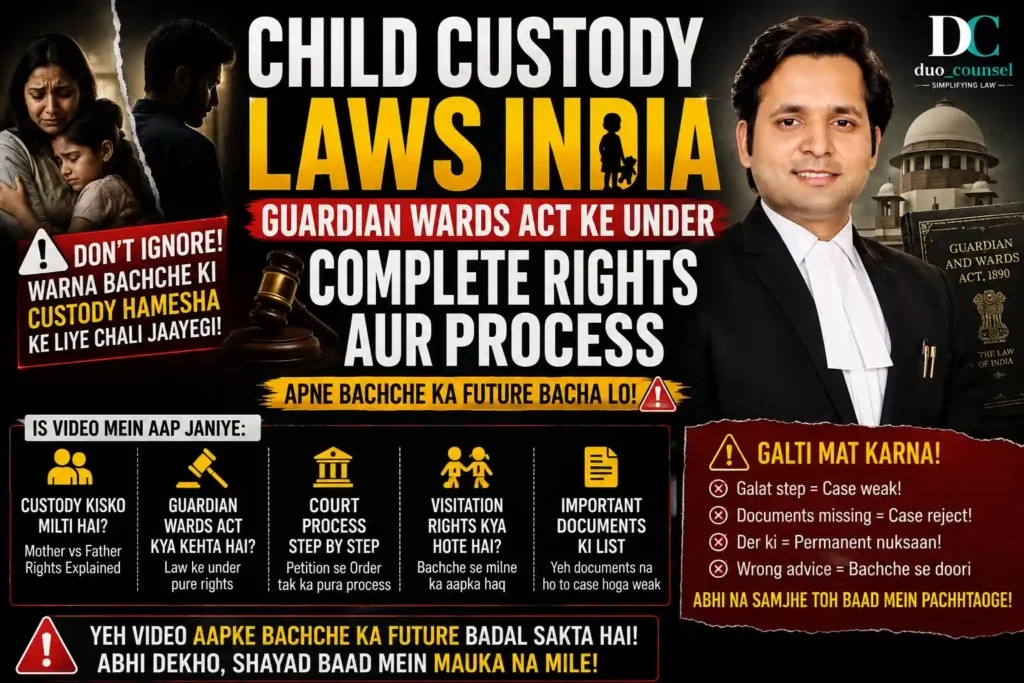
Divorce ke sabse dil-dhadkane wale sawaal mein se ek hai — “Hamare bachche ke saath kya hoga?”
Do log jo kabhi ek dusre se mohabbat karte the — ab court mein ek doosre ke saamne khade hain. Lekin dono ke beech mein ek innocent child hai jis pe yeh faisla sabse zyada asar daalegaa. Child custody laws India mein is situation ko bahut carefully handle karti hain — kyunki law ka primary focus parents ki feelings nahi, bachche ka bhala hai.
Main ek practicing advocate hoon aur Gurugram Family Courts mein child custody laws India ke under regularly cases handle karta hoon. Main dekha hoon ki dono parties — father aur mother — itnaa zyada apni position pe focused hote hain ki woh bhool jaate hain ki court unke baare mein nahi sooch rahi — court bachche ke baare mein sooch rahi hai. Jo parent yeh sach samajh le, woh case mein behtar position mein hota hai.
Is complete evergreen guide mein main cover karunga — child custody laws India ka complete framework (Guardian and Wards Act 1890 + Hindu Minority Act 1956), custody ke types, welfare of child ke 10 factors, tender years doctrine, 12+ saal bachche ki preference, father vs mother realistic rights, joint custody kaise kaam karta hai, interim custody, court process step-by-step, visitation rights, aur 8 landmark SC judgments.
Quick Answer: Child custody laws India mein ek paramount rule hai — “welfare of child.” GWA 1890 Section 17 aur Hindu Minority Act 1956 Section 13 ke under court bachche ke interest ko parents ke rights se upar rakhti hai. Physical custody (bachcha kiske saath rahega) aur legal custody (decisions kaun lega) alag hote hain. Under-5 mein mother presumption (tender years doctrine). 12+ saal mein bachche ki preference court seriously consider karti hai. Joint custody increasing trend hai. Family Court mein petition file karein — Section 7 GWA ya Section 26 HMA (agar divorce simultaneously chal raha ho). Interim custody order pehli hearing mein possible hai. child custody laws India
Also Read :- BNSS 2026: Bhartiya Nagarik Suraksha Sanhita Summons, e-FIR Aur Naye Niyam Ki Complete Guide
Child Custody Laws India Ka Legal Framework — Kaun Sa Kanoon Apply Hoga
Child custody laws India mein religion ke hisaab se alag laws apply hote hain — lekin ek overarching secular law bhi hai: child custody laws India
1. Guardian and Wards Act, 1890 (GWA) — Universal Law
Yeh sab religions pe apply hota hai. Section 7 ke under court guardian appoint kar sakti hai. Section 17 ke under court custody decide karti hai — welfare of child primary factor.
Agar parents alag religion ke hain, ya special circumstances hain — GWA 1890 primary applicable law hai.
2. Hindu Minority and Guardianship Act, 1956 (HMGA)
Hindu, Sikh, Jain, Buddhist families ke liye. Section 6 natural guardianship define karta hai. Section 13 — welfare of child paramount.
3. Hindu Marriage Act, 1955 — Section 26
Agar divorce case chal raha hai simultaneously — custody HMA Section 26 ke under decide ho sakti hai divorce proceedings mein hi.
4. Muslim Personal Law
Muslim families — Shariat ke under — mother ko hizanat (custody) ka right milta hai young children ke liye. Father natural guardian hai. Courts GWA bhi apply karte hain agar welfare demands it.
5. Indian Divorce Act, 1869 — Christians
Christian families ke custody matters — Indian Divorce Act + GWA.
Practical reality: Sab laws mein ek common thread hai — “welfare of child is the paramount consideration.” No court ignores this, regardless of which personal law applies.
Custody Ke Types — Kya Hota Hai Physical, Legal Aur Joint Custody
Child custody laws India mein custody ka ek dimension nahi hai — multiple types hain: child custody laws India child custody laws India
Physical Custody (Residential Custody)
Bachcha physically kiske saath rahega — daily life, school, meals, sleep.
- Sole Physical Custody: Bachcha ek parent ke saath rehta hai; doosra parent visiting rights pata hai
- Shared Physical Custody: Bachcha dono parents ke saath alternately rehta hai — week-on week-off ya split schedule
Legal Custody
Major life decisions kaun lega — school admission, medical treatment, religion, travel abroad.
- Sole Legal Custody: Ek parent decide karta hai — doosre ki consent nahi chahiye
- Joint Legal Custody: Dono parents milke decide karte hain — communication required child custody laws India
Joint Custody (Increasingly Common)
Dono parents ke saath time spend karta hai bachcha — different splits possible: child custody laws India
- 50-50: Equal time both parents
- 60-40: Primary + secondary parent with significant access child custody laws India
- Weekday-Weekend split: One parent weekdays, other weekends
Indian courts ka trend: Sole custody (typically mother) + visitation rights (father) — traditional approach. Lekin ab joint custody orders badh rahe hain — especially jab dono parents cooperative hain aur bachcha bada hai.
Interim/Temporary Custody
Divorce case pending hai — jab tak final order nahi aata, interim custody order milta hai. Yeh pehli hearing mein hi possible hai — GWA Section 12 + HMA Section 26.
Advocate’s Note: India mein child custody laws ke under physical custody aur legal custody ka distinction courts ab clearly karne lagi hain — especially educated urban families mein. Ek parent ke paas physical custody ho sakti hai aur dono ke paas joint legal custody — bachche school mein dono parents attend karte hain, medical decisions jointly — yeh arrangements increasingly court orders mein aa rahi hain. Agar aap joint legal custody chaahte hain, explicitly petition mein maango. child custody laws India
Welfare Of Child — 10 Factors Jo Court Consider Karti Hai
Child custody laws India mein “welfare of child” ek vague concept nahi hai. GWA 1890 Section 17 aur Supreme Court judgments ne specific factors identify kiye hain:
Factor 1: Age Aur Sex Of Child
Young children (under 5) — mother presumption (tender years doctrine). Older children — age-appropriate considerations. Girls ke liye kuch courts mother prefer karti hain.
Factor 2: Parent Ki Ability To Provide
Financial stability, housing, time available for child — court realistic assessment karti hai. “Ameer parent” automatically win nahi karta — involvement zyada important hai.
Factor 3: Emotional Bond child custody laws India
Bachche ka kiske saath zyada attachment hai — behavior, reactions, primary caregiver history. Child psychologist report bhi possible hai.
Factor 4: Continuity Aur Stability
Bachche ki current living arrangement — usse disrupt karna harmful hai. Current school, friends, neighborhood — stability important hai. Courts existing arrangements prefer karte hain agar woh working hain.
Factor 5: Parent Ki Mental/Physical Health
Koi serious mental illness? Substance abuse? Physical disability jo childcare affect kare? Courts medical reports maang sakti hain.
Factor 6: Sibling Relationship
Siblings ko alag karna harmful hota hai — courts siblings ko saath rakhne ki preference deti hain. Split custody (ek sibling ek parent ke saath, doosra doosre ke saath) — courts avoid karti hain generally. child custody laws India
Factor 7: Child Ka Preference (12+ Saal)
GWA Section 17(3): “If the minor is old enough to form an intelligent preference, the court may consider that preference.”
Supreme Court — Smriti Madan Kansagra v. Perry Kansagra — child’s preference is vital but not determinative. Courts judge ke chamber mein bachche se privately baat karte hain — parents present nahi hote.
Practical reality: 12+ saal ke bachche ki strong preference courts usually respect karti hain. 9-12 saal — consider karte hain lekin determinative nahi. Under 9 — preference note karte hain but weight less.
Factor 8: Parent Ka Conduct
Domestic violence history, criminal record, immoral conduct — court negatively consider karti hai. Social media posts, WhatsApp chats, police records — sab evidence mein aa sakte hain. child custody laws India child custody laws India
Factor 9: Willingness To Foster Relationship With Other Parent
Jo parent actively doosre parent ka relationship bachche ke saath undermine kare — “parental alienation” — courts is behavior ko seriously negatively consider karti hain. Jo parent dusre parent ko access dene mein cooperative ho — positive factor.
Factor 10: Religious Upbringing
Particularly relevant jab parents alag religions ke hain. Courts child ki existing religious upbringing ko disrupt nahi karna chahti usually.
<!– Image Suggestion: 10 welfare factors infographic — child custody courts India consider karte hain –> <!– Alt Text: child custody laws India welfare of child factors court Guardian Wards Act Section 17 –>
Tender Years Doctrine — Under 5 Ka Special Rule
Child custody laws India mein under-5 bachcho ke liye ek established doctrine hai:
Tender Years Doctrine: Young children — especially under 5 — ki custody generally mother ko milti hai. Biological presumption ki chhoti umar mein mother ki proximity aur care essential hai.
Legal Basis
- HMGA Section 6 — “Until the minor reaches five years, the mother shall be his/her guardian”
- GWA Section 17 — court welfare factors mein age prominent consideration
- Multiple SC judgments — tender years mein mother presumption
Yeh Absolute Nahi Hai
Agar mother:
- Mentally ill hai
- Substance abuse hai
- Violent ya neglectful hai
- Kisi aur sahre pe completely dependent hai
- Bachche ko proper care dene mein capable nahi hai
Tab court father ya kisi aur guardian ko custody de sakti hai even for under-5. child custody laws India
Key point: Tender years doctrine “rebuttable presumption” hai — strong evidence se override ho sakti hai. But burden proof karne ki father pe hoti hai.
Father Vs Mother — Realistic Rights Analysis
Bahut fathers poochte hain — “Kya mujhe kabhi custody milegi?” Bahut mothers poochti hain — “Kya court automatically mujhe custody degi?” Dono questions ke realistic answers: child custody laws India
Mother Ka Position
Advantages:
- Tender years doctrine (under-5)
- Traditional primary caregiver role — courts familiar hain
- Emotional bond presumption younger children mein child custody laws India
Disadvantages:
- Agar working full-time aur bachche ke liye time kam hai
- Agar new relationship mein hai jo child ke liye disruptive ho
- Agar financially completely dependent (some courts consider)
- Agar conduct issues hain — violence, substance abuse child custody laws India
Father Ka Position
Traditional challenges:
- Tender years doctrine against hai for young children
- “Not the primary caregiver” assumption courts mein
- Working hours — availability concern
Father ko kaise strong position milti hai:
- Active involvement document karo — school pickup, doctor visits, activities
- Parental alienation avoid karo — mother ko reasonable access do
- Stable home environment dikhao — steady income, own house
- 12+ saal ke bachche ki preference — agar bachcha father prefer karta hai strongly, courts seriously lete hain
- Mother ke conduct issues — documented domestic violence against father, substance abuse, neglect
Realistic picture: Courts bias kisi ke against nahi rakhti officially — but ground reality mein younger children ki custody mothers ko zyada milti hai. Older children (12+) mein father equally strong position mein ho sakta hai agar involvement documented hai.
Joint Custody — Best Outcome Often
Child custody laws India mein increasingly courts joint custody orders pass kar rahi hain jab: child custody laws India
- Dono parents reasonable hain
- Communication possible hai
- Bachcha adequately older hai
- Geographic proximity hai (same city)
- Child ka interest best served hota hai dono parents ke saath time se
Court Process — Child Custody Case Kaise File Karein
Step 1: Family Court Identify Karo
Child custody laws India ke under Family Court Acts 1984 ke under designated Family Courts handle karte hain:
- Jahan bachcha ordinarily rehta hai
- Jahan parents last together rehte the
Step 2: Petition Draft Karo
Section 7 GWA ke under petition ya Section 26 HMA (agar divorce chal raha ho). child custody laws India
Petition mein:
- Parties ki details — parents + child
- Marriage details
- Separation timeline
- Current living arrangement
- Grounds ki aap better custodial parent kyun hain
- Welfare factors apke favour mein — explain karo
- Prayer — specific custody arrangement maango (physical, legal, joint)
- Interim custody prayer — urgent basis pe
Step 3: Interim Custody — Pehli Hearing Mein
GWA Section 12 + HMA Section 26 — court pending final order interim custody arrangement pass kar sakti hai. Yeh pehli ya doosri hearing mein ho sakta hai.
Interim custody application urgently file karo agar:
- Doosra parent child ko le jaane ki threat de raha hai
- Child currently unsafe environment mein hai
- Access completely deny ho raha hai
Step 4: Mediation Referral
Family Courts mandatory mediation refer karti hain — MCPC (Mediation and Conciliation Project Committee). Custody cases mein mediation bahut effective hai — 40-50% cases mein parents mutual agreement reach karte hain. child custody laws India
Mediated settlement benefits:
- Both parents ownership feel karte hain — compliance better
- Child ke liye less traumatic
- Customized arrangement possible
- Court time save
Step 5: Child’s Interview (Agar 7+ Hai)
Court in-camera interview kar sakti hai child ka — judge ke chamber mein, parents present nahi. Child freely baat kar sakta/sakti hai. Court yeh note karta hai — evidence mein use hota hai.
Step 6: Social Investigation Report (SIR)
Court probation officer ya social worker se Social Investigation Report maang sakti hai:
- Both parents ka home environment visit
- Child ke saath interaction observe karna
- School teacher, doctor, relatives se feedback
- Report court ko submit hoti hai
Step 7: Evidence Aur Arguments
- Documents — income proof, school records, medical records, photos
- Witnesses — grandparents, teachers, doctors
- Expert reports — child psychologist, social worker
- Electronic evidence — WhatsApp chats, emails, social media
Step 8: Final Custody Order
Court permanent custody order pass karti hai — physical custody, legal custody, visitation schedule sab specify hota hai. Order both parties pe binding hai.
<!– Image Suggestion: Child custody court process flowchart — petition to final order –> <!– Alt Text: child custody laws India court process petition interim custody mediation final order –>
Visitation Rights — Non-Custodial Parent Ka Haq
Custody ek parent ko milti hai — lekin doosre parent ka access/visitation right bhi important part hai child custody laws India ka. child custody laws India
Standard Visitation Schedule
Courts typically order:
- Weekends — alternate weekends (Friday evening to Sunday evening) child custody laws India
- Holidays — alternate between parents (Diwali, Holi, Christmas, Eid — rotate) child custody laws India
- Summer vacation — 2-4 weeks with non-custodial parent
- Special occasions — birthdays, school events — both parents attend
Supervised Visitation
Agar non-custodial parent ke conduct ke baare mein serious concerns hain:
- Visits supervised hote hain — relative ya court-appointed supervisor present
- Public place pe meeting — mall, park
- Video calls monitored kiye ja sakte hain
Denial Of Visitation — Contempt Of Court
Custodial parent agar court-ordered visitation deny kare bina valid reason — contempt of court. Court: child custody laws India
- Fine impose kar sakti hai
- Custody revise kar sakti hai
- Jail even (extreme cases)
Yeh bahut important hai: Agar aapko court-ordered access nahi mil raha — turant advocate se milein aur contempt petition file karein.
Joint Custody Kaise Kaam Karta Hai — Practical Guide
Child custody laws India mein joint custody increasingly common ho raha hai. Lekin successful joint custody ke liye kya chahiye:
Practical Requirements
- Geographic proximity — dono parents same city ya nearby area mein
- Communication — WhatsApp group, co-parenting apps, school coordinator
- Flexible schedules — both parents jobs accommodate kar sakein
- Older child — very young babies joint custody mein challenging
Common Joint Custody Arrangements
Week-on, Week-off: Monday to Sunday — ek week mother ke paas, ek week father ke paas. Clear, simple, predictable.
2-2-3 Schedule: Monday-Tuesday: Parent A. Wednesday-Thursday: Parent B. Friday-Sunday: Parent A. Next week reverse. Bachcha kabhi 3 din se zyada ek parent se door nahi rehta.
School week/Weekend Split: Weekdays — school continuity ke liye ek parent. Weekends — doosre parent ke saath quality time.
Co-Parenting Do’s
- School events mein dono attend karein — separately baithein agar need ho
- Medical decisions share karein — WhatsApp pe inform zaroor karein
- Bachche ke saamne ex-partner ki burai mat karein — “parental alienation” hai
- Pickup-dropoff smooth karein — grandparent ya neutral third party use karein agar face-to-face tense ho
Custody Modification — Kab Change Ho Sakti Hai
Child custody laws India mein custody order permanent nahi hoti — circumstances badlein toh modification possible hai.
Modification Ke Grounds
- Custodial parent ki situation dramatically badi — new marriage aur step-parent hostile, relocation to another city, substance abuse, criminal conviction
- Child ki preference change — older ho gaya, strongly dusra parent prefer karta hai
- Non-custodial parent ki situation improved — stable job, own house ab hai
- Current arrangement child ke welfare ke against — documented evidence
- Parental alienation — custodial parent actively relationship doosre parent se damage kar raha hai
Modification Process
- Same Family Court mein application
- “Change of circumstances” prove karna hoga — modification sirf tab hoti hai jab circumstances materially change hue ho
- Child ka current welfare assess hoga phir se
- SIR phir se ho sakta hai
Inter-Country Custody — Hague Convention Aur NRI Cases
Aajkal bahut NRI custody cases hain — bachche India mein ya abroad hain, ek parent USA/UK/Canada mein.
Hague Convention On International Child Abduction
India ne Hague Convention ratify nahi kiya hai yet — lekin Supreme Court ne its principles consider kiye hain.
Indian courts ka approach:
- If child is habitually resident in India — Indian courts decide
- If parent wrongfully removed child abroad — Indian courts can order return
- Foreign custody orders — Indian courts give “comity” (respect) but not automatic enforcement
NRI Custody Cases
- Indian parent can file in Indian courts — even if other parent is abroad
- Court can pass custody order — enforcement abroad is challenging
- Child abduction to India — left-behind parent in foreign country can approach SC directly
- SC has repatriated children in several cases — comity of courts principle
V. Ravi Chandran v. Union of India (SC 2010): SC ordered child’s repatriation to US — even though India not party to Hague Convention — comity principle.
8 Landmark Supreme Court Judgments — Child Custody Laws India
| Case | Court | Key Ruling |
|---|---|---|
| Rosy Jacob v. Jacob A Chakramakkal (1973) | SC | Welfare of child is paramount — not rights of parents. Object of GWA is protection of child’s health, maintenance, education |
| Gaurav Nagpal v. Sumedha Nagpal (2009) | SC | Child’s welfare is supreme — technicalities of law should not override; courts can mould orders creatively |
| Nil Ratan Kundu v. Abhijit Kundu (2008) | SC | 10-year-old’s preference considered seriously — child said wanted to stay with father — court respected it |
| Roxann Sharma v. Arun Sharma (2015) | SC | Tender years doctrine — mother’s claim is strong for young children, but rebutted by conduct issues |
| Smriti Madan Kansagra v. Perry Kansagra (2020) | SC | Child’s preference “vital” in determining custody — Section 17(3) GWA — child’s inclination carefully noted |
| Vikram Vir Vohra v. Shalini Bhalla | SC | 7-year-old child interviewed by judge — wishes taken into account — not determinative but relevant |
| K. M. Vinaya v. B. R. Srinivas (2022) | SC | Joint custody ordered — child to spend weekdays with mother, weekends with father — cooperative parenting model |
| V. Ravi Chandran v. Union of India (2010) | SC | Inter-country custody — comity of courts — child repatriated even without Hague Convention |
Real Case Study — Gurugram Joint Custody Order
Background: Rahul (age 38, IT engineer) aur Priya (age 35, teacher), Gurugram. Married 2017, daughter Aanya (age 6). Separation 2023. Both are working, stable incomes, no domestic violence history, no criminal records. Geographic proximity — both families Gurugram mein.
Priya ka petition: Section 26 HMA ke under divorce proceedings ke saath custody — Sole physical custody + reasonable visitation to Rahul.
Rahul ka counter-petition: Joint physical custody — 50-50.
Evidence presented:
Priya ki taraf se:
- Primary caregiver documentation — school pickups, doctor visits, teacher notes
- Aanya ke saath photos, activities
- Income stability proof
- Character witnesses — parents, colleagues
Rahul ki taraf se:
- Active father documentation — weekend activities, school events attended
- Income aur housing stability
- Own parents (dadi-dada) available for childcare support
- No history of violence ya misconduct
Court process:
- Interim custody: Priya ke saath — Rahul every weekend access
- Mediation referral — dono cooperative the, 3 sessions
- Social Investigation Report — both homes visited, both positive
- Aanya (age 6) — judge se brief in-camera chat — “I love both Mummy and Papa”
Mediation settlement (accepted by court):
- Physical custody: Primary — Priya (school days). Alternate weekends — Rahul (Friday evening to Monday morning school drop)
- Legal custody: Joint — major decisions jointly, WhatsApp group with school/doctor
- Holidays: Alternating — Rahul: Diwali odd years + Summer vacation 3 weeks. Priya: Holi + Winter vacation
- Birthdays: Both parents attend Aanya’s birthday — neutral venue
- Relocation: Neither parent can move to another city without 30-day notice to other parent + court permission
Court’s observation: “Both parents are committed, responsible, and clearly love the child. The arrangement ensures Aanya retains strong bonds with both parents. This is in her best interest.”
Timeline: Filing to final order — 8 months (including mediation).
Lesson: When both parents are reasonable and cooperative, child custody laws India facilitate creative joint arrangements that serve the child best. Contentious litigation only harms the child and costs both parties more.
7 Common Mistakes — Child Custody Cases Mein
Mistake 1: Bachche Ko “Weapon” Banana
Dono parent ki emotions high hoti hain. But bachche ko dusre parent ke against use karna — “Papa ne yeh bura kiya,” “Mama ko dono nahi chahiye” — parental alienation hai. Courts yeh behavior strongly negatively consider karti hain. May even result in custody transfer to other parent.
Mistake 2: Social Media Pe Vent Karna
Divorce aur custody proceedings ke dauraan social media pe partner ki burai — screenshots court mein evidence bante hain. Silent rehna social media pe — avoid karo.
Mistake 3: Access Deny Karna Court Order Ke Bina
Agar court-ordered visitation hai — usse deny karna contempt hai. Agar safety concern hai — turant advocate se milein, court order modify karwao. Unilaterally deny mat karo.
Mistake 4: Sirf “Jeetne” Pe Focus Karna
Parents jab “case jeetneka” pe focus karte hain — toh evidence game shuru hoti hai. Courts yeh feel karti hain — “yeh parent bachche ke baare mein nahi, ego ke baare mein soch raha hai.” Jo parent genuinely child ke welfare focus kare — woh better position mein hota hai.
Mistake 5: Relocation Bina Permission
Custody order ke baad doosre shahar ya country move karna — bina court permission — contempt aur custody loss ka ground hai. Relocation chahiye toh pehle advocate se milein, petition file karein.
Mistake 6: Income Hide Karna
Child support calculate karne ke liye income disclose hoti hai. Income hide karna — agar pata chale — credibility destroy karta hai court mein. Honest financial disclosure always better.
Mistake 7: Bachche Se Cases Discuss Karna
“Court mein aaj yeh hua,” “Papa ne yeh argue kiya,” “Mama jhoot bol rahi hai” — bachche ke saamne yeh sab mat karo. Damaging hota hai emotionally. Court bhi yeh behavior ko seriously lete hain.
FAQ — Child Custody Laws India Ke Common Questions
Q: Mother ya father — kisko automatically custody milti hai? A: Child custody laws India mein kisi ko “automatically” custody nahi milti. Court ka primary test hai — welfare of child. Under-5 mein tender years doctrine se mother ko presumption milti hai. 5-12 saal mein dono equally consider hote hain. 12+ mein bachche ki preference significant hoti hai. Kisi bhi umar mein conduct, stability, aur involvement decide karte hain.
Q: Kya court bachche se baat karti hai custody decide karne ke liye? A: Haan — GWA Section 17(3) ke under agar bachcha “intelligent preference” form kar sake, court consider karta hai. In-camera interview hoti hai — judge ke chamber mein, parents present nahi. SC ne Smriti Kansagra case mein kaha — child’s preference is “vital.” 12+ saal ke bachche ki preference courts usually respect karti hain. Under-9 mein preference note hoti hai lekin less determinative.
Q: Dono parents kaam karte hain — custody kaise decide hogi? A: Both working parents mein court dekhti hai — primary caregiver kaun raha hai (school pickups, doctor, activities), availability after work, support system (grandparents, daycare quality), flexibility. Zyada involvement document kiya hua ho — school notes, medical records, teacher statements — woh parent stronger position mein hota hai.
Q: Joint custody kaise file karein? A: Family Court mein petition mein explicitly joint custody pray karein — physical aur legal dono ke baare mein clearly specify. Mediation mein cooperative approach rakho. Court joint custody tab prefer karti hai jab dono parents reasonable hain, geographic proximity hai, aur child ka welfare best served hota hai. Advocate se joint custody petition specifically draft karwao.
Q: Custody order ke baad dusre city mein shift karna ho toh? A: Relocation ke liye court permission mandatory hai custody order ke baad. Petition file karein — “change of circumstances” show karein (new job, family medical emergency, etc.). Doosra parent ko notice. Court bachche ke welfare balance karti hai — relocation ka reason valid hai, aur doosre parent ke access maintain karne ka plan hai — tab court allow kar sakti hai.
Q: Agar doosra parent custody order violate kare — bachcha wapas nahi de raha — kya karein? A: Turant Family Court mein contempt petition file karein. Court can order immediate return of child. Extreme cases mein — police assistance bhi court order kar sakti hai. Agar parent doosre state gaya — habeas corpus petition High Court mein. Emergency mein advocate se immediately milein.
Q: Kya NRI parent Indian court mein custody petition file kar sakta hai? A: Haan — agar bachcha India mein rehta hai. Indian courts jurisdiction lete hain jahan bachcha “habitually resident” hai. NRI parent Power of Attorney de sakta hai India mein trusted person ko proceedings ke liye. Video conferencing se hearings mein participate bhi possible hai kuch courts mein. SC ne kai NRI custody cases handle kiye hain.
Q: Custody order mein change kaise kare — situation badal gayi? A: Same Family Court mein modification petition file karo. “Material change in circumstances” prove karna hoga. Court bachche ka current welfare phir se assess karegi. SIR phir ho sakti hai. Examples: Custodial parent moved abroad, substance abuse developed, new spouse hostile to child, child ki strong preference change hui, non-custodial parent ki situation improved. Advocate se specific grounds clearly identify karwao.
Bachche Ka Bhala — Sab Se Pehle
Divorce ek traumatic experience hai — dono parents ke liye, aur sabse zyada bachche ke liye. Child custody laws India ka pure design yeh ensure karne ke liye hai ki is trauma ko minimize kiya jaaye, aur bachche ke life mein dono parents ki positive presence bani rahe.
Ek practicing advocate ki taraf se genuine advice — bachche ko case ka center rakhein, ego ko nahi. Court ki woh observation jo mujhe most yaad hai ek Gurugram case mein: “These parents have forgotten that they are not fighting each other — they are fighting for their child. The child needs both of them.”
Yaad rakhein:
- Child custody laws India mein paramount rule — welfare of child, parents ke rights nahi
- Tender years doctrine — under-5 mein mother presumption, rebuttal possible
- 12+ saal — bachche ki preference courts seriously consider karti hain
- Physical custody (kahan rahega) aur legal custody (decisions) — dono alag hain
- Joint custody — increasing trend, dono cooperative parents ke liye best option
- Visitation rights — non-custodial parent ka legal right — deny karna contempt hai
- 10 welfare factors — conduct, stability, involvement, sibling bond, emotional attachment
- Parental alienation — biggest mistake, may result in custody transfer to other parent
- Interim custody — pehli hearing pe possible — turant petition karo urgent cases mein
- Mediation — custody cases mein best route — court se faster, less traumatic, more customized
===== AUTHOR SECTION =====
Is Article Ke Baare Mein
Yeh article DuoCounsel ke dono practicing advocates ne Gurugram Family Courts ke child custody aur matrimonial law experience ke aadhar pe likha hai.
Adv. Yogesh Solanki
Co-Founder, DuoCounsel | Punjab & Haryana Bar Council
Adv. Yogesh Solanki DuoCounsel ke Co-Founder aur Punjab & Haryana Bar Council se enrolled practicing advocate hain. Gurugram District Courts aur Punjab & Haryana High Court mein active practice — RERA disputes, consumer cases, civil litigation, property disputes aur criminal matters mein specialization. Solanki Engineers ke official legal retainer.
Child custody cases, divorce proceedings, interim custody applications — Yogesh ka Gurugram Family Court mein direct hands-on experience hai. Guardian and Wards Act petitions, HMA Section 26 custody, contempt petitions (visitation denial) — sab handle kiye hain. DuoCounsel podcast ke through legal awareness Hinglish mein pahunchate hain.
Specialization: Family Law | Child Custody | Property Disputes | RERA | Consumer Cases | Criminal Law
📍 Practice: Gurugram District Courts | Punjab & Haryana High Court
Adv. Barkha Jain
Co-Founder, DuoCounsel | Punjab & Haryana Bar Council
Adv. Barkha Jain DuoCounsel ki Co-Founder aur Punjab & Haryana Bar Council se enrolled practicing advocate hain. Corporate law, business compliance aur matrimonial law mein deep expertise.
Child custody — especially mothers’ rights, joint custody negotiations, mediation-based settlements, NRI custody matters — Barkha ka Gurugram Family Court mein extensive experience hai. Alimony, child support calculation, POSH Act, domestic violence cases mein bhi comprehensive guidance. DuoCounsel podcast mein legal matters simple Hinglish mein explain karti hain.
Specialization: Matrimonial Law | Child Custody | Alimony | Corporate Law | Business Compliance | GST | Income Tax
📍 Practice: Gurugram District Courts | Punjab & Haryana High Court
⚠️ Disclaimer: Yeh article sirf legal awareness aur educational purpose ke liye hai. Child custody cases highly fact-specific hote hain — specific situations mein professional legal advice ke liye qualified advocate se personally consult zaroor karein. Bachche ke bhale ke liye timely legal guidance critical hai.
🎙️ DuoCounsel Podcast sunein — legal awareness Hinglish mein | duocounsel.com/podcast