Ghar mein kisi ki maut ho gayi. Pehle 40 din shok mein guzar jaate hain. Phir ek din bank wala aa ke kehta hai — “Jab tak proper document nahi, account access nahi.” Builder kehta hai — “Property transfer ke liye legal documents chahiye.” Employer kehta hai — “Pension/gratuity ke liye heir certificate chahiye.” Income tax department notice bhejti hai — “Estate return file karo.” deceased ki property par claim
Aur aap sochte hain — ab kahan se shuru karein? deceased ki property par claim
Deceased ki property par claim karna India mein ek aise process hai jis mein bahut log galat document apply karte hain, galat authority ke paas jaate hain, ya important deadline miss kar dete hain. Rs 50 lakh ki FD ke liye Succession Certificate chahiye, aur koi SDM ke paas legal heir certificate ke liye bhaag jaata hai — 3 mahine baad pata chalta hai galat document hai. deceased ki property par claim
Main ek practicing advocate hoon aur Gurugram courts mein property aur succession matters regularly handle karta hoon. Is complete guide mein main aapko clearly bataunga — deceased ki property par claim karne ke liye exactly kaunsa document chahiye, kahan se milega, process kya hai, kitna time lagega, aur kya kya galtiyan avoid karni hain. deceased ki property par claim
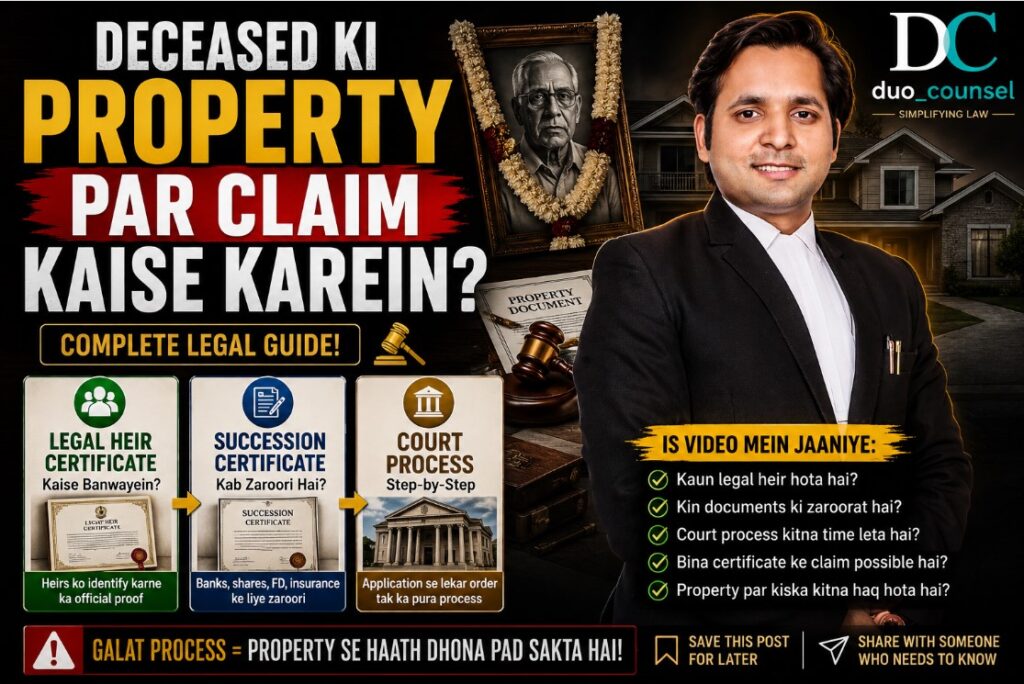
Quick Answer: Deceased ki property par claim karne ke liye mainly 2 documents hain — (1) Legal Heir Certificate — SDM/Tehsildar se, 15-30 din mein, property mutation/pension/government benefits ke liye; (2) Succession Certificate — District Court se, 3-6 mahine, bank accounts/FDs/shares/securities ke liye. Will ho toh — Probate ya registered Will + death certificate often sufficient. Property mutation — Revenue department (tehsil). Bank account — Nomination hai toh nomination form, nahi hai toh Succession Certificate. Hindu families — Hindu Succession Act, Christians/Parsis — Indian Succession Act. Dono certificates alag purposes ke liye hain — ek doosre ka substitute nahi.
Also Read :- Lucknow High Court Cause List (2026): Case Kab Lagega? Daily List Check Karne Ka Tarika.
Pehle Samjho — Kaunsa Certificate Kab Chahiye
Deceased ki property par claim process mein sabse pehli galti yeh hoti hai ki log bina samjhe koi bhi certificate apply kar lete hain. Teeno scenarios samjho:
Scenario 1: Will (Wasiyat) Hai — Registered
Agar deceased ne registered Will likhi thi:
- Probate (agar Mumbai, Kolkata, Chennai mein — mandatory for Hindus too in these cities)
- Registered Will + Death Certificate — bahut se transactions ke liye sufficient
- Legal heir certificate phir bhi useful hai — additional proof ke liye
- Succession certificate usually not needed agar Will clear hai
Scenario 2: Will Nahi Hai — Most Common Case
Intestate succession — bina Will ke:
- Legal Heir Certificate — SDM se — government benefits, property mutation initiation
- Succession Certificate — District Court se — bank accounts, FDs, shares, securities
- Dono alag cheezein hain — ek doosre ka substitute nahi
Scenario 3: Joint Property Hai
Agar property joint ownership mein thi — joint bank account, joint property:
- Surviving co-owner ko automatically rights milte hain (survivorship)
- Death certificate + bank request usually sufficient for joint accounts
- Property ke liye mutation + legal heir certificate
Legal Heir Certificate — Complete Guide
Kya Hai Legal Heir Certificate
Legal Heir Certificate ek government document hai jo deceased person ke legal heirs ko officially identify karta hai. Yeh state government authority jaari karti hai — primarily Tehsildar, SDM (Sub-Divisional Magistrate), ya Revenue Officer.
Legal Heir Certificate Kab Chahiye
- Property mutation — deceased ki property waris ke naam karna (tehsil/patwari records)
- Government pension — family pension claim
- Gratuity aur PF — employer se claim (agar no nomination)
- Insurance claim — kuch companies maangti hain
- Government job compassionate appointment
- Ration card update
- Electricity, gas, telephone — connection transfer
- Employer ke pending dues — salary arrears
- Income tax refund — deceased ka pending refund claim
Legal Heir Certificate Ke Liye Kaun Apply Kar Sakta Hai
- Spouse (husband/wife)
- Children (sons aur daughters — equal rights, Hindu Succession Act 2005 amendment ke baad)
- Parents
- Siblings (kuch states mein)
Note: Divorced spouse, adopted children, step-children — eligibility state law pe depend karti hai.
Documents Required — Legal Heir Certificate
- Death certificate (municipal corporation ya gram panchayat se issued) — original
- Aadhaar card — deceased ka (agar available) + all heirs ka
- Ration card — family ration card (deceased ka naam listed)
- Affidavit — Rs 20 stamp paper pe — applicant ki declaration ki woh legal heir hai
- Family tree / relationship proof — school certificate, birth certificate, marriage certificate
- Address proof — heirs ka current address
- Passport size photos — applicant ka
- Application form — SDM office se ya online
Legal Heir Certificate Process — Step By Step
Step 1: Application Submit Karo
Online option (most states mein):
- Haryana: saralharyana.gov.in
- Delhi: e-district.delhigovt.nic.in
- UP: edistrict.up.gov.in
- Maharashtra: aaplesarkar.mahaonline.gov.in
- Rajasthan: emitra.rajasthan.gov.in
- Tamil Nadu: tnedistrict.tn.gov.in
Offline option: SDM office ya Tehsil office mein application form + documents submit karo. Counter pe acknowledgment lein. deceased ki property par claim
Step 2: Verification
- Revenue department ki local inquiry hogi
- Patwari ya village officer nearby verification karega
- Neighbors ya local witnesses se confirm hoga
- 7-15 din typically
Step 3: Objection Period
Koi objection (disputed heirs) nahi aayi toh process continue.
Step 4: Certificate Issued
- 15-30 din typically
- Original certificate + copies lein
- Notarized copies banwao multiple — various purposes ke liye
Legal Heir Certificate Fee:
- Application fee: Rs 10-50 (state-wise alag)
- Stamp paper affidavit: Rs 20-100
- Online service charge: Rs 30-100
Total cost: Rs 50-200 approximately.
<!– Image Suggestion: Legal heir certificate vs succession certificate comparison infographic –> <!– Alt Text: deceased ki property par claim legal heir certificate succession certificate difference SDM court India –>
Succession Certificate — Complete Court Process
Kya Hai Succession Certificate
Succession Certificate ek District Court order hai jo heirs ko movable assets aur debts collect karne ka legal authority deta hai. Indian Succession Act, 1925 ke Sections 370-390 govern karte hain ise. deceased ki property par claim
Succession Certificate Kab Chahiye
- Bank accounts — significant balance (FDs, savings, current)
- Fixed Deposits — bank mein
- Shares aur debentures — Demat account
- Mutual funds — nominee nahi hai toh
- Bonds aur securities
- Insurance — agar nomination nahi thi
- Debts — deceased ki kisi ko di hue loan wapas lena
- PPF — nomination nahi hai toh deceased ki property par claim
Important: Succession Certificate immovable property (zameen, makan) ke liye nahi hota — iske liye Legal Heir Certificate + mutation process.
Succession Certificate Process — Step By Step
Step 1: Petition Draft Karo
District Court mein petition file hogi. Advocate se draft karwao — petition mein:
- Deceased ka naam, address, date of death
- Time aur place of death
- Heirs ki complete list — relationship clearly
- Assets ki list — specific bank, account number, amount
- Prayer — succession certificate grant karo
Step 2: Jurisdiction Decide Karo
File karo:
- Jahan deceased ordinarily rehta tha — at time of death, ya
- Jahan asset located hai — agar residence known nahi
Step 3: Court Fee Pay Karo
Yeh important — court fee property/asset value ka percentage hai:
| Asset Value | Court Fee (Approximate) |
|---|---|
| Rs 1 lakh tak | Rs 2,000-3,000 |
| Rs 5 lakh | Rs 10,000-15,000 |
| Rs 10 lakh | Rs 20,000-30,000 |
| Rs 50 lakh | Rs 1-1.5 lakh |
| Rs 1 crore | Rs 2-3 lakh |
State-wise different — 2-3% of estate value typically. Plus advocate fee additional.
Step 4: Court Notice — 45 Days
Petition admit hone ke baad court:
- Public notice — newspaper mein — objections invite karta hai
- Notice to known heirs — sab legal heirs ko
- 45 days ka mandatory notice period
Step 5: Objection Period deceased ki property par claim
45 din mein koi objection? Koi disputed heir? Court hearing schedule karega. Agar koi objection nahi — next step.
**Step 6: Court Hearing
- Judge petition examine karta hai
- Death certificate, relationship proof verify
- Heirs ki examination — brief questions
- Satisfied hone pe — certificate grant
Step 7: Succession Certificate Issued
- District Judge sign karta hai
- Specific assets listed — jis asset ke liye apply kiya
- Stamp duty alag se pay karni ho sakti hai
- Copy aapko diya jaata hai
Total timeline: 3-6 mahine typically (no objections). Contested cases: 1-2 saal.
Succession Certificate Ke Saath Bank Ko Kya Dena Hota Hai
- Original succession certificate
- Bank ka application form (deceased account claim)
- Heirs ki KYC — Aadhaar, PAN
- Joint affidavit — all heirs sign karein (agar multiple heirs)
- Indemnity bond (kuch banks maangti hain)
Legal Heir Certificate Vs Succession Certificate — Master Comparison
| Aspect | Legal Heir Certificate | Succession Certificate |
|---|---|---|
| Issuing Authority | SDM/Tehsildar/Revenue Officer | District Court (Judge) |
| Governing Law | State laws | Indian Succession Act, 1925 |
| Timeline | 15-30 din | 3-6 mahine |
| Cost | Rs 50-200 | 2-3% of estate value |
| For Immovable Property | ✅ Yes (mutation) | ❌ No |
| For Bank Accounts/FDs | ⚠️ Sometimes accepted | ✅ Yes (legally stronger) |
| For Shares/Securities | ❌ Generally not | ✅ Yes |
| For Pension/Gratuity | ✅ Yes | ❌ Not typically |
| Conclusive Proof | ❌ Not conclusive | ✅ Conclusive evidence |
| Court Process | ❌ No court | ✅ Court petition required |
| Public Notice | ❌ No | ✅ 45-day notice mandatory |
| Best For | Quick initial claims | Large movable assets |
Advocate’s Note: Bahut banks aaj kal Legal Heir Certificate + Indemnity Bond se bhi small accounts release karte hain. But large FDs, demat accounts, aur disputed cases mein Succession Certificate hi strongest aur legally safest option hai. Meri practical advice — pehle Legal Heir Certificate banwao (quick, cheap), aur simultaneously Succession Certificate petition file karo bank assets ke liye. deceased ki property par claim
Property Mutation — Naam Transfer Kaise Hoga
Legal Heir Certificate milne ke baad — deceased ki immovable property (zameen, makan) ka naam waris ke naam transfer karna padta hai. Yeh process hai Mutation (Intaqal). deceased ki property par claim
Mutation Kahan Hota Hai
- Rural area: Patwari (village level revenue officer)
- Urban area: Municipal Corporation ya Urban Local Body
- Agricultural land: Tehsil revenue records
Mutation Process — Step By Step
Documents:
- Legal Heir Certificate (original)
- Death certificate
- Property documents (khasra/khatauni — agricultural; sale deed ya title deed — urban)
- Aadhaar cards — all heirs
- Affidavit of heirs — indemnity ke liye
- NOC from other heirs — agar one heir is applying
Process:
- Mutation application submit karo tehsil/municipal office mein
- Patwari field visit karega — verification
- Other heirs ko notice — objection period (usually 30 days)
- Revenue officer order pass karega — mutation record
- New record of rights (Khasra/Khatauni) mein heirs ka naam aa jaayega
Timeline: 30-90 din typically Fee: Rs 100-500 (state-wise)
Important: Mutation sirf revenue records mein naam change karta hai — yeh ownership title create nahi karta. Proper registered transfer deed baad mein bhi ho sakti hai agar heirs property divide karna chahte hain. deceased ki property par claim
Bank Account Claim — Kya Process Hai
Deceased ki property par claim mein bank accounts sabse common aur confusing issue hai.
Scenario A: Nomination Hai
Deceased ne bank account mein nominee register karwaya tha:
- Nominee directly bank ko death certificate + KYC + nomination form copy deta hai
- Bank turant process karta hai — nominee ko amount milti hai
- Nomination = fastest route
But remember: Nomination sirf temporary custody deta hai nominee ko. Legal heirs ka right bhi hota hai ultimately. If other legal heirs dispute karein — nominee ko court process face karna pad sakta hai. Will ya family settlement better hai long-term ke liye.
Scenario B: Nomination Nahi — Small Balance
RBI guidelines ke under:
- Agar balance Rs 1 lakh tak — bank apne discretion se Legal Heir Certificate + indemnity bond se release kar sakta hai
- Bank-specific policy matter — kuch banks Rs 50,000, kuch Rs 1 lakh limit maante hain
Scenario C: Nomination Nahi — Large Balance
- Succession Certificate mandatory hai legally
- Bank technically bina SC ke release nahi kar sakta large amounts
- Kuch banks affidavit + indemnity bond accept karte hain — but legally risky hai heirs ke liye
- Succession Certificate best protection hai sab parties ke liye
Joint Account — Death Of One Holder
- Survivor account holder directly access karta hai — death certificate + bank intimation
- No succession certificate needed typically
- Survivor ka account hi ho jaata hai
<!– Image Suggestion: Deceased property claim flowchart — bank account, property, shares — kya karna hai –> <!– Alt Text: deceased ki property par claim bank account property shares FD nomination succession certificate process India –>
Shares, Demat Aur Mutual Funds Inheritance
Demat Account — Physical Shares
Registered nomination hai:
- Depository participant (DP) ko death certificate + KYC + nomination form
- Transmission form fill karo
- 15-30 din mein transfer
Nomination nahi:
- Small value (Rs 2 lakh tak for physical shares) — Legal Heir Certificate + affidavit + indemnity
- Large value — Succession Certificate
- SEBI guidelines follow hote hain
Mutual Funds
- Nomination thi: AMC ko death certificate + nomination form + KYC — transmission
- Nomination nahi: Succession Certificate + death certificate — all heirs jointly apply
- Some AMCs accept Legal Heir Certificate for small folios — check with specific AMC
PPF (Public Provident Fund)
- Nomination thi: Post office/bank ko form submit — 60 din mein process
- Nomination nahi: Rs 1 lakh tak — Legal Heir Certificate; above Rs 1 lakh — Succession Certificate
EPF/PF (Employees Provident Fund)
- EPFO Form 20 (death claim) + Form 10D (pension)
- Nomination registered thi — direct claim
- Nomination nahi — Legal Heir Certificate sufficient mostly (EPFO accepts)
- Employer ka certificate bhi helpful hota hai
Hindu Succession Act Vs Indian Succession Act — Kaunsa Apply Hoga
Deceased ki property par claim mein kaunsa personal law apply hoga — yeh religion pe depend karta hai:
| Religion | Applicable Law | Key Feature |
|---|---|---|
| Hindu, Sikh, Jain, Buddhist | Hindu Succession Act, 1956 | Class I heirs priority, 2005 amendment — daughters equal coparceners |
| Muslim | Muslim Personal Law (Shariat) | Share-based inheritance, Hanafi school mostly |
| Christian, Parsi | Indian Succession Act, 1925 | Western-style inheritance, probate required sometimes |
| Registered Civil Marriage | Indian Succession Act, 1925 |
Hindu Succession Act — Class I Heirs (Highest Priority)
Section 8 ke under — Class I heirs sabse pehle inherit karte hain:
Class I Heirs:
- Widow (or widower)
- Sons aur daughters (equal — 2005 amendment)
- Mother
- Son’s widow (agar son pehle mar gaya)
- Son’s children (agar son pehle mar gaya)
- Daughter’s children (agar daughter pehle mar gayi)
Agar koi Class I heir hai — Class II heirs ko kuch nahi milta.
2005 Amendment: Daughters ko coparcenary property mein equal rights mila — Supreme Court ne Vineeta Sharma case mein confirm kiya — retrospective effect — daughters who were alive on 9 September 2005 have rights even if father died before 2005. deceased ki property par claim
Real Case Study — Teen Certificates Ek Saath Zaroorat Padi
Background: Mr. Ramesh Verma (age 68), Gurugram. Sudden heart attack mein death. Family mein — wife Sunita (age 63), son Amit (age 38), daughter Priya (age 35, married). deceased ki property par claim
Assets left behind:
- House — Sector 45, Gurugram — market value Rs 85 lakh
- FD — HDFC Bank — Rs 22 lakh (no nomination)
- Shares — Demat account — Rs 8 lakh approximate
- PF — EPFO — Rs 6 lakh (wife nominated)
- Pension — Government job retired — family pension to wife
Challenge: No Will. Three different asset types needing different documents.
Strategy DuoCounsel Ne Bataayi:
Week 1-2:
- Death certificate — municipal corporation se
- All family members ka Aadhaar, PAN collect kiya
Week 3:
- Legal Heir Certificate apply kiya — SDM Gurugram office mein — Sunita, Amit, Priya teeno heirs as per Hindu Succession Act
- Online apply — saralharyana.gov.in
Simultaneously — Month 1:
- Succession Certificate petition — Gurugram District Court mein — specifically for HDFC FD Rs 22 lakh + demat shares
- Indian Succession Act Section 372 ke under
- Advocate ne petition draft kiya
- Court fee: Rs 22 lakh + Rs 8 lakh = Rs 30 lakh estate — approximately Rs 60,000 court fee
Week 6 — Legal Heir Certificate mila:
- Wife Sunita ne pension department mein submit kiya — family pension start hoi
- EPFO mein Form 20 submit kiya — PF Rs 6 lakh claim start (wife nominee thi — fast process)
- Mutation application tehsil mein — property records mein teeno heirs ka naam add karne ke liye deceased ki property par claim
Month 5 — Succession Certificate mila:
- 45-day notice period — no objections
- District Judge ne grant kiya
- HDFC Bank mein submit — FD claim process start
- Depository participant ko — shares transmission start
Month 7 — All Settled:
- Property mutation complete — teeno heirs ka naam records mein
- Bank FD released — teeno heirs mein divided as per Hindu Succession Act
- Shares transferred
- PF received — wife
- Family pension ongoing — wife
Total cost: Legal Heir Certificate (Rs 200) + Succession Certificate (court fee Rs 60,000 + advocate fee Rs 45,000) + mutation (Rs 500) = approximately Rs 1,06,000 for Rs 1.21 crore worth assets. deceased ki property par claim
Lesson: Deceased ki property par claim mein teen documents simultaneously handle karna padta hai often — each for different asset type. Ek document doosre ka substitute nahi hai. deceased ki property par claim
7 Common Mistakes — Deceased Ki Property Par Claim Mein
Mistake 1: Galat Certificate Apply Karna
FD claim ke liye SDM ke paas Legal Heir Certificate apply kar diya — bank ne reject kiya, Succession Certificate maanga. 2 mahine waste. Fix: Pehle asset type identify karo, phir certificate decide karo. deceased ki property par claim
Mistake 2: Nomination Check Nahi Kiya
Succession Certificate banwane lage, baad mein pata chala wife nominee thi — sirf death certificate se kaam ho jaata. 5 mahine aur Rs 60,000 court fee waste. Fix: Har asset mein pehle nomination status check karo. deceased ki property par claim
Mistake 3: Mutation Ignore Karna
Legal Heir Certificate mila, bank FD bhi release ho gayi, lekin property mutation nahi karwaya. 5 saal baad jab property bechni thi — title unclear, buyer ne refuse kiya. Fix: Mutation turant karwao legal heir certificate milte hi. deceased ki property par claim
Mistake 4: Partial Heirs Ne Apply Kiya
Sirf son ne legal heir certificate apply kiya, daughter ka naam nahi — certificate incomplete issue hua. Daughter baad mein dispute raise ki. Fix: Sab legal heirs simultaneously application mein listed ho.
Mistake 5: Koi Will Nahi Mila — Assume Intestate
Bank locker nahi check kiya, relatives se nahi poochha — assume kiya koi Will nahi. Baad mein Will mili — sab process phir se. Fix: Before starting — Will ki thorough search karo — bank locker, home files, relatives, lawyer ke paas. deceased ki property par claim
Mistake 6: Advocate Nahi Liya Succession Certificate Ke Liye
Self-drafted petition file ki — jurisdiction galat, documents incomplete, 45-day notice properly nahi hua — petition dismissed. Fix: Succession Certificate ke liye advocate mandatory practically — court process complex hai. deceased ki property par claim
Mistake 7: Income Tax Return File Nahi Ki
Deceased ka ITR pending tha — estate pe demand notice aaya. Fix: Deceased ke CA ya tax advisor se immediately milein — pending ITR file karo. Legal representative file kar sakta hai. deceased ki property par claim
FAQ — Deceased Ki Property Par Claim Ke Common Questions
Q: Legal heir certificate aur succession certificate mein sabse important difference kya hai? A: Legal Heir Certificate SDM/revenue authority se milta hai — 15-30 din mein — immovable property mutation, pension, government benefits ke liye. Succession Certificate District Court se milta hai — 3-6 mahine — bank accounts, FDs, shares, securities ke liye. Dono alag purposes ke liye hain, ek doosre ka substitute nahi. Deceased ki property par claim mein dono simultaneously apply karo — alag assets ke liye.
Q: Agar Will hai toh kya succession certificate ki zaroorat nahi? A: Will hai toh process simple hota hai — registered Will + death certificate bahut transactions ke liye sufficient hai. Lekin kuch banks aur institutions phir bhi Succession Certificate maangti hain — especially large amounts ke liye. Mumbai, Chennai, Kolkata mein Probate mandatory hai even with Will. Advocate se specific situation ke liye consult karo.
Q: Bank FD release karne se pehle kitna time lagta hai? A: Nomination thi toh — 15-30 din (death certificate + KYC submit karo). Nomination nahi — small amounts: Legal Heir Certificate + indemnity bond — 30-60 din. Large amounts: Succession Certificate — 3-6 mahine court process. Deceased ki property par claim mein bank FD sabse time-consuming asset type hota hai agar nomination nahi thi. deceased ki property par claim
Q: Kya beti ka bhi equal hissa hota hai property mein? A: Haan — Hindu Succession Act 2005 Amendment aur Vineeta Sharma v. Rakesh Sharma (SC 2020) ke under — daughters ko equal coparcenary rights milte hain ancestral aur self-acquired property dono mein. Yeh right retrospective hai — daughters jo 9 September 2005 ko alive thein unhe yeh right milta hai chahe father ki death kab bhi hui ho. Daughters ke rights ignore karna legally invalid hai.
Q: NRI hoon, India mein kaise claim karein? A: Power of Attorney (PoA) banwao ek trusted representative ko — registered PoA. Woh aapki taraf se sab processes handle karega. Legal Heir Certificate aur Succession Certificate dono mein PoA accepted hai. Online proceedings mein video appearance bhi possible hai kuch courts mein. Advocate se specifically NRI inheritance process ke liye consult karo.
Q: Multiple heirs hain aur ek cooperate nahi kar raha — kya karein? A: Succession Certificate petition mein sab heirs ko listed karna mandatory hai — even if one doesn’t cooperate. Court unhe notice deta hai — aana padhega. Agar phir bhi cooperate nahi karta — court ex parte proceed kar sakta hai. Civil suit for partition alag option hai — court property formally divide karega. Advocate se immediately milein agar family dispute hai. deceased ki property par claim
Q: Succession certificate mein court fee bahut zyada lag rahi hai — koi alternative hai? A: Court fee estate value ka 2-3% hota hai — high-value cases mein significant. Alternative: Kuch banks small amounts ke liye Legal Heir Certificate + indemnity bond accept karte hain. Agar all heirs agree aur no dispute — Family Settlement Deed + Legal Heir Certificate se kuch transactions possible hain. Lekin legally strongest option Succession Certificate hi hai — especially large assets ke liye.
Q: Property mutation aur property transfer mein kya fark hai? A: Mutation — sirf revenue records mein naam change hota hai (Khasra/Khatauni). Ownership transfer nahi hota — ek administrative process hai. Property Transfer — registered deed (sale deed ya gift deed) se actual ownership transfer hoti hai. Mutation inheritance establish karta hai — registered transfer actual conveyance hai. Dono different purposes ke liye hain — mutation pehle karo, proper registered transfer baad mein agar heirs property divide karna chahein.
Ek Step Ek Time — Systematically Claim Karo
Deceased ki property par claim karna ek emotional aur procedurally complex process hai — ek beloved family member ki loss ke baad. Lekin systematically approach karo toh yeh manageable hai.
Simple decision tree:
DEATH HUI
    ↓
Will hai? → Registered Will → Probate (Mumbai/Chennai/Kolkata) ya
                              Will + Death Certificate use karo
    ↓
Will nahi hai?
    ↓
Assets identify karo:
│
├── Property (zameen/makan) → Legal Heir Certificate → Mutation
│
├── Bank accounts/FDs → Nomination hai?
│   ├── Haan → Death certificate + KYC → Fast release
│   └── Nahi → Succession Certificate (3-6 months)
│
├── Shares/Demat → Nomination hai?
│   ├── Haan → Transmission form → 15-30 days
│   └── Nahi → Succession Certificate / SEBI guidelines
│
├── PF/PPF → Nomination hai?
│   ├── Haan → Form 20 → Direct claim
│   └── Nahi → Legal Heir Certificate sufficient (EPFO)
│
└── Government pension → Legal Heir Certificate → Family pension start
Yaad rakhein:
- Deceased ki property par claim — pehle Will search karo — turant, before anything else
- Legal Heir Certificate — SDM se, 15-30 din, cheap — property mutation, pension, PF ke liye
- Succession Certificate — District Court se, 3-6 mahine, court fee — bank accounts, FDs, shares
- Nomination check karo har asset mein — nomination hai toh fastest route
- Mutation — property ke liye zaroori — Legal Heir Certificate ke baad turant karwao
- Daughter ka equal hak — Hindu Succession Act 2005, Vineeta Sharma judgment — ignore mat karo
- NRI — registered Power of Attorney se claim possible
- Multiple heirs — sab ko simultaneously apply karo — ek bhi miss ho toh future disputes
- Advocate — Succession Certificate ke liye definitely, baaki ke liye bhi guidance lena smart hai
- ITR — deceased ka pending income tax return file karo — legal representative kar sakta hai
DuoCounsel ke podcast pe humne property inheritance, succession laws aur Will importance pe detailed episodes kiye hain. Zaroor sunein. Agar deceased ki property par claim mein koi confusion hai ya specific assets ke liye guidance chahiye — comment mein poochein. Hum practicing advocates hain Gurugram mein aur Punjab & Haryana Bar Council se enrolled hain.
===== AUTHOR SECTION =====
Is Article Ke Baare Mein
Yeh article DuoCounsel ke dono practicing advocates ne Gurugram courts ke succession aur property law experience ke aadhar pe likha hai. Legal Heir Certificate, Succession Certificate, property mutation — Adv. Yogesh Solanki aur Adv. Barkha Jain dono regularly Gurugram District Courts mein handle karte hain.
👨⚖️ Adv. Yogesh Solanki
Co-Founder, DuoCounsel | Punjab & Haryana Bar Council
Adv. Yogesh Solanki DuoCounsel ke Co-Founder aur Punjab & Haryana Bar Council se enrolled practicing advocate hain. Gurugram District Courts aur Punjab & Haryana High Court mein active practice — RERA disputes, consumer cases, civil litigation, property disputes, succession matters aur criminal matters mein specialization. Solanki Engineers ke official legal retainer.
Property mutation, succession certificate petitions, legal heir certificate processes, ancestral property disputes — Yogesh ka Gurugram Revenue Courts aur District Courts mein direct experience hai. Deceased ki property par claim related matters mein practical guidance. DuoCounsel podcast ke through legal awareness Hinglish mein pahunchate hain.
Specialization: RERA | Property Disputes | Succession Matters | Civil Litigation | Consumer Cases | Criminal Law | MACT Claims
📍 Practice: Gurugram District Courts | Punjab & Haryana High Court
👩⚖️ Adv. Barkha Jain
Co-Founder, DuoCounsel | Punjab & Haryana Bar Council
Adv. Barkha Jain DuoCounsel ki Co-Founder aur Punjab & Haryana Bar Council se enrolled practicing advocate hain. Corporate law, business compliance, commercial disputes aur matrimonial law mein deep expertise.
Succession matters — corporate assets inheritance, business succession planning, NRI property claims, family settlement deeds — Barkha ka hands-on experience hai. Startups aur businesses ke liye succession planning, Will drafting advisory, aur deceased ki property par claim related corporate asset transfers mein comprehensive guidance. Matrimonial law context mein widow’s rights, daughter’s inheritance rights (Vineeta Sharma judgment) — deep expertise.
Specialization: Corporate Law | Business Compliance | Succession Planning | NRI Property Claims | Matrimonial Law | GST | Income Tax
📍 Practice: Gurugram District Courts | Punjab & Haryana High Court
⚠️ Disclaimer: Yeh article sirf legal awareness aur educational purpose ke liye hai. Har case ki facts, asset types aur family situation alag hoti hain — specific situations mein professional legal advice ke liye qualified advocate se personally consult zaroor karein. Succession matters mein advocate guidance highly recommended hai.
🎙️ DuoCounsel Podcast sunein — legal awareness Hinglish mein | duocounsel.com/podcast