
Raat ke 2 baje — aapke ghar ki khidki toot ke ek aadmi andar ghusa. Aapke haath mein cricket bat hai. Aap use maaro — woh gir jaata hai. Police aati hai — kya aap par murder ka case hoga?
Ya — road pe koi aapke saath jhagda karta hai, churi nikalta hai. Aap usse rok ne ke liye ek punch maarte ho — woh gir ke sar pe lag jaata hai, hospital mein hai. Aap accused hain kya?
Ya — aapki beti ke saath koi forced karne ki kosis kar raha hai. Aap wahan hain — usse rok ne ke liye aap ne jo bhi kiya — kya aap criminal hain?
Nahi. Indian law mein — self defense ka right ek fundamental legal protection hai. Bharatiya Nyaya Sanhita (BNS) 2023 ke Sections 34-44 ke under — jo kuch bhi private defence mein kiya jaaye, woh offence nahi hai. BNS Section 34 seedha kehta hai: “Nothing is an offence which is done in exercise of the right of private defence.”
Lekin — aur yeh bahut important “lekin” hai — self defense ka right unlimited nahi hai. Proportionality, immediacy, aur “no excessive force” — yeh teeno conditions miss karo, toh self defense claim fail ho jaata hai aur aap accused ban jaate ho.
Main ek practicing advocate hoon aur criminal cases regularly handle karta hoon. Self defense ka right India mein bahut log galat samajhte hain — ya toh bahut narrow (sochte hain kuch bhi nahi kar sakte) ya bahut broad (sochte hain kuch bhi justify ho jaata hai). Sach dono ke beech hai — aur is complete guide mein main woh sach bataunga.
Quick Answer: Self defense ka right BNS Sections 34-44 (purane IPC 96-106) ke under available hai. Aap apna body, doosre ka body, apni property aur doosre ki property defend kar sakte ho. Death sirf tab justified hai jab: (a) death ya grievous hurt ka reasonable apprehension ho, (b) rape/kidnapping/wrongful confinement ka attempt ho. Property mein death sirf house-breaking by night, arson, ya robbery mein death/grievous hurt apprehension mein. 4 conditions mandatory — (1) Threat real aur imminent ho, (2) No time to seek police help, (3) Force proportionate ho, (4) Aggressor ne pehle attack kiya ho. Bhagte attacker ko peeche se maarna = murder, self defense nahi.
Also Read :- FIR Kaise Darj Kare — Online, Offline, Zero FIR Aur Police Refuse Kare Toh Kya Kare
Self Defense Ka Right Kya Hai — Meaning Aur Foundation
Right of Private Defence — yeh criminal law ka ek “General Exception” hai. Matlab — normally kisi ko maarna BNS ke under murder ya hurt hai. Lekin agar aap private defence mein kiya toh — woh offence hi nahi hai.
BNS Vs IPC — Section Numbers Change Hue, Law Same Raha
| IPC Section | BNS Section | Subject |
|---|---|---|
| Section 96 | Section 34 | General principle — nothing is offence in private defence |
| Section 97 | Section 35 | Right to defend body + property |
| Section 98 | Section 36 | Defence against insane/drunk aggressor |
| Section 99 | Section 37 | Restrictions on the right |
| Section 100 | Section 38 | When death can be caused — body defence |
| Section 101 | Section 39 | Harm (not death) in body defence |
| Section 102 | Section 40 | When right commences and continues |
| Section 103 | Section 41 | When death can be caused — property defence |
| Section 104 | Section 42 | Harm (not death) in property defence |
| Section 105 | Section 43 | When property right commences and continues |
| Section 106 | Section 44 | Bystander harm in self defence |
1 July 2024 se BNS lagu hua. Pehle IPC sections cite kiye jaate the. Ab BNS sections use karo — lekin logic exactly same hai.
Kyun Yeh Right Exist Karta Hai
Supreme Court ne Darshan Singh v. State of Punjab (2010) mein explain kiya: “Self-preservation is a basic human instinct recognized across all civilized legal systems. The state cannot be present everywhere to protect every citizen. Law therefore empowers citizens to protect themselves when state protection is unavailable.”
Matlab — police 24 ghante hamare ghar ke bahar khadi nahi reh sakti. Jab sudden attack ho — self defense ka right law ki taraf se aapko diya gaya own protection ka haq hai.
BNS Section 37 — 4 Restrictions Jo Samajhni Zaroori Hain
Self defense ka right unlimited nahi hai. BNS Section 37 (purana IPC Section 99) ne 4 clear restrictions lagayi hain. Yeh yaad karo:
Also read :-Domestic Violence Case Kaise Kare 2026: DV Act, Protection Order Aur Rights Ki Complete Guide
Restriction 1: Lawful Public Servant Ke Against Nahi
Agar police officer valid warrant se arrest kar raha hai — aap self defense ka right use karke resist nahi kar sakte. Police ka lawful act = no right to resist.
Exception: Agar police officer unlawfully kuch kar raha hai — bina warrant cognizable offence nahi hai, ya excessive torture kar raha hai — tab limited defence possible hai. Lekin yeh risky area hai — advocate se consult zaroor karein.
Restriction 2: Police Ki Help Available Ho Toh
Agar time hai — police ko call kar sakte the, help maang sakte the — toh self defense ka right kam strong ho jaata hai. Right tab properly triggers hota hai jab no time to seek public authority help.
Practical reality: Supreme Court ne kaha hai — yeh condition strictly apply nahi hoti. Panic situation mein police ko call karna realistic nahi hota. Courts is condition ko practically samajhte hain.
Restriction 3: Force Proportionate Hona Chahiye
Yeh sabse important restriction hai. Force ka level threat ke level ke barabar hona chahiye — zyada nahi.
- Slap maari gai = slap se defend karo, gun se nahi
- Chhuri dikhayi = appropriate force, but killing proportionate nahi agar chhuri use nahi ki gayi
- Death ka threat = death causing force justified
“Mathematical precision” nahi chahiye — SC ne kaha hai ki panic situation mein exact proportionality impossible hai. Lekin grossly disproportionate force = self defence claim fail.
Restriction 4: Threat Real Aur Imminent Hona Chahiye
Past threat pe self defense nahi. Future threat pe preemptive attack nahi. Threat abhi, is waqt, imminent hona chahiye.
- “Kal usne threat di thi” = no right today
- “Mujhe lag raha hai woh aayega” = no right yet
- “Woh abhi chhuri lekar aa raha hai” = right immediately triggers
Advocate’s Note: Self defense ka right bahut frequently courts mein misuse hota hai. Criminal ne intentionally situation create ki — fight mein ghusna, pehle attack karna — phir “self defence” claim kiya. SC ne Ram Swarup case mein kaha: “No aggressor can claim private defence. Agar aapne situation create ki — aap defender nahi, aggressor ho.” Courts is angle ko seriously lete hain — evidence clearly dikhana hoga ki threat aap pe aaya, aapne nahi badhaya.
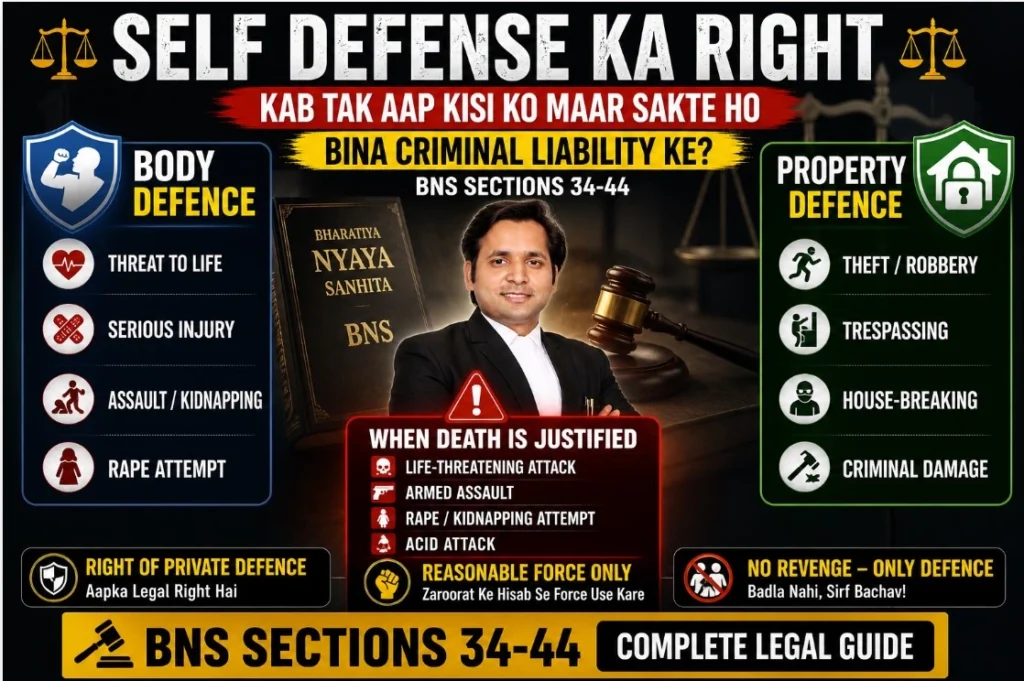
Body Defence — Kab Tak Force Use Kar Sakte Hain
BNS Section 35 — Basic Right
Aap defend kar sakte ho:
- Apna body — kisi bhi offence affecting human body ke against
- Doosre ka body — stranger ko bhi defend kar sakte ho (kisi aur ki madad = valid)
- Apni property — theft, robbery, mischief, criminal trespass ke against
- Doosre ki property — yahan bhi doosre ki property defend karna valid hai
BNS Section 40 — Right Kab Shuru Aur Khatam Hota Hai
Shuru: Jab reasonable apprehension ho attack ki — actual attack hona zarooori nahi.
Example: Koi chhuri lekar aapki taraf aa raha hai, abhi strike nahi ki — lekin reasonable apprehension hai — self defense ka right abhi shuru ho gaya.
Khatam: Jab apprehension khatam ho jaaye.
Example: Attacker bhaag gaya, ya gir gaya, ya unconscious ho gaya — apprehension khatam — self defense ka right bhi khatam. Aage strike karna = criminal liability.
BNS Section 38 — Kab Death Cause Karna Justified Hai (Body Defence)
Yeh 6 specific situations hain jab body defence mein death causing force allowed hai:
Situation 1: Death Ka Reasonable Apprehension Attack aisa hai ki agar nahi roka toh aap mar sakte ho — death causing force justified.
Situation 2: Grievous Hurt Ka Reasonable Apprehension Agar attack se aapko permanent disability, serious injury hone ka reasonable fear hai — death force possible.
Grievous hurt examples: Eye jaana, ear jaana, permanent disfigurement, bone fracture, dangerous disease, any hurt endangering life.
Situation 3: Rape Ka Attempt Agar koi rape karne ki kosis kar raha hai — victim ya jो defend kar raha hai — death force justified.
Situation 4: Unnatural Lust Ka Attempt Unnatural sexual assault attempt — death force justified.
Situation 5: Kidnapping Ya Abduction Ka Attempt Kisi ko kidnap karne ki kosis — death force justified.
Situation 6: Wrongful Confinement — Death Ya Grievous Hurt Ka Fear Aapko kisi jagah band kiya jaa raha hai aur aapko darr hai woh aapko maar denge ya seriously hurt karenge — death force justified.
BNS Section 39 — Jab Death Justify Nahi (Sirf Harm)
Agar situation Section 38 ke under nahi aati — matlab death/grievous hurt/rape/kidnapping ka apprehension nahi — tab sirf harm (nahi death) allowed hai.
Example: Koi aapko dhakel raha hai, uthaa-patak raha hai — lekin death ka fear nahi. Aap use push kar sakte ho, maar sakte ho (non-lethal) — lekin gun shoot karna ya seriously maarna = excessive force = criminal liability.
Property Defence — Ghar Mein Chor Aa Jaaye Toh Kya
Self defense ka right property ke liye bhi available hai — lekin thoda stricter conditions ke saath.
BNS Section 35 — Property Defence Ka Basic Right
Aap apni ya doosre ki property defend kar sakte ho:
- Theft se
- Robbery se
- Mischief se (damage karna)
- Criminal trespass se (ghar mein ghusna)
BNS Section 41 — Property Defence Mein Kab Death Justified
Property ke liye death force sirf in 5 specific situations mein:
Situation 1: House-Breaking By Night Raat ko ghar mein ghusna (break karke) — death causing force justified. Yeh India ka sabse important property defence provision hai.
“Raat” ki definition: Sunset se sunrise ke beech. “House-breaking” sirf break karke ghusna — khuli khidki se ghusna house-breaking nahi necessarily.
Situation 2: Arson — Fire Lagana Koi aapke ghar ya property ko aag lagane ki kosis kare — death force justified.
Situation 3: Theft, Robbery Ya Mischief Jo Death Ya Grievous Hurt Cause Kare Agar theft/robbery ke saath death ya serious injury ka reasonable apprehension ho — death force justified.
Situation 4: Robbery With Death/Grievous Hurt Apprehension Dacoity ya robbery ke dauraan death ya serious injury ka fear — death force justified.
Situation 5: Wrongful Confinement + Death/Grievous Hurt Fear Property dispute mein kisi ne band kar diya aur darr hai serious harm hoga — death force possible.
BNS Section 42 — Property Defence Mein Sirf Harm (No Death)
Agar Section 41 situations nahi hain — property defence mein sirf harm allowed hai, death nahi.
Classic example: Chor ek ghante se goods uthaa raha hai, aap usse rok rahe ho physically — usse push karna, restraint karna, non-lethal force = valid. Usse goli maarna ya fatally wound karna = criminal liability — kyunki death ka Section 41 ground nahi tha.
“Ghar Mein Chor” Scenario — Most Common Question
Question: Raat 2 baje ghar mein chor ghusa, aapne cricket bat se maara, woh mar gaya. Aap criminal hain?
Answer depends on facts:
- Raat ko, break karke ghusa (Section 41 — house-breaking by night) — death force justified — aap criminal nahi
- Chor sirf TV uthaa raha tha, coat wapas jaate waqt maara (no death apprehension, fleeing) — excessive force — criminal liability possible
- Chor ke paas hatyaar tha, aap pe aaya (death apprehension) — Section 38 — aap criminal nahi
Key factor: Context of the moment — was there reasonable apprehension at the exact moment of your action?
BNS Section 36 — Drunk Ya Insane Attacker Se Defence
Agar koi drunk hai ya mentally unsound hai aur aap pe attack kare:
- Aapka self defense ka right wahi rehta hai jaisa sane person ke against hota
- Attacker ka drunk/insane hona aapka right kam nahi karta
- Courts same proportionality test apply karte hain
Example: Drunk neighbor ne aapko chhuri se attack kiya — wahi rights apply honge jo sober attacker ke against hote.
BNS Section 44 — Innocent Bystander Ko Harm Ho Jaaye
Yeh provision bahut practically important hai:
Agar mob attack ho raha hai, aap defend kar rahe ho — aur defence mein accidentally ek innocent bystander ko harm ho jaaya:
- Agar death/grievous hurt ka reasonable apprehension tha
- Aur bystander ko effectively avoid karna possible nahi tha
- Aap criminal nahi — bystander harm covered hai Section 44 ke under
Example: Mob aap pe attack kar raha hai, aapne gun fire ki self defence mein, crowd mein ek innocent vyakti hit ho gaya — agar genuine self defence ki situation thi, Section 44 protect karta hai.
<!– Image Suggestion: Flowchart — self defense ka right — is force justified? Decision tree –> <!– Alt Text: self defense ka right India flowchart body property death justified BNS Section 38 41 conditions –>
8 Landmark Supreme Court Judgments — Self Defense Ka Right
| Case | Court | Key Ruling |
|---|---|---|
| Darshan Singh v. State of Punjab (2010) | SC | Liberal construction — right should serve social purpose, no duty to retreat, reasonable apprehension sufficient |
| James Martin v. State of Kerala (2003) | SC | Proportionality key — wounds on both sides relevant evidence, cannot expect mathematical precision in panic |
| Buta Singh v. State of Punjab (1991) | SC | Cannot weigh exact force in heat of moment, BUT grossly disproportionate force not excused |
| Kashi Ram v. State of Rajasthan | SC | Reasonableness assessed from attacker’s perspective at moment of threat — no retreat required |
| Jai Dev v. State of Punjab (AIR 1963 SC 612) | SC | Once apprehension disappears — right ends. Cannot pursue fleeing attacker. |
| Ram Swarup v. State of UP (1974) | SC | “Right of defence, not retribution.” Aggressor cannot claim private defence. Stage-managed situation = no right. |
| Sampath Ram v. State of Rajasthan | SC | Doubt resolved against claimant where evidence unclear — not benefit of doubt like regular cases |
| Manjeet Singh v. State of HP (2014) | SC | Accused initiated hostilities — no genuine fear — conviction upgraded. False self-defence claim = culpable homicide |
Darshan Singh Principles — Sabse Important Reference
Supreme Court ne Darshan Singh case mein 10 principles consolidate kiye jo aaj bhi binding hain:
- Self-preservation basic human instinct — recognised in law
- Private defence available only when suddenly confronted with impending danger
- Danger should not be self-created
- Reasonable apprehension sufficient — actual offence need not have occurred
- Right begins when reasonable apprehension arises
- Right continues as long as apprehension lasts
- No duty to retreat — person can stand their ground
- Cannot expect mathematical precision in danger — it is not a court of law
- Liberal construction — right should serve social purpose
- Wounds on accused — important evidence that genuine attack occurred
Also Read :- Property Registration Kaise Hoti Hai 2026 — Stamp Duty, Documents Aur Online Process Step-by-Step
6 Real-Life Scenarios — Self Defense Ka Right Analysis
Scenario 1: Road Rage Mein Maar Diya
Situation: Car accident ke baad argument hua. Dusra driver gali de raha tha, aapko dhakelne laga. Aapne ek punch maari, woh gir ke sar laga — hospital mein serious.
Analysis:
- Kya threat imminent tha? Haan — dhakelna physical assault tha
- Kya force proportionate tha? Depend karta hai — ek punch usually proportionate hai dhakelne ke against
- Kya aapne pehle attack kiya? Nahi — woh dhakel raha tha
- Likely outcome: Section 39 ke under valid defence — harm causing allowed, but court circumstances dekhega
Scenario 2: Bhagte Chor Ko Peeche Se Maara
Situation: Chor ne aapka laptop uthaya — bhaag raha tha. Aapne peeche se danda maara — fatal injury.
Analysis:
- Kya threat imminent tha? Nahi — bhaagta chor aap pe attack nahi kar raha
- Section 43: Property defence right tab khatam ho jaata hai jab chor retreat kar le
- Outcome: Criminal liability — self defence claim fail — culpable homicide possible
Scenario 3: Ghar Mein Raat Ko Chor Ghusa — Uthao Ya Maaro
Situation: Raat 1 baje — khidki toot ke chor ghusa. Haath mein hatyaar tha. Aapne heavy object se maara — woh critically injured.
Analysis:
- House-breaking by night: Section 41 ground — death force justified
- Hatyaar tha — death apprehension: Section 38 ground bhi
- Outcome: Aap criminal nahi — clear self defence ka right
Scenario 4: Apni Beti Ko Bachaya — Attacker Mar Gaya
Situation: Koi forced entry karke aapki beti ko harm karne ki kosis kar raha tha — aapne rok te huye jo bhi kiya — attacker seriously injured, hospital mein mar gaya.
Analysis:
- Rape/sexual assault attempt: Section 38 — death force explicitly justified
- Doosre ka body defend karna: Section 35 — valid
- Outcome: Complete acquittal — strongest self defence scenario
Scenario 5: Drunk Neighbor Ne Raat Ko Attack Kiya
Situation: Drunk neighbor 2 baje raat ko aapke ghar aaya, argument hua, usne knife nikali aur aap pe aaya. Aapne defend karne mein use seriously hurt kiya.
Analysis:
- Section 36: Drunk attacker ke against same rights
- Knife = death/grievous hurt apprehension = Section 38 trigger
- Serious hurt causing proportionate hai knife attack ke against
- Outcome: Valid self defence — not criminal
Scenario 6: “Main Tujhe Kal Dekhunga” — Preemptive Attack
Situation: Dushman ne kal aapko seriously threaten kiya — “aaj raat tujhe khatam karunga.” Aapne darr ke aaj subah use pehle attack kar diya.
Analysis:
- Threat imminent nahi thi abhi — kal ki baat thi
- Section 40: Right tab shuru hota hai jab reasonable apprehension arise ho
- Preemptive attack = no private defence
- Outcome: Criminal liability — self defence claim completely fail
Self Defence Claim Fail Kyun Hota Hai — 7 Common Mistakes
Mistake 1: Aapne Pehle Attack Kiya
Agar aapne fight shuru ki — chhuri nikali, pehle maara — baad mein self defence nahi chal sakti. “Aggressor cannot claim private defence” — Ram Swarup SC case.
Mistake 2: Bhagte Attacker Ko Pursue Kiya
Jab attacker bhaag gaya — apprehension khatam — right khatam. Peeche jaake maarna = murder, self defence nahi. Jai Dev v. State of Punjab — settled law.
Mistake 3: Grossly Disproportionate Force
Slap ke jawab mein gun shoot karna. Dhakelne ke jawab mein knife maarna. Force level bahut zyada tha threat ke comparison mein — claim fail.
Mistake 4: FIR Nahi Ki Turant
Self defence mein koi mara ya injured hua — turant police ko inform karo. Delay karna = conduct suspicious lagta hai = court mein negative inference. Innocent person immediately report karta hai.
Mistake 5: Stage-Managed Situation
Khud fight mein ghuse, situation create ki, phir self defence claim kiya. Courts yeh spot karte hain — conduct before the incident crucial evidence hai.
Mistake 6: Koi Injury Aap Ko Nahi Aayi
Supreme Court ne kaha — wounds on the accused important evidence hai ki genuine attack hua tha. Agar aap pe koi injury nahi hai lekin aapne attacker ko bahut maar diya — court suspicious hoga ki genuine threat thi kya.
Mistake 7: Witnesses Contradict Your Story
Jo log maujood the — unka bayaan aapki version se contradict kare — claim fail. Immediate consistent version bahut important hai.
Real Case Study — Self Defence Claim Aur Acquittal
Background: Mr. Suresh (age 52), pharmacist, Gurugram area. Late evening apni clinic band kar raha tha. Ek patient ka relative — jisne charge lete waqt argument kiya tha — gun lekar clinic mein ghusa. Directly threat kiya — “Paisa wapas de warna maar dunga.” Suresh ne counter pe rakha heavy metal paperweight utha ke maar diya — attacker ke sar pe lag gayi — hospital mein critical, baad mein mar gaya.
FIR: Suresh ke against IPC 302 (murder) — now BNS Section 101.
Defense arguments:
- Aggressor gun lekar aaya — death ka reasonable apprehension clear (Section 38, Situation 1)
- Suresh pe pehle attack ka attempt — aggressor ki party ne pehle action kiya
- Suresh ne turant police ko call kiya — innocent person ki typical behavior
- Clinic ka CCTV — clearly dikhaya ki attacker gun lekar andar aaya
- Witness — compounder maujood tha — confirmed attacker ka gun
- Darshan Singh principles cited — reasonable apprehension sufficient, mathematical precision nahi chahiye
Sessions Court: Conviction — culpable homicide not amounting to murder
High Court: Conviction upheld
Supreme Court: Complete acquittal
SC held: “The deceased was the clear aggressor. He entered the clinic armed with a pistol. The appellant’s apprehension of death was reasonable. The force used — though fatal — was not disproportionate given the threat. The right of private defence clearly extended to causing death in these circumstances.”
Key factors jisne case jeeta:
- CCTV evidence — clear aggressor identification
- Immediate police call — innocent behavior
- Weapon clearly established on attacker’s side
- Consistent witness testimony
- Darshan Singh framework properly applied
Lesson: Self defense ka right real hai aur courts seriously lete hain — agar evidence strong ho, consistent version ho, aur proportionality reasonable ho.
Practical Guide — Self Defence Situation Ke Baad Kya Karein
Agar aapne self defence mein kisi ko hurt kiya ya death hua:
- Turant police call karo — 100 pe — khud call karo, run mat karo
- Medical help — injured person ke liye ambulance
- Scene disturb mat karo — jahan hai wahan rakho evidence
- Note karo mentally — exactly kya hua, sequence mein — memory taaza rakhni hai
- Kisi ko bhi kuch mat bolo — police se pehle koi statement mat do
- Advocate se turant milein — phone pe bhi — statement dene se pehle
- Witnesses ke naam note karo — jo maujood the
- Injuries document karo — apni injuries — medical examination
- Consistent rehna — police, court — sab jagah same version
- Self defence claim clearly raise karo — pehli statement se hi
FAQ — Self Defense Ka Right Ke Common Questions
Q: Kya India mein “no duty to retreat” ka rule hai? A: Haan — Supreme Court ne Darshan Singh case mein clearly kaha ki aapko bhaagne ki zaroorat nahi — aap apni jagah khade rahke defend kar sakte ho. Yeh US ke “stand your ground” law se milta-julta hai. Lekin agar completely safe escape route available hai aur aap ne bhi wahi choose kiya — phir bhi aapka self defence ka right valid rehta hai.
Q: Agar main galti se innocent ko hurt kar deta hoon self defence mein — kya main criminal hoon? A: BNS Section 44 protect karta hai — agar genuine self defence ki situation thi, death/grievous hurt ka reasonable apprehension tha, aur innocent ko hurt karna unavoidable tha — aap criminal nahi. Mob attack scenarios mein yeh commonly apply hota hai.
Q: Kya main kisi doosre ko defend karne ke liye force use kar sakta hoon? A: Haan — BNS Section 35 clearly kehta hai — aap apna body ya kisi doosre ka bhi body defend kar sakte ho. Stranger bhi. Aapki beti, wife, friend — sab. Doosre ki property bhi defend karna valid hai. “Good Samaritan defence” fully valid hai India mein.
Q: Drunk attacker ke against self defence ka right kam ho jaata hai? A: Nahi — BNS Section 36 kehta hai ki drunk ya insane attacker ke against same rights apply hote hain. Attacker ka drunk hona aapka right nahi hatata — wahi proportionality test apply hoga.
Q: Police valid arrest kar rahi hai — kya self defence use kar sakte hain? A: Generally nahi — lawful public servant ka act resist karna illegal hai (Section 37 Restriction 1). Lekin agar police illegal/unlawful kuch kar rahi hai — jaise bina cause torture — tab limited defence possible hai. Yeh complex area hai — immediately advocate se milein.
Q: Attacker mujhe verbal threats de raha hai — bina physical attack ke — kya main self defence use kar sakta hoon? A: Generally nahi — verbal threats akele self defence trigger nahi karte. Physical action ya imminent physical threat chahiye. Lekin agar verbal threat ke saath weapon dikha, physical gestures threatening hain — tab reasonable apprehension arise ho sakta hai. Facts pe depend karta hai.
Q: Property defence mein daytime chor ke against kya rights hain? A: Daytime mein sirf “house-breaking” ka Section 41 ground nahi milega (woh raat ke liye hai). Lekin agar chor armed hai, death/grievous hurt ka apprehension hai — Section 38 (body defence) apply ho sakta hai. Unarmed daytime chor ke against Section 42 ke under sirf harm (no death) justified hai.
Q: Agar self defence mein kisi ki death ho gayi toh kya case zaroor hoga? A: FIR almost zaroor hogi — police investigate karti hai. Lekin investigation mein agar self defence ke grounds clear hain — charge sheet nahi bhi ho sakti. Agar charge sheet aayi toh court mein defence raise karo — acquittal possible hai agar facts strong hain. Darshan Singh, James Martin, Kashi Ram — in cases mein courts ne completely acquit kiya hai.
Self Defence Ka Right — Dhaal Hai, Hatyaar Nahi
Self defense ka right India ke criminal law ka ek fundamental protection hai — aam naagrik ke liye, real emergencies mein. Yeh dhaal hai apni aur doosron ki raksha ke liye — hatyaar nahi aggression ke liye.
BNS Sections 34-44 ne yeh right statutory force diya hai. Supreme Court ne Darshan Singh se lekar James Martin tak — baar baar confirm kiya hai ki yeh right liberally construe hona chahiye, aur “mathematical precision” ki ummid kisi se nahi ki jaati panic situation mein.
Lekin — proportionality, immediacy, aur no aggression — yeh teeno conditions miss karo toh self defence claim fail ho jaata hai.
Yaad rakhein:
- Self defense ka right BNS Section 34 ke under — genuine private defence = no offence
- Death justified sirf Section 38 ke 6 situations mein (body) aur Section 41 ke 5 situations mein (property)
- 4 Restrictions — no lawful officer, no public authority time, proportionate, imminent threat
- No duty to retreat — aap khade reh sakte ho — Darshan Singh SC ruling
- Aggressor ko private defence nahi milti — Ram Swarup case
- Bhaagta attacker — right khatam — Jai Dev case
- Turant police call karo self defence situation ke baad
- Advocate se milein pehle statement se — critical advice
- Wounds on you — important evidence ki genuine threat thi
- CCTV, witnesses — self defence claim mein strongest evidence
DuoCounsel ke podcast pe humne self defence, criminal law aur real court cases pe detailed episodes kiye hain. Zaroor sunein. Agar aapke saath aisi koi situation hui hai ya kisi family member ko is baare mein guidance chahiye — comment mein likhein ya directly consult karein.
===== AUTHOR SECTION =====
Is Article Ke Baare Mein
Yeh article DuoCounsel ke dono practicing advocates ne Gurugram courts ke criminal law aur self defence case experience ke aadhar pe likha hai. Self defence claims, criminal trial defence, BNS provisions — Adv. Yogesh Solanki criminal courts mein regularly handle karte hain.
👨⚖️ Adv. Yogesh Solanki
Co-Founder, DuoCounsel | Punjab & Haryana Bar Council
Adv. Yogesh Solanki DuoCounsel ke Co-Founder aur Punjab & Haryana Bar Council se enrolled practicing advocate hain. Gurugram District Courts aur Punjab & Haryana High Court mein active practice — RERA disputes, consumer cases, civil litigation, property disputes aur criminal matters mein specialization. Solanki Engineers ke official legal retainer.
Self defence claims, criminal trial defence, BNS provisions — Yogesh ka Gurugram Sessions Court mein direct hands-on experience hai. MACT, Section 498A, cheque bounce, FIR matters — sab mein criminal law expertise. DuoCounsel podcast ke through woh legal awareness Hinglish mein pahunchate hain.
Specialization: RERA | Criminal Law | Civil Litigation | Self Defence Cases | Property Disputes | Consumer Cases | MACT Claims
📍 Practice: Gurugram District Courts | Punjab & Haryana High Court
👩⚖️ Adv. Barkha Jain
Co-Founder, DuoCounsel | Punjab & Haryana Bar Council
Adv. Barkha Jain DuoCounsel ki Co-Founder aur Punjab & Haryana Bar Council se enrolled practicing advocate hain. Corporate law, business compliance, commercial disputes aur matrimonial law mein deep expertise.
Self defence context — workplace violence, domestic violence situations, criminal liability overlaps — Barkha ka matrimonial aur corporate practice mein relevant experience hai. DV Act (domestic violence) cases mein self defence principles bhi apply hote hain — Barkha in matters mein practical guidance deti hain. DuoCounsel podcast mein woh complex legal matters simple Hinglish mein explain karti hain.
Specialization: Corporate Law | Business Compliance | Matrimonial Law | Domestic Violence Cases | GST | Income Tax Notices
📍 Practice: Gurugram District Courts | Punjab & Haryana High Court
⚠️ Disclaimer: Yeh article sirf legal awareness aur educational purpose ke liye hai. Har case ki facts alag hoti hain — self defence claim bahut fact-specific hoti hai. Kisi bhi specific situation mein immediately qualified criminal advocate se personally consult karein. Agar aap self defence situation mein involved ho gaye hain — pehle advocate se milein, phir police statement dein.
🎙️ DuoCounsel Podcast sunein — legal awareness Hinglish mein | duocounsel.com/podcast