
Imagine karo — aapka 15-saal ka beta bike pe ghar se nikla, kisi ko takkar maar di, aur victim serious injury mein hai. Ya aapki 14-saal ki beti ne school mein kisi classmate pe hamla kiya. Ya pados ke bachchon ke saath mil ke aapke 16-saal ke ladke ne dukaan mein chori ki. Police station se call aata hai — “Aapka beta pakda gaya hai.”
Yeh situations sirf film mein nahi hoti. Juvenile crime India mein badhta hua crisis hai — NCRB ke 2023 data ke mutaabik 50,000+ juvenile crime cases har saal register hote hain. Aur parents ka pehla reaction hota hai — “Mere bachche ko jail hogi? Uski life khatam ho jaayegi? Mujhe kya saza milegi?”
Jawab complex hai — kyunki juvenile crime ke liye India mein alag aur specialized kanoon hai jo adults ke criminal law se bilkul alag kaam karta hai. Yeh system punishment pe nahi — rehabilitation pe focused hai. Aur haan, kuch cases mein parents pe bhi legal liability aati hai.
Main ek practicing advocate hoon aur Gurugram courts mein juvenile cases handle kiye hain. Is complete article mein main aapko sab kuch bataaunga — BNS ke under criminal liability, Juvenile Justice Act 2015 ka full framework, parents ki liability, aur kab ek minor ko adult ki tarah trial hoti hai.
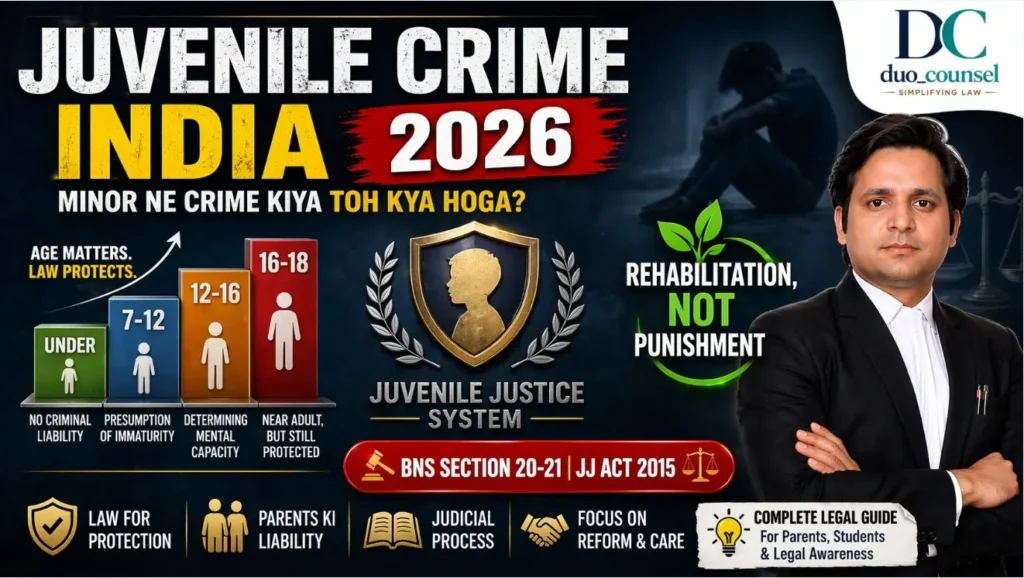
Quick Answer: Juvenile crime mein India ka kanoon age-based hai. Under 7: zero criminal liability (BNS Section 20). 7-12 saal: discretion — maturity dekhte hain (BNS Section 21). 12-16 saal: Juvenile Justice Board process, no regular prison. 16-18 saal heinous crime: Adult trial possible (JJ Act Section 15). Parents ki liability: civil compensation + Motor Vehicles Act Section 199A (agar minor driving kare). Juvenile Justice Board (JJB) decide karta hai — regular courts nahi. Focus rehabilitation hai, jail nahi.
Also Read :-Section 498A False Case 2026 — Husband Ka Bachaav Aur Legal Defense Strategy
Juvenile Crime Aur Indian Kanoon — Basic Framework
India mein juvenile crime handle karne ke liye 2 main laws hain:
1. Bharatiya Nyaya Sanhita (BNS) 2023 — Sections 20-21 Yeh define karta hai ki minor ki criminal liability hai ya nahi — age ke basis pe.
2. Juvenile Justice (Care and Protection of Children) Act, 2015 (JJ Act) Yeh define karta hai juvenile crime ke baad kya process follow hogi — JJB, observation home, adult trial.
Dono laws milke ek complete system banate hain — BNS batata hai liability hai ya nahi, JJ Act batata hai process kya hogi.
BNS Section 20-21 — Minor Ki Criminal Liability Ka Legal Framework
Bharatiya Nyaya Sanhita (BNS) 2023 ne Indian Penal Code (IPC) replace kiya — 1 July 2024 se effective. Minor ki criminal liability ke liye BNS Sections 20 aur 21 relevant hain. Yeh “Doli Incapax” principle pe based hain — Latin mein matlab “incapable of doing wrong.”
BNS Section 20 — Under 7 Saal: Zero Liability
“Nothing is an offence which is done by a child under seven years of age.”
- 7 saal se kam bachcha — koi criminal offence nahi
- Koi bhi crime kare — murder, theft, assault — legally innocent
- Reason: 7 saal se kam bachche mein mens rea (guilty mind) form karne ki capacity nahi
- Absolute immunity — koi exception nahi
Doli Incapax Presumption: Law presume karta hai ki 7 saal se kam baccha “incapable of crime” hai — yeh conclusive presumption hai, rebuttable nahi.
BNS Section 21 — 7 to 12 Saal: Discretionary Liability
“Nothing is an offence which is done by a child above seven years of age and under twelve, who has not attained sufficient maturity of understanding to judge of the nature and consequences of his conduct on that occasion.”
- 7-12 saal ke beech — conditional liability
- Key test: Kya bacche mein “sufficient maturity of understanding” thi?
- Maturity judge karta hai court — age, mental development, circumstances dekhe jaate hain
- Rebuttable presumption — prosecution prove kar sakta hai ki bacche ko pata tha woh kya kar raha hai
Practical reality: 7-12 saal ke juvenile crime cases bahut rare hain conviction mein — courts usually rehabilitation recommend karte hain even agar maturity prove bhi ho.
12-18 Saal — JJ Act 2015 Govern Karta Hai
BNS ka Section 20-21 sirf under-12 ke liye relevant hai. 12-18 saal ke juvenile crime ke liye JJ Act 2015 complete framework provide karta hai — alag court (JJB), alag process, alag outcomes.
Advocate’s Note: Bahut log confuse hote hain — “BNS mein Section 22-23 juvenile crime ke liye hai.” Yeh galat hai. BNS Sections 20-21 infancy defense hain. JJ Act Sections 22-23 alag context mein hain (JJB proceedings mein adult ke saath joint trial prohibited etc.). Juvenile crime primarily JJ Act 2015 se govern hoti hai, BNS sirf liability test ke liye hai.
<!– Image Suggestion: Age-based criminal liability infographic — Under 7, 7-12, 12-16, 16-18 –> <!– Alt Text: juvenile crime India age based criminal liability BNS Section 20 21 JJ Act 2015 –>
Juvenile Justice Act 2015 — Complete Framework
JJ Act 2015 India ka primary law hai juvenile crime handle karne ke liye. 1 January 2016 se effective.
Teen Categories of Offences (JJ Act)
JJ Act Section 2(45), 2(54), 2(33):
| Category | Definition | Examples | Outcome |
|---|---|---|---|
| Petty Offences | Max punishment 3 saal | Petty theft, trespass | Community service, counselling |
| Serious Offences | 3-7 saal punishment | Theft, simple assault, cheating | Reformatory measures |
| Heinous Offences | 7+ saal punishment | Murder, rape, robbery, acid attack | JJB decides — adult trial possible (16-18) |
Juvenile Justice Board (JJB) — Specialized Court
Har district mein JJB hoti hai — regular court nahi. JJB mein:
- Principal Magistrate (Judicial Magistrate First Class)
- 2 Social Workers (including minimum 1 woman)
- Child-friendly environment — no adversarial system
JJB powers:
- Inquiry conduct karna
- Social Investigation Report (SIR) order karna
- 16-18 saal ke heinous offenders ka adult trial assessment
- Bail/custody decisions
- Final order — rehabilitation, community service, observation home
What Happens When A Minor Is Apprehended
Step 1: Apprehension Police minor ko arrest nahi karti — “apprehend” karti hai. Significant difference:
- Handcuff allowed nahi (usually)
- Minor ke saath police ki body language child-friendly honi chahiye
- Special Juvenile Police Unit (SJPU) ya trained officer handle kare
Step 2: Parents/Guardian Ko Inform Immediately — 24 ghante ke andar parents ko inform karna mandatory.
Step 3: JJB Mein Production — 24 Hours Minor ko 24 ghante ke andar JJB ke saamne produce karna mandatory. Adult mein magistrate ke saamne produce karte hain — minor mein JJB ke saamne.
Step 4: Social Investigation Report (SIR) Probation Officer 15 din mein SIR taiyar karta hai:
- Minor ki family background
- Economic conditions
- School history
- Previous offences (if any)
- Psychological assessment
Step 5: Inquiry + Order JJB inquiry karta hai aur order pass karta hai — rehabilitation focused.
16-18 Saal — Adult Trial Kab Possible Hai
Yeh juvenile crime ka sabse controversial provision hai — JJ Act Section 15.
Section 15 — Preliminary Assessment
Agar 16-18 saal ka minor heinous offence kare:
- JJB preliminary assessment karta hai
- 3 months ki deadline hai assessment ke liye
- Psychologists aur social experts involved
- Tests: Bhatia’s Battery of Intelligence, Rorschach Inkblot Test
- Assessment factors: Mental maturity, physical capacity, circumstances
Assessment outcome:
Option A — JJB Decides: Minor Has No Adult Maturity
- Case JJB ke paas rehta hai
- Juvenile crime treatment — rehabilitation, observation home
- Maximum 3 saal detention — observation home mein
- Adult prison NAHI
Option B — JJB Decides: Minor Has Adult Maturity
- Case Children’s Court ko transfer
- Adult ki tarah trial
- Regular IPC/BNS punishment applicable
- BUT — conviction pe bhi reformatory sentence preferred till 21 years age, regular prison after
Nirbhaya Case Connection: 2012 Nirbhaya case mein ek accused 17-saal 6-mahine ka tha. JJ Act ke under sirf 3 saal observation home mein raha — 2015 mein release. Public outrage ke baad 2015 JJ Act mein Section 15 add hua — 16-18 saal heinous crime = adult trial possible.
<!– Image Suggestion: JJB process flowchart from apprehension to final order –> <!– Alt Text: juvenile crime India JJB process JJ Act 2015 Section 15 adult trial 16-18 years –>
Parents Ki Liability — Kab Aur Kitni
Yeh most important section hai parents ke liye jab unka bachcha juvenile crime mein involved ho.
Civil Liability — Compensation Dena Pad Sakta Hai
Agar minor ka juvenile crime victim ko nuqsan pahunchata hai:
- Parents civilly liable ho sakte hain negligence ke ground pe
- Legal principle: Vicarious liability — parents responsible hain minor ki actions ke liye agar negligence prove ho
- Victim civil court mein damages claim kar sakta hai parents ke against
Example: 15-saal ke bete ne classmate pe hamla kiya, victim ko permanent injury. Parents pe civil suit — damages claim possible.
Criminal Liability — Motor Vehicles Act Section 199A
Yeh most specific parents liability section hai. Motor Vehicles Amendment Act 2019 mein add kiya gaya:
Section 199A MVA:
- Agar guardian/owner ne minor ko motor vehicle chalane diya
- Minor ne accident kiya
- Guardian presumed guilty — burden of proof reversal
- Guardian ko prove karna hoga ki “due diligence” ki thi
- Punishment: 3 saal jail + fine
- Vehicle registration: 12 months cancel
- Insurance: “Pay and Recover” doctrine — insurer victim ko pay karta hai, phir guardian se recover
“I didn’t know” defense nahi chalti — court presume karta hai guardian ki consent thi.
BNS Context:
- Minor driving rash driving: BNS Section 281 (purana IPC 279)
- Death by negligence: BNS Section 106(1) (purana IPC 304A)
- Hit and run: BNS Section 106(2) — stricter (10 saal punishment)
When Parents Face Criminal Proceedings
- Negligence in supervision — if minor repeatedly commits juvenile crime aur parents ignore karte rahein, Child Welfare Committee (CWC) parents ko notice de sakti hai
- Counselling orders — parents ke liye compulsory
- CWC monitoring — home environment assess hogi
- Extreme cases mein — child ko “Fit Institution” ya foster care transfer
Observation Home Vs Regular Jail — Fundamental Difference
Juvenile crime mein minor ko jail nahi jaana padta — Observation Home ya Special Home mein rakha jaata hai.
| Aspect | Adult Jail | Observation Home (Minor) |
|---|---|---|
| Purpose | Punishment | Rehabilitation |
| Communication | Limited | Supervised contact with parents |
| Education | Not mandatory | Mandatory schooling |
| Vocational Training | Limited | Core component |
| Psychological Support | Rare | Mandatory counselling |
| Phone/Internet | Prohibited usually | Strictly prohibited |
| Routine | Restricted | Structured — 6 AM to 9 PM |
| Maximum Stay | As per sentence | 3 saal maximum |
| Records | Permanent | Destroyed after 7 years |
JJ Act Section 24 — No Disqualification
Critical protection for juveniles:
- Minor jo JJB ke saamne case mein involved raha — uska record destroyed hota hai 7 saal baad
- Koi bhi disqualification nahi lagti (job, education, passport)
- Regular criminal conviction ke consequences nahi lagte
Matlab — juvenile crime mein involve hona adult life ruin nahi karta agar rehabilitation effective rahi.
Real Case Study — Gurugram Juvenile Crime Case 2024
Background: Aarav (age 16), Class 11 student, Gurugram. November 2024 — peer pressure mein classmate Rohan ke saath phone snatch kiya — bike pe. Victim ki ungli mein injury, phone (Rs 45,000 ka) chhaata. Police ne dono ko pakda. Aarav ke parents ko call: “Aapka beta serious crime mein pakda gaya hai.”
Legal Classification:
- Offence: Robbery (BNS Section 309) — heinous offence (7+ saal punishment)
- Aarav ki age: 16 saal, 4 mahine
- Applicable law: JJ Act 2015 Section 15 (16-18, heinous = preliminary assessment)
Immediate Steps:
- Parents turant advocate se mile
- JJB mein production — 24 ghante mein
- Bail application — JJ Act Section 12 ke under
- Aarav ke liye legal aid arranged
JJ Act Section 12 — Bail Rule: Minor ko bail default rule hai — unless:
- Release moral/physical/psychological danger mein daalti ho
- Accused pe genuine concern ho
Bail mila — parents custody mein, weekly JJB check-in condition.
Preliminary Assessment Process:
- JJB ne Aarav ka psychological assessment kiya
- First-time offender, no prior juvenile crime history
- Good academic record (8.5 CGPA)
- Peer pressure clearly documented
- Parents cooperative, financially stable, supervising properly
JJB Assessment Result:
- “No adult maturity demonstrated” — Aarav immature, peer-influenced
- Case JJB ke paas rakha gaya — Children’s Court transfer NAHI
Final Order:
- 24 months probation — Probation Officer supervision
- Community service: 100 hours — NGO mein
- Mandatory counselling: 6 months
- Parents ko counselling + supervision report monthly
- Victim ko Rs 45,000 compensation — parents ke through
Phone: Victim ko wapas kiya gaya. Aarav’s outcome: 10th board exams appeared normally, no school record mention, life normal track pe.
Parents ke against: Civil case — Rs 45,000 compensation (paid). No criminal charges as Aarav cooperative tha aur parents immediately involved hue.
Timeline: Apprehension se final order tak — 4 months.
Key Lessons:
- Turant advocate engage karo
- JJB process regular court se alag hai — child-friendly
- Bail default rule — minor ko custody mein nahi rakha jata normally
- First-time juvenile crime + good background = lenient outcome
- Parents ki involvement critical — court notice karta hai
7 Tips — Agar Aapka Bachcha Juvenile Crime Mein Involved Ho
- Turant advocate hire karo — JJ Act specialist, regular criminal lawyer nahi
- Police se khud koi statement mat do — juvenile crime mein parents ka statement bhi document hota hai
- JJB hearing mein attend karo — absence negative impression deta hai
- Social Investigation Report mein sach batao — SIR me fabrication backfire karta hai
- Minor ki psychological support arrange karo — court ko dikhao ki rehabilitation seriously le rahe ho
- Victim ke saath settlement — compensation offer karo, sincere apology — court pee positive impact
- Records destroy hote hain — minor ka future permanently affected nahi hoga agar process sahi follow ki
FAQ — Juvenile Crime Ke Common Questions
Q: Kya 16-saal ka bachcha murder case mein adult ki tarah jail jaayega? A: Haan, possible hai — but automatic nahi. JJ Act Section 15 ke under JJB pehle preliminary assessment karta hai. Agar bachche mein adult-level maturity aur understanding prove ho, toh Children’s Court adult trial kar sakta hai. Agar nahi, toh observation home mein maximum 3 saal. Nirbhaya case ke baad yeh provision add kiya gaya tha.
Q: Minor ko juvenile crime mein handcuff lag sakti hai? A: Generally nahi. Police training aur JJ Act guidelines ke under minor ke saath child-friendly behavior mandatory hai. Handcuff ya aggressive behavior juvenile crime cases mein prohibited hai unless extreme security risk ho.
Q: Juvenile crime record aage life mein problem karta hai? A: JJ Act Section 24 ke under — records destroyed kiye jaate hain 7 saal ke baad. Koi disqualification nahi lagti jobs, education, passport ke liye. Yeh adult criminal conviction se fundamental difference hai.
Q: Minor driving car se accident hua — parent pe kya case hoga? A: MVA Section 199A ke under parent/guardian presumed guilty hai. 3 saal jail + fine + 12 months registration cancel. Insurance victim ko pay karega aur parents se recover karega. “Mujhe nahi pata tha” defense nahi chalti — due diligence prove karni padegi.
Q: Kya parents ke khilaaf juvenile crime ke case mein FIR ho sakti hai? A: Directly minor ke juvenile crime ke liye parents pe FIR normally nahi hoti — unless MVA Section 199A (minor driving) ya specific negligence prove ho. Lekin Child Welfare Committee parents ko notice de sakti hai aur counselling, supervision order kar sakti hai.
Q: JJB hearing mein minor ko lawyer chahiye? A: Haan — mandatory legal aid available hai JJ Act ke under. Agar parents afford nahi kar sakte toh District Legal Services Authority (DLSA) free legal aid provide karta hai. Private advocate hire karna better hai complex juvenile crime cases mein.
Q: Observation home aur jail mein kya difference hai? A: Observation home rehabilitation-focused hai — education, vocational training, counselling mandatory. Jail punishment-focused hai. Minor ko jail nahi — observation home. Records 7 saal baad destroy. Maximum stay 3 saal, sentence nahi. Adult life permanently affected nahi hoti.
Q: 14-saal ke minor ne serious assault kiya — school expel kar sakti hai? A: School ko JJ Act ke provisions follow karne chahiye — minor ko expel karna child rights violation ho sakta hai. Minor ki proceedings JJB mein hogi. School counsellor involvement JJB order mein ho sakta hai. Advocate se consult karo — juvenile crime mein educational rights bhi protected hain.
Juvenile Crime — System Punishment Ke Liye Nahi, Bachaane Ke Liye Hai
India ka juvenile crime framework ek important principle pe built hai — bacha galti karta hai, lekin uski life khatam nahi hoti. BNS Sections 20-21 legally define karte hain ki chote bachche criminally liable nahi hain. JJ Act 2015 ensure karta hai ki teenage juvenile crime bhi rehabilitation ka chance de — not permanent punishment.
Yaad rakhein:
- Under 7: Zero criminal liability (BNS Section 20) — absolute
- 7-12 saal: Maturity test (BNS Section 21) — discretion
- 12-18 saal: JJ Act 2015 govern karta hai — JJB, not regular courts
- 16-18 heinous crime: Adult trial possible — JJB preliminary assessment zaroor
- Observation home: Jail nahi — rehabilitation center, maximum 3 saal
- Records destroyed after 7 years — adult life affected nahi
- Parents liable — civil compensation + MVA Section 199A (minor driving)
- Bail default rule — minor ko custody mein nahi rakha normally
- Turant advocate engage karo — JJ Act specialist
Juvenile crime mein panic mat karo — system ka maqsad bachche ko ek doosra mauka dena hai. Lekin sahi legal guidance zaroori hai — process unfamiliar hai, aur galti karne se outcome worse ho sakta hai.
━━━━━━━━━━━━━━━━━━━━━━━━━━━━━━━━
✍️ Yeh Article Likha Hai:
👨⚖️ Adv. Yogesh Solanki
Co-Founder, DuoCounsel
RERA | Criminal Law | Civil Litigation | Consumer Cases
Punjab & Haryana Bar Council | Gurugram District Courts
Solanki Engineers — Legal Retainer
👩⚖️ Adv. Barkha Jain
Co-Founder, DuoCounsel
Corporate Law | Business Compliance | GST | Income Tax | Matrimonial
Punjab & Haryana Bar Council | Gurugram District Courts
🎙️ DuoCounsel Podcast sunein — Legal awareness Hinglish mein
📍 Gurugram, Haryana | Practice: District Courts + Punjab & Haryana High Court
━━━━━━━━━━━━━━━━━━━━━━━━━━━━━━━━
⚠️ DISCLAIMER: Yeh article sirf legal awareness ke liye hai.
Kisi bhi specific case mein professional legal advice ke liye
advocate se personally consult karein.